Is Sket Dance Overrated? A 7.47 That Rides Switch's Backstory and a Twin Reveal Into Numbers the Runtime Can't Sustain
Kenta Shinohara's Kaimei High odd-jobs comedy clears MyAnimeList at 8.21 and the Codex at 7.47 — a 0.74-point gap that names exactly which two arcs the crowd is grading and which seventy episodes it isn't.
Kenta Shinohara's Kaimei High odd-jobs comedy clears MyAnimeList at 8.21 and the Codex at 7.47 — a 0.74-point gap that names exactly which two arcs the crowd is grading and which seventy episodes it isn't.
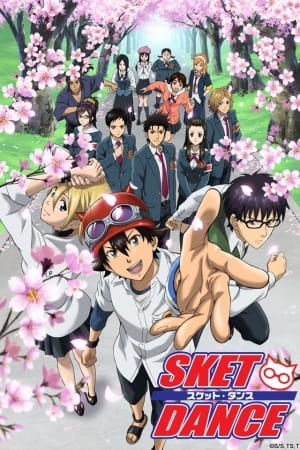
Ask whether Sket Dance is overrated and the honest answer is that MyAnimeList's 8.21 is scoring roughly six episodes of the seventy-seven Tatsunoko Production aired between April 2011 and September 2012. The Codex lands at 7.47. That 0.74-point gap is not a rounding error and it is not a taste dispute — it is what happens when a rubric weighs runtime, world, and cultural footprint against a fanbase grading two exceptional dramatic pivots and calling it the whole show.
The Consensus Position, Named
The 8.21 crowd reads Sket Dance as a hidden gem — the underrated Jump comedy that suddenly gets serious, the show where Switch's backstory episode blindsides you, the one with the twin reveal you didn't see coming. That reading isn't wrong. It's just partial. It rewards peak moments and forgives the connective tissue, which is how a functionally-animated 77-episode gag comedy with a mid-tier setting and a cult-scale cultural footprint ends up posted next to shows doing more work across more axes. The gap between Sket Dance's reputation and its rubric score is the story. Name what the crowd is rewarding that the rubric won't.
The Two Arcs Doing All the Heavy Lifting
Sket Dance's character score is an 8.5, and it is earned. Bossun's leadership routine cracks open into abandonment issues that give his goggle-gag concentration bit real ballast. Himeko's Onihime past is not backstory tourism — it explains her loyalty to a club that would otherwise read as a hangout. And Switch's arc, the one everyone cites, delivers on a premise the show sat on for episodes: the speech synthesizer is not a quirk, it is grief. His brother's death and the survivor's guilt underneath the deadpan are the show at its most disciplined, and the direction pulls back into restrained, muted framing for the flashback in a way that most Jump adaptations don't have the tonal control to attempt.
The Bossun-Tsubaki twin reveal works on similar principles — visual gags and running jokes seeded episodes earlier that pay off structurally rather than sentimentally. This is genuinely good writing. It is also, per the story score of 7.5, roughly two arcs across seventy-seven episodes. The rubric's justification is specific about the weakness: structural inconsistency, filler gag episodes that meander, a comedy-to-drama ratio that goes uneven across the long runtime. When the crowd scores the show at 8.21, it is scoring Switch's flashback. It is not scoring the stretch of episodes between the flashback and whatever came before it.
The Runtime Problem MyAnimeList Doesn't Punish
Seventy-seven episodes is a lot of Kaimei High School, and the world score of 6.5 tells you why the setting can't carry the weight the runtime asks of it. Kaimei is populated — the student council, rival clubs, teachers, Roman, Captain, Tsubaki's whole faction — and that density is what lets the recurring bits land. It is not, however, a world with mechanics. The concentration goggles are a joke about a power system, not a power system. The odd-jobs premise is a scaffold for episodic requests, and once you have watched twenty of those requests you have seen the shape of the fortieth.
MyAnimeList rewards long-running Jump comedies for their endurance — the score compounds with completion, and viewers who finish 77 episodes are self-selected fans. The Codex rubric doesn't grant that credit. It weighs whether the setting can sustain what the runtime demands, and Kaimei — coherent, populated, believable — cannot. This is the same structural pattern that drags Yawara!'s 124-episode Madhouse adaptation into the middle stretch it never fully recovers from: character writing that would score higher across a tighter cut gets diluted by episodes that exist because the manga was still running.
The Animation the Direction Nearly Rescues
Tatsunoko Production's work here scores 6.8, and the justification is precise about why. The comedy is served — snappy reaction faces, rapid visual gags, parody sequences timed with real craft. The direction earns its keep in the Switch flashback specifically, where the tonal shift from frantic slapstick to restrained framing lands without whiplash. That is not a small thing. Most Jump adaptations attempting the same pivot produce tonal collision, not tonal control.
But the backgrounds are workmanlike. Standard scenes are functional. Across seventy-seven episodes there are visible consistency dips, which is what happens when a studio without top-tier sakuga capacity commits to a runtime that long. The animation is not the show's failure — it is the show's ceiling. The rubric registers a ceiling that the crowd, watching for jokes and reaction faces, doesn't feel as a constraint. The same dynamic operates in reverse on shows like Genshiken, where Palm Studio's 6.0 animation caps a scorecard the writing wants to push higher; with Sket Dance, Tatsunoko's ceiling is higher but the runtime is longer, and the math ends up close.
The Cultural Footprint the Crowd Overweights
Cultural impact scores 6.0, and this is where the MAL 8.21 diverges hardest from the rubric. Sket Dance has a devoted fanbase, a solid MAL standing, and a memorable Gintama crossover that gets cited every time the show is recommended. That is a cult-favorite footprint, not a landmark one. It never crossed over into the mainstream cultural conversation the way its Jump contemporaries did. The 2009 Shogakukan Manga Award in the shōnen category is real recognition; it is not the same as sustained cultural reach.
The crowd score doesn't distinguish between "beloved by its fandom" and "shaped the medium." The Codex rubric does, which is one reason gaps like this open up on Jump titles — the same reason Blue Lock posts a similar-shaped gap for different reasons and Trigun grades below its silhouette. When cultural weight is graded on footprint rather than affection, mid-tier numbers appear where the fanbase expects high ones.
The Strongest Case for the Consensus
The steelman: Sket Dance's themes score is 7.8, which is high for a Jump gag comedy, and the reason it is high is that the drama is rooted in established characters rather than imported for cheap pathos. The found-family thesis, the survivor's guilt, the helping-others-as-self-repair through-line — these are real, and they are unusually well-integrated for the genre. If you weight character (8.5) and themes (7.8) as heavily as the crowd implicitly does, an 8.21 becomes defensible.
The rubric reads it differently because the rubric refuses to let two strong criteria carry four weaker ones. Character and themes are real strengths. World, animation, cultural weight, and the structural unevenness of the story cannot be waved through because Switch's flashback made you cry.
Verdict
Sket Dance is a 7.47, and the 0.74-point gap with MyAnimeList is exactly what a rubric produces when a fanbase grades peak moments and the criteria grade the whole runtime. It is a genuinely well-written Jump comedy with two arcs that earn every ounce of their reputation, capped by an animation ceiling, a workable-not-remarkable world, and a footprint that never left cult status. Watch it for Switch. Don't confuse the flashback for the show.
Featured in the Codex


More from The Codex
The Seven Deadly Sins Is a 6.60 Wearing a 7.60 Costume: A One-Point Gap Earned by Groping Gags and Convenient Flashbacks
The Seven Deadly Sins scores 6.60 on the Codex against MyAnimeList's 7.60 because the crowd is grading a Netflix breakout and a Ban-and-King friendship, not the 24 episodes A-1 Pictures actually broadcast in 2014.
The 10.0 That Built a Sunday: How Sazae-san's Cultural Score Carries a 6.58 Scorecard
Sazae-san is a case study in how a single criterion — cultural — can define how a show is remembered, and the 10.0 the Codex hands Eiken's 1969 institution is doing every bit of the heavy lifting its other five scores refuse to.
The Sebastian Problem: Why Black Butler Sits 1.10 Below Its MAL Line and the Crowd Refuses to Notice
Black Butler (Kuroshitsuji) posts a 1.10-point gap between MyAnimeList's 7.65 and the Codex 6.55 because the crowd is grading Sebastian's silhouette and a Phantomhive aesthetic, not the anime-original finale A-1 Pictures actually shipped in 2009.
Discussion
Set a display name above to post.
Loading discussion…