Blue Lock
Is Blue Lock worth watching?
Worth a look. Anime Codex rates Blue Lock 7.48 out of 10 — scored on six criteria (story, characters, themes, world-building, animation, and cultural impact), not crowd votes. 90th of 226 on the Codex rubric — top 40% of the catalogue. The crowd rates it 0.63 higher than the rubric does — the Codex is harder on it than on 55% of the catalogue.
Where to watch
Trailer
What the data says
Computed from the Codex rubric across the whole catalogue.
Summary
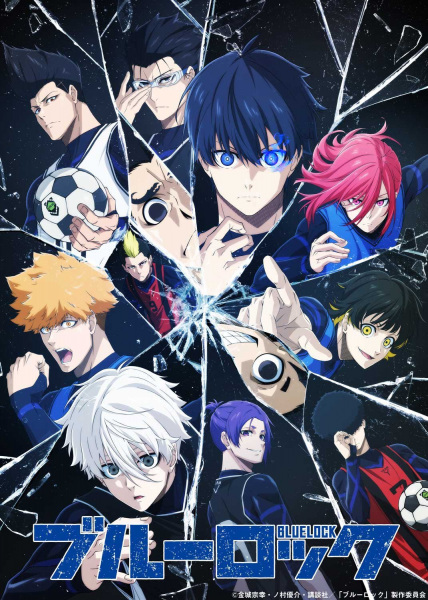
Blue Lock distinguishes itself within shonen by weaponizing the sports genre's conventions against themselves: instead of friendship and teamwork, it preaches ego, ruthlessness, and individual hunger as the path to greatness, framed through a battle-royale facility that feels closer to a death game than a soccer club. Isagi's growth is its strongest asset, anchored by a concrete 'spatial awareness' mechanic that makes his evolution legible rather than mystical, while the gamified world-building and provocative philosophy give it a fresh ideological identity. The colorful rival cast — Bachira, Nagi, Barou, Rin — provides spectacle, though several remain trait-defined archetypes. Its weaknesses are real: the back half leans on repetitive monologue and conveniently revealed new abilities, the project's premise strains credibility, and 8bit's animation, though stylish and visually inventive in its expressionistic flourishes, often falters in actual on-pitch motion, leaning on CGI and stills. Thematically it provokes more than it warms, trading emotional depth for relentless intensity. Still, as a high-concept reinvention of the sports anime that landed at a cultural moment, it's a confident, distinctive entry — good and ambitious, if visually uneven and occasionally one-note in its messaging.
Criterion breakdown
Story & narrative
The death-game-meets-sports premise injects genuine tension into a genre that usually relies on win-or-lose stakes alone, and the structured progression from the ranking battles to the Second Selection's team-vs-team format keeps the elimination pressure escalating. The First Selection arc with Team Z is tightly constructed, but the back half occasionally stalls in repetitive monologue-heavy buildup, and the narrative leans hard on convenient revelations of new 'weapons' to resolve matches. The arbitrary, contrived logic of the project itself is acknowledged in-universe but never fully justified, which strains the realism the sport demands.
Character writing & growth
Isagi's arc from a hesitant team-player to a calculating striker who 'devours' others is the show's spine, and his analytical 'spatial awareness' awakening against Rin and during the Team V match gives his growth a concrete, trackable mechanism rather than vague willpower. The supporting cast is vivid in caricature — Bachira's chaotic 'monster,' Nagi's prodigious apathy, Chigiri's speed-trauma, Barou's egotism — but many remain archetypes defined by a single trait rather than evolving. Nagi and Reo's relationship and Isagi's rivalry with Kunigami stand out as the most genuinely developed dynamics.
Themes & emotional resonance
The core thesis — that ego and self-interest, not teamwork, breed world-class strikers — is a bold, deliberately provocative inversion of the genre's usual friendship sermons, and Ego Jinpachi's philosophy gives the show a coherent ideological backbone. The emotional resonance is real when Isagi confronts his original betrayal-pass trauma, but the relentless 'devour or be devoured' messaging can feel one-note and emotionally cold, sacrificing warmth for intensity. It provokes thought more than it moves the heart.
World-building & power system
Blue Lock as a setting is strikingly original within sports anime — a dystopian, gamified facility with rankings, elimination, and a manufactured competitive ecosystem that functions almost like a power system through quantified player 'weapons' and awakenings. The internal logic of player evaluation, the Wild Card mechanic, and the spatial-awareness conceit are distinctive and consistent. It loses points because the premise's plausibility frays under scrutiny, and the broader world outside the facility is barely sketched.
Animation & direction
8bit's direction excels in stylized, expressionistic flourishes — the neon imagery, the 'devouring' visual metaphors, and the dramatic framing of Isagi's field vision — which give the show a memorable identity. However, the actual soccer animation is inconsistent, frequently relying on speed lines, stills, and CGI-assisted movement that undercuts the kinetic fluidity the sport requires, especially in later matches. The bombastic presentation often overcompensates for limited in-motion play.
Cultural impact
Blue Lock became a breakout hit during a World Cup cycle, fueling a surge of interest and merchandising that crossed into real football fandom and earned commentary from actual players. It revitalized the sports-anime conversation by proving an anti-teamwork ego narrative could dominate Weekly Shonen Magazine sales and streaming charts. Its impact on the genre's tone and popularity is significant for so recent a title.
Synopsis (from MAL)
Yoichi Isagi was mere moments away from scoring a goal that would have sent his high school soccer team to the nationals, but a split-second decision to pass the ball to his teammate cost him that reality. Bitter, confused, and disappointed, Isagi wonders if the outcome would have been different had he not made the pass. When the young striker returns home, an invitation from the Japan Football Union awaits him. Through an arbitrary and biased decision-making process, Isagi is one of three hundred U-18 strikers selected for a controversial project named Blue Lock. The project's ultimate goal is to turn one of the selected players into the star striker for the Japanese national team. To find the best participant, each diamond in the rough must compete against others through a series of solo and team competitions to rise to the top. Putting aside his ethical objections to the project, Isagi feels compelled to fight his way to the top, even if it means ruthlessly crushing the dreams of 299 aspiring young strikers. [Written by MAL Rewrite]
Ranked nearby
Explore rankings
Discussion
Set a display name above to post.
Loading discussion…