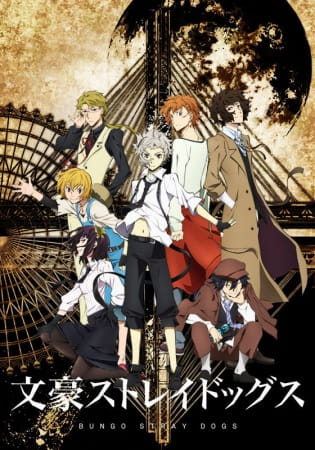
Bungo Stray Dogs
Is Bungo Stray Dogs worth watching?
Worth a look. Anime Codex rates Bungo Stray Dogs 7.45 out of 10 — scored on six criteria (story, characters, themes, world-building, animation, and cultural impact), not crowd votes. 93rd of 226 on the Codex rubric — top 41% of the catalogue. The crowd rates it 0.35 higher than the rubric does — the Codex is harder on it than on 38% of the catalogue.
Where to watch
Trailer
What the data says
Computed from the Codex rubric across the whole catalogue.
Summary
Bungo Stray Dogs distinguishes itself within shonen through its inventive premise: ability users named after real literary figures whose powers derive from their famous works, a conceit that elevates it above generic battle fare. The first season's strongest asset is its character work, especially Dazai's slowly-revealed Port Mafia past and the Atsushi-Akutagawa rivalry, both anchored in a shared meditation on who deserves to exist. Bones provides slick, dynamic action and a striking visual style. Its central weakness is tonal: the jarring oscillation between broad slapstick comedy and serious psychological drama repeatedly deflates emotional tension, and the season functions more as extended setup than a complete arc, banking heavily on future payoffs. The large supporting cast also leaves many Agency members as one-note quirks. As an introduction it succeeds in establishing an intriguing world and a compelling protagonist-antagonist dynamic, but it asks viewers to commit to later seasons for full satisfaction. Judged against the best shonen of its kind, it is a well-crafted, original, and stylish entry that is held back from greatness by structural unevenness and inconsistent tone — good but flawed, with clear potential it only partially realizes in these twelve episodes.
Criterion breakdown
Story & narrative
The first season's structure is uneven, splitting between the introductory Armed Detective Agency cases and the Port Mafia conflict, with a tonal whiplash between slapstick comedy and serious thriller beats that doesn't always cohere. The Azushi-vs-Akutagawa setup and the introduction of the Guild as a looming American threat in the final episodes effectively plant hooks, but season one functions more as extended exposition than a self-contained arc. The tiger mystery resolves satisfyingly early, though much of the narrative momentum is borrowed against future payoffs.
Character writing & growth
Atsushi's self-worth arc — his orphanage trauma manifesting in his belief that he has no right to exist — gives the protagonist genuine emotional grounding beyond the typical shonen everyman. Dazai is the standout, his flippant suicidal gags concealing a Port Mafia past that the show wisely doles out slowly, and the Akutagawa parallel (both shaped by the question of who deserves to live) is sharp. However, the large ensemble means many Agency members like Kenji or Naomi remain quirk-defined caricatures with little development this season.
Themes & emotional resonance
The recurring meditation on the right to exist — Atsushi's 'I have no place here' anxiety mirrored against Akutagawa's desperate need for Dazai's approval — gives the show real thematic spine. The literary conceit, naming abilities after each author's actual works (Dazai's 'No Longer Human,' Atsushi's 'Beast Beneath the Moonlight'), adds a layer of allusion that rewards literate viewers. Yet the emotional resonance is frequently undercut by abrupt comedic tonal shifts that deflate dramatic tension before it lands.
World-building & power system
The central conceit — ability users named after and thematically tied to real-world literary figures (Dazai, Akutagawa, Kunikida, Poe later) — is genuinely original and distinguishes Bungo from generic power-fantasy peers. Abilities like Kunikida's notebook-manifestation 'Doppo Poet' and Dazai's nullifying 'No Longer Human' are clever and internally consistent. The Yokohama setting and the Agency/Mafia/Guild faction triangle is well-defined, though the literary references sometimes feel like cosmetic naming rather than deeply integrated mechanics.
Animation & direction
Bones delivers characteristically fluid action, particularly the Atsushi-Akutagawa clashes with their dynamic tiger-versus-Rashomon choreography. Nobuhiro Arai's direction leans into stylish, high-contrast color palettes and expressive comedic exaggeration that suits the manga's tonal duality. The character designs are distinctive and the OP 'Trash Candy' by Granrodeo is energetic, though some quieter episodes show the budget conserved for set-piece battles.
Cultural impact
Bungo Stray Dogs built a substantial and devoted fanbase, particularly through its bishonen ensemble and the novelty of repackaging Japanese literary icons as action heroes, which sparked renewed casual interest in authors like Dazai and Akutagawa. With over 1.5 million MAL members and multiple sequel seasons plus a film, it became a recognizable mid-tier franchise, though it never reached the cultural ubiquity of top-tier shonen.
Synopsis (from MAL)
For weeks, Atsushi Nakajima's orphanage has been plagued by a mystical tiger that only he seems to be unaware of. Suspected to be behind the strange incidents, the 18-year-old is abruptly kicked out of the orphanage and left hungry, homeless, and wandering through the city. While starving on a riverbank, Atsushi saves a rather eccentric man named Osamu Dazai from drowning. Whimsical suicide enthusiast and supernatural detective, Dazai has been investigating the same tiger that has been terrorizing the boy. Together with Dazai's partner Doppo Kunikida, they solve the mystery, but its resolution leaves Atsushi in a tight spot. As various odd events take place, Atsushi is coerced into joining their firm of supernatural investigators, taking on unusual cases the police cannot handle, alongside his numerous enigmatic co-workers. [Written by MAL Rewrite]
Ranked nearby


Explore rankings
Discussion
Set a display name above to post.
Loading discussion…