Is Blue Lock Overrated? A 7.48 That Rides a World Cup Cycle and an Ego Sermon Into Numbers the Animation Can't Back
Blue Lock scores 7.48 on the Codex against MyAnimeList's 8.11 — a 0.63-point gap that names exactly what the crowd is rewarding and what the rubric refuses to wave through.
Blue Lock scores 7.48 on the Codex against MyAnimeList's 8.11 — a 0.63-point gap that names exactly what the crowd is rewarding and what the rubric refuses to wave through.
The gap between Blue Lock's reputation and its rubric score is the story. 8bit's 2022 adaptation posts an 8.11 on MyAnimeList and a 7.48 on the Codex, and the 0.63-point delta isn't a rounding error or a taste dispute. It's the difference between grading a show on the timing of its release and grading it on what's actually on screen for twenty-four episodes.
The Consensus Position, and Why It's Selling You Short
The MyAnimeList 8.11 isn't inexplicable. Blue Lock aired during the Qatar World Cup cycle, dropped a shonen-magazine bestseller into a season starved for sports anime with real teeth, and staked out an ideological position — ego over teamwork — that felt provocative enough to generate discourse for months. The crowd is scoring that footprint. The Codex rubric agrees the footprint is real; cultural weight comes in at 8.5, the highest number on the scorecard. What the consensus is doing is letting that 8.5 metastasize across criteria it doesn't belong in. Animation gets graded like it's Haikyuu!! Story gets graded like the Second Selection resolves its own contrivances. It doesn't.
This is a familiar pattern. Oshi no Ko posts a nearly identical structural gap — a crowd rewarding the premiere and the OP while the rubric grades the middle episodes — and Blue Lock's version of the same trick is a World Cup tailwind and a philosophy speech.
The Animation Score Is Where the Argument Starts
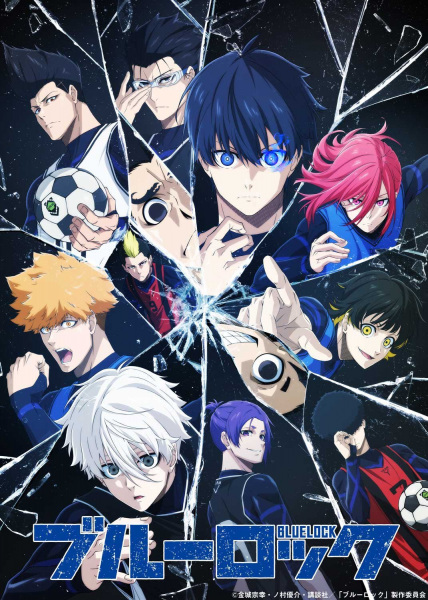
8bit's direction lands a 6.5 on the Codex, and that's the number doing the most damage to the weighted total. The stylized layer works. The neon field-vision sequences, the literal devouring imagery when Isagi eats Bachira's monster, the framing when the spatial-awareness conceit gets externalized as geometric overlay — these are legitimate expressionistic choices that give the show a visual grammar you can identify in a two-second clip. That's the strength.
The problem is the football. The actual sport, in motion, is where 8bit runs out of budget and ideas. Speed lines substitute for footwork. Key frames drop into stills at the moment a genuine sports anime would push a cut of animation. CGI-assisted movement — never the studio's strong suit — takes over the wide shots in the Second Selection matches, and the seams show. When a show's central promise is competitive football and the football itself is animated at a level well below what the genre's benchmarks demand, the bombast starts reading as compensation. The neon can only do so much when the ball physics look like a PS3 cutscene.
Put this next to the Codex's best-animated shonen ranking and Blue Lock's absence from the conversation stops being controversial.
The Story Leans on Contrivance the Rubric Notices
Story lands at 7.5, and the number is generous. The First Selection arc with Team Z is the show at its tightest — Ego Jinpachi's rules are fresh, the elimination pressure escalates cleanly, and Isagi's early confrontations with Bachira and Kunigami have real stakes because the losers actually leave. That's roughly the first eight episodes doing structural work the back half never matches.
The Second Selection is where the writing starts issuing itself power-ups on demand. New "weapons" appear on the same match they're needed. Awakenings arrive in monologue form, then get demonstrated on the next possession. The gamified logic that made Blue Lock feel distinct in episode two starts revealing itself as a delivery mechanism for whatever ability the current opponent requires. This is a shonen convention, but Blue Lock explicitly positioned itself as a corrective to shonen conventions — an ego-driven, quantified, hyper-rational alternative. When the resolution mechanism is "Isagi realizes something new during the match," you're back inside the friendship-punch grammar the show claimed to be inverting.
The premise's plausibility is the deeper issue. The rubric flags that the JFA-funded death-game training facility is never fully justified in-universe, and the show knows it — Ego lampshades the contrivance more than once — but acknowledgment isn't defense. The realism the sport itself demands keeps colliding with the artifice the format requires.
The Themes Are Bold, Cold, and One-Note
Themes score 7.0, and this is the criterion where the crowd most obviously over-weights. Ego Jinpachi's thesis — that world-class strikers are grown in soil poisoned against cooperation — is a genuine, deliberately hostile inversion of the genre's default sermon, and it gives the show an ideological spine most sports anime don't attempt. Isagi's confrontation with his original betrayal-pass trauma, the sequence that reframes his passing instinct as cowardice rather than virtue, is the emotional peak of the season and it lands.
The problem is that after that beat, the ideology has nowhere to go. "Devour or be devoured" gets repeated across arcs, across characters, across matches, until the emotional register flattens. Every character has to be an ego-monster on their own terms, and once you've catalogued Bachira's chaos, Nagi's apathy, Chigiri's speed-trauma, and Barou's egotism, the show has almost nothing to do with those archetypes beyond restaging them at different intensities. The thesis provokes more than it moves. That's a real ceiling.
Character does better — 7.8 — because Isagi's arc has a trackable mechanism in the spatial-awareness awakening, and the Nagi–Reo dynamic and the Isagi–Kunigami rivalry are genuinely developed. But most of the ensemble is a single trait animated hard. The rubric grades that honestly. The crowd does not.
The Steelman: What Blue Lock Actually Does That Nothing Else Does
The honest counter-argument is that Blue Lock's world-building — the Codex's 8.0, and the second-highest number on the card — is doing something no other sports anime has done. The gamified facility functions as a power system in a way the genre has never attempted. The Wild Card mechanic, the ranking board, the quantified evaluation of player weapons: these are internally consistent, distinctive, and legitimately original within the sports category. If you value that novelty, the 8.11 is defensible. You're rewarding a show that reshaped what a football anime can look like structurally, and cultural impact at 8.5 confirms the reshape actually happened.
The rubric doesn't dispute any of that. It just refuses to let two strong criteria — world and cultural — offset animation that undercuts the sport, story that leans on convenient revelations, and themes that lose torque by the twentieth "devour" monologue. The math is the math.
Verdict
Blue Lock at 7.48 is a shonen with a real idea, a real footprint, and a real ceiling — and the crowd's 8.11 is grading the idea and the footprint while the rubric grades the execution. Watch it for Ego's thesis and the Team Z arc; don't pretend the football animation clears the bar its own premise sets.
Featured in the Codex
More from The Codex
The Seven Deadly Sins Is a 6.60 Wearing a 7.60 Costume: A One-Point Gap Earned by Groping Gags and Convenient Flashbacks
The Seven Deadly Sins scores 6.60 on the Codex against MyAnimeList's 7.60 because the crowd is grading a Netflix breakout and a Ban-and-King friendship, not the 24 episodes A-1 Pictures actually broadcast in 2014.
The 10.0 That Built a Sunday: How Sazae-san's Cultural Score Carries a 6.58 Scorecard
Sazae-san is a case study in how a single criterion — cultural — can define how a show is remembered, and the 10.0 the Codex hands Eiken's 1969 institution is doing every bit of the heavy lifting its other five scores refuse to.
The Sebastian Problem: Why Black Butler Sits 1.10 Below Its MAL Line and the Crowd Refuses to Notice
Black Butler (Kuroshitsuji) posts a 1.10-point gap between MyAnimeList's 7.65 and the Codex 6.55 because the crowd is grading Sebastian's silhouette and a Phantomhive aesthetic, not the anime-original finale A-1 Pictures actually shipped in 2009.
Discussion
Set a display name above to post.
Loading discussion…