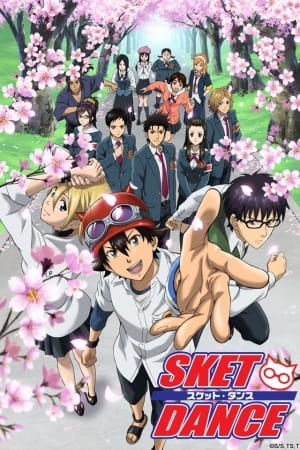
Sket Dance
Is Sket Dance worth watching?
Worth a look. Anime Codex rates Sket Dance 7.47 out of 10 — scored on six criteria (story, characters, themes, world-building, animation, and cultural impact), not crowd votes. 91st of 226 on the Codex rubric — top 40% of the catalogue. The crowd rates it 0.74 higher than the rubric does — the Codex is harder on it than on 62% of the catalogue.
Where to watch
What the data says
Computed from the Codex rubric across the whole catalogue.
Summary
Sket Dance is one of the most underrated comedies to emerge from Weekly Shonen Jump, distinguished by how seamlessly it weaponizes 70-plus episodes of school gag comedy to land genuinely devastating emotional arcs. Its greatest strength is character writing: the SKET trio—anxious leader Bossun, ex-delinquent Himeko, and mute hacker Switch—are far deeper than the slacker-club premise implies, and supporting players like Tsubaki are given real interiority. The series' best moments, especially Switch's harrowing backstory and the Bossun-Tsubaki twin reveal, succeed because the drama is seeded through earlier jokes rather than imported for cheap pathos. Its weaknesses are structural: the enormous episode count produces filler stretches and an uneven comedy-to-drama rhythm, and the animation is competent rather than ambitious, leaning on expressive faces and parody timing over visual spectacle. The world-building is limited to a well-populated but conventional high school, with the 'power system' existing only as a comedic goggle gag. Judged against the best of shonen comedy, Sket Dance is a warm, sincere, often hilarious show whose emotional payoffs reward patient viewers, held back from greatness only by its bloated length and modest production values. A genuine hidden gem.
Criterion breakdown
Story & narrative
Sket Dance excels at episodic comedy while strategically deploying multi-episode dramatic arcs that recontextualize its goofy cast—the standout being Switch's backstory arc, which reveals the reason for his speech synthesizer and his brother's death with genuine devastation. The Bossun and Tsubaki twin reveal arc is similarly well-seeded, paying off jokes and visual gags planted episodes earlier. The weakness is structural inconsistency: for every brilliant emotional pivot there are stretches of filler gag episodes that meander, and the 77-episode length means the comedy-to-drama ratio occasionally feels uneven.
Character writing & growth
The trio's chemistry is the show's engine—Bossun's insecurity beneath his leadership, Himeko's Onihime delinquent past informing her loyalty, and Switch's mute trauma make them far richer than the slacker-club premise suggests. Supporting cast like Tsubaki (the student council rival who turns out to be Bossun's twin), Roman, and Captain are given real interiority rather than one-note running gags. Growth is gradual but authentic, especially Switch's arc toward speaking aloud, which the series wisely refuses to fully resolve, respecting his character.
Themes & emotional resonance
Beneath the comedy runs a consistent thesis about found family, grief, and helping others as a form of self-repair—Switch's survivor's guilt and Bossun's abandonment issues give the 'helping club' premise emotional weight. The show earns its tonal whiplash because the drama is rooted in established characters rather than imported for cheap pathos. It stops short of the thematic depth of seinen drama, but for a Jump gag comedy the emotional resonance of arcs like Switch's is exceptional.
World-building & power system
Kaimei High School is a believable, fully-populated setting where recurring side characters (student council, rival clubs, teachers) create a lived-in ecosystem that supports both comedy and continuity. There is no power system beyond Bossun's tongue-in-cheek 'concentration' goggle gag, which is treated as comedic flavor rather than mechanics. The premise of an odd-jobs club is not wildly original, but the school's density of consistent recurring characters gives it strong internal coherence.
Animation & direction
Tatsunoko's production is functional and expressive where it counts—the comedy relies on snappy reaction faces, rapid visual gags, and parody sequences that the direction times well. It is not a visually ambitious show; backgrounds and standard scenes are workmanlike, and the long runtime shows occasional dips in consistency. The direction shines in tonal control, smoothly shifting from frantic comedy to the muted, restrained framing of Switch's flashback without feeling jarring.
Cultural impact
A solid Jump entry with a strong MAL standing (8.21) and a devoted fanbase, but it never achieved the mainstream cultural footprint of its contemporaries. Its notable crossover with Gintama is a memorable bit of fan trivia, and it remains a frequently recommended hidden gem for comedy fans, but its impact is more cult-favorite than landmark.
Synopsis (from MAL)
At Kaimei High School there is a special club dedicated to helping others known as the SKET Brigade. The brains of the group is Kazuyoshi "Switch" Usui, a tech-savvy otaku who speaks through speech synthesis software, while the brawn is provided by Hime "Himeko" Onizuka, the hockey stick-wielding girl once known as "Onihime." And last but not least, their leader is Yuusuke "Bossun" Fujisaki, whose latent ability is evoked by his goggles, allowing him to summon the awesome power of extraordinary concentration. However, most of the school only know them as the club that handles odd jobs. Many of their days are spent in the clubroom slacking off, but when there is something to be done, they give their all to help others—usually in sincere, but unintentionally hilarious, ways. The SKET Brigade do all they can to provide support, kindness, encouragement, and troubleshooting to any students crazy enough to ask for their services. [Written by MAL Rewrite]
Ranked nearby
Explore rankings
Discussion
Set a display name above to post.
Loading discussion…