Is Trigun Overrated? A 7.53 That Rides Vash's Silhouette and a Toonami Slot to a Reputation the Writing Doesn't Fully Earn
Madhouse's 1998 gunslinger posts a 0.69-point gap between MyAnimeList's 8.22 and the Codex 7.53 because the crowd is grading a silhouette and a saxophone cue, not the twelve episodes before the plot arrives.
Madhouse's 1998 gunslinger posts a 0.69-point gap between MyAnimeList's 8.22 and the Codex 7.53 because the crowd is grading a silhouette and a saxophone cue, not the twelve episodes before the plot arrives.
Trigun is remembered as a lean, tragic space-western. It isn't. It's a 26-episode Madhouse production that spends its first half doing bounty-of-the-week hijinks and its second half finally reckoning with the show it always wanted to be — and the reputation people carry around is almost entirely built on the second half plus a red coat. That's the gap. That's the story.
The Consensus, Named
MyAnimeList scores Trigun 8.22. The Codex rubric returns 7.53. A 0.69-point spread is not a rounding error — it's the size of the gap between "canon seinen" and "solid genre entry with a great protagonist." The crowd position, stated plainly, is that Trigun belongs in the same conversation as Cowboy Bebop as a defining late-90s Western-inflected seinen — a show whose blend of comedy, gunplay, and pathos earned it permanent shelf space next to Watanabe's work. That's the position to engage.
The rubric doesn't agree. It sees a show carried by two criteria — character (8.0) and cultural impact (8.5) — propped up by decent thematic writing, and dragged down by an animation floor (6.5) and a structurally lopsided story (7.0) that the crowd has spent twenty-five years forgiving. The gap between Trigun's reputation and its rubric score is the story. What follows is naming what the crowd is rewarding that the rubric won't.
The First Half Is a Bounty-of-the-Week Show, and the Reputation Pretends Otherwise
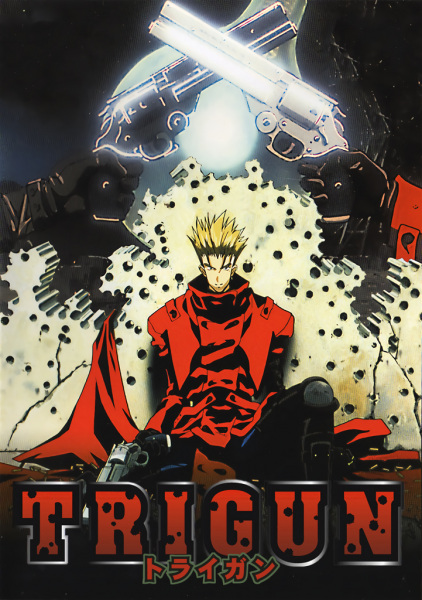
The received memory of Trigun is Vash haunted, Wolfwood dying, July burning. The actual first half of the broadcast is Meryl and Milly chasing a slapstick Vash through frontier towns while Yousuke Kuroda's scripts run through episodic bounty-hunter setups that could be lifted wholesale into another show. This isn't a rhythm choice — it's a structural liability. The Gung-Ho Guns don't cohere as an antagonist force until roughly episode 16, and Vash's origin, the July catastrophe, and the Knives revelation all crowd into the last third because the first two-thirds didn't do the setup work.
The tonal whiplash is the specific failure. When the show pivots — and it does pivot, hard — from doughnut gags to genocide, the seams show. There's no gradient. A show that had used its middle episodes to seed dread instead of resetting to comic status quo would land the July flashback with more force. As delivered, the back half is doing work the front half should have started. That's a story score of 7.0, and it's generous.
Character Is Where the Show Actually Earns Its Reputation
Credit where the rubric gives it. Vash the Stampede is a superb protagonist — the buffoonery is a functional mask, and the peel is patient enough that his refusal to kill Knives in the finale reads as earned rather than doctrinal. Nicholas D. Wolfwood is the standout. His "kill to protect" ethic is not a foil written to lose; it's a genuine philosophical counterweight, and his death is the strongest sustained piece of writing the series produces. The character score of 8.0 is where the show's reputation has real load-bearing capacity.
What it doesn't have is a supporting ensemble. Meryl Stryfe and Milly Thompson are charming and functionally deployed as audience surrogates, but neither has an arc. Milly's relationship with Wolfwood is gestured at, not developed. Meryl's shift from insurance skeptic to true believer is a beat, not a curve. This is the same problem — different genre — that we've flagged elsewhere on shows whose ensembles diffuse the protagonist's gravity, and it caps how high the character score can climb.
The Animation Ceiling Is Where the Crowd Forgives Most
Trigun is a 1998 TV production, and it looks like one. Madhouse gets the gunfight choreography right and animates Vash's face with real range — the shift from clown to haunted gunman across a single cut is one of the show's actual craft achievements. But the budget is visible constantly: off-model background figures, recycled motion during the episodic stretch, action beats that cut around what a bigger budget would have shown. Tsuneo Imahori's guitar score and the "H.T." cue carry more atmospheric weight than the visuals do, and any honest viewer knows it.
The rubric returns a 6.5. That's not a hit piece — it's what a 1998 TV budget delivered on an ambitious property. The crowd's 8.22 is scoring the memory of Vash's silhouette against a red sun, not the actual frame-by-frame execution across 26 episodes. This is the same crowd-forgiveness pattern we've documented on Steins;Gate, where mid-tier animation gets absorbed by strong criteria elsewhere. Trigun benefits from the same forgiveness — and the rubric declines to grant it.
Cultural Weight Is Doing More Work Than Anyone Admits
The 8.5 on cultural impact is real and it's earned. Trigun was a Toonami and Adult Swim spine, one of the shows that built the Western anime boom, and Vash's design remains one of the medium's most recognizable silhouettes. The 2010 Badlands Rumble film and Orange's 2023 Stampede reboot exist because the property has permanent shelf space. The gunslinger-with-a-heart archetype in post-2000 anime and Western animation owes it a debt.
The problem is that cultural weight is doing disproportionate work in the crowd's aggregate score. When an 8.22 encounters a show whose story is a 7.0 and whose animation is a 6.5, something else is being weighted heavily to get there — and that something is nostalgia and iconography, not craft. This is a familiar pattern: crowd scores absorb cultural residue and pay it back as story points the writing didn't earn. We've argued the same thing about Code Geass at a larger scale.
The Strongest Counter-Argument
The honest steelman: Trigun's finale — Vash's refusal to kill Knives, the mercy-versus-justice weight — is thematically rigorous enough that it retroactively redeems the goofy first half by revealing it as the mask the protagonist himself was wearing. The tonal whiplash is the point. The comedy episodes are Vash performing Vash, and when the mask comes off, the show comes off with it.
There's real merit here, and it's why themes score an 8.0 rather than lower. But the rubric grades execution, not intention. A structural conceit only works if the early episodes are visibly setting up the reveal, and Trigun's middle stretch mostly isn't — it's marking time until the source material catches up. The idea is defensible. The delivery is padded.
Verdict
Trigun at 7.53 is a genuinely good seinen carried by a great protagonist, a great secondary lead, and a cultural footprint that outsized its craft. The 8.22 is scoring the silhouette, the saxophone, and the July flashback — not the twelve episodes that precede the plot. Watch it for Vash and Wolfwood. Don't confuse the memory of it for what's on the disc.
Featured in the Codex
More from The Codex
The Seven Deadly Sins Is a 6.60 Wearing a 7.60 Costume: A One-Point Gap Earned by Groping Gags and Convenient Flashbacks
The Seven Deadly Sins scores 6.60 on the Codex against MyAnimeList's 7.60 because the crowd is grading a Netflix breakout and a Ban-and-King friendship, not the 24 episodes A-1 Pictures actually broadcast in 2014.
The 10.0 That Built a Sunday: How Sazae-san's Cultural Score Carries a 6.58 Scorecard
Sazae-san is a case study in how a single criterion — cultural — can define how a show is remembered, and the 10.0 the Codex hands Eiken's 1969 institution is doing every bit of the heavy lifting its other five scores refuse to.
The Sebastian Problem: Why Black Butler Sits 1.10 Below Its MAL Line and the Crowd Refuses to Notice
Black Butler (Kuroshitsuji) posts a 1.10-point gap between MyAnimeList's 7.65 and the Codex 6.55 because the crowd is grading Sebastian's silhouette and a Phantomhive aesthetic, not the anime-original finale A-1 Pictures actually shipped in 2009.
Discussion
Set a display name above to post.
Loading discussion…