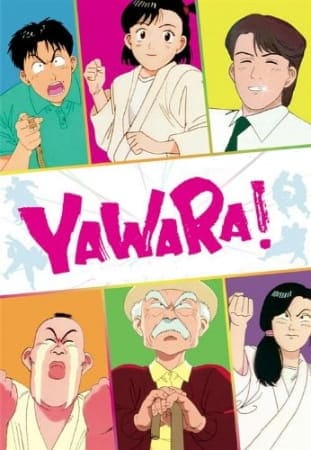
Yawara! A Fashionable Judo Girl Review: A 7.55 That Rides Character Writing and Pays for It in Runtime
Madhouse's 124-episode Urasawa adaptation clears MyAnimeList by 0.03 points because the rubric rewards a protagonist worth watching for three years, not the middle stretch that tests your patience.
Madhouse's 124-episode Urasawa adaptation clears MyAnimeList by 0.03 points because the rubric rewards a protagonist worth watching for three years, not the middle stretch that tests your patience.
The most interesting number on the Yawara! A Fashionable Judo Girl scorecard is not the 7.55 composite or the 6.8 animation mark that tells you exactly what a late-80s TV production looked like at scale. It is the 8.2 for character — the criterion that decides whether 124 episodes of reluctant tournament judo justifies itself, and the one that quietly pulls the rest of the rubric up behind it.
The Consensus and the Gap
The MyAnimeList crowd scores it 7.52. Anime Codex has it at 7.55. A 0.03-point gap is a rounding error on paper and something more interesting in practice — it means the rubric and the aggregate audience have arrived at nearly the same destination by very different routes. The crowd is scoring nostalgia, a Barcelona-era time capsule, and the residual halo of Naoki Urasawa's name after Monster and 20th Century Boys sent readers back to his earlier catalogue. The Codex is scoring a specific claim: that a Madhouse production from 1989 built one of the richer protagonists in sports anime, and that this compensates for a middle stretch which visibly stretches its manga source across a broadcast window ending on the countdown to a real Olympics.
Judged against one consistent rubric, Yawara! A Fashionable Judo Girl is best understood by which criteria carry it and which drag it down — not by a single number. The number is a summary. The scorecard is the argument.
Character at 8.2 Is Doing the Work
The show's central premise — a prodigy who wants to be ordinary rather than great — sounds like a genre commonplace until you sit with how Yawara Inokuma is actually written. She does not resist judo because of trauma or a rival's shadow or a dead mentor. She resists because she wants to shop, to date, to be looked at as a fashionable teenager and not as her grandfather's Olympic project. That is a materially different reluctance from the shonen default, and it gives every tournament she wins a small note of loss underneath the victory.
Jigorou Inokuma is the show's second-best writing decision. A comic tyrant whose scheming to force his granddaughter into the ring reads as cruel on paper and lands as affection on screen, he supplies the engine that keeps the plot moving when Yawara herself would happily walk away from it. Kousaku Matsuda's arc — opportunist sports reporter slowly converted into sincere believer — is the third pillar, and Sayaka Honami's shift from imperious rival to genuine competitor is the fourth. None of these arcs happen quickly. All of them happen. The 8.2 is earned across dozens of episodes of accumulated small revisions, not in a single set piece.
This is the same critical shape that makes Master Keaton worth its 24 episodes on the Codex — a Madhouse-produced Urasawa adaptation carried by a fixed-lens protagonist and lived-in supporting cast rather than by escalation. Urasawa was already writing this way in 1986. The anime is faithful to it.
Story at 7.5: The Spine Holds, the Middle Sags
The narrative architecture is sound. Yawara hiding her ability, the reluctant ascent through national competition, the Sayaka rivalry that supplies competitive stakes, Matsuda's pursuit that supplies narrative pressure from outside the dojo, and the Barcelona Olympics arc as terminal destination — with each episode literally ending on a countdown to the real Games — is a cleaner long-form structure than most 124-episode productions manage.
The 7.5 pays for the middle. Somewhere past the initial national tournament arcs, the show settles into a pattern of tournament-plus-romantic-misunderstanding-plus-Matsuda-humiliation that repeats with variations for a long stretch. This is the standard failure mode of late-80s manga-to-TV adaptations running alongside an ongoing serialization: material has to be stretched, filler misunderstandings have to be manufactured, and the emotional stakes flatten while the show waits for the manga to hand it the next real beat. The Barcelona arc recovers the tension. Getting there involves passages where the machinery is visible.
Animation at 6.8 Is the Rubric Being Honest
Madhouse in 1989 on a weekly broadcast is not Madhouse on a theatrical feature. The judo choreography reads cleanly — throws have the snap they need, matches are legibly staged, and comedic timing is sharp when the storyboards call for it, with Tensai Okamura's contributions across episodes 5, 58, 72, 79, 87, 101, and 122 marking some of the more compositionally interesting installments. Keiji Gotou's key animation on episodes 17 and 26 sits in a similar register.
The rest is what a 124-episode weekly production looks like when the calendar is unforgiving. Recycled stills. Detail that slips between episodes. Backgrounds that carry an era rather than a location. The 6.8 is not a punishment; it is an accurate description of what the medium could afford in 1989 across a three-year run, and it is the ceiling the rubric places on any long-form production that cannot maintain feature-grade craft across its full runtime.
World-Building at 7.6 and Themes at 7.3
The judo itself is treated with more institutional specificity than most sports anime bother with — weight classes, federation politics, the mechanics of throws, the actual apparatus of competitive judo in Japan — and the bubble-era Tokyo the show is set in comes through in the sports tabloids Matsuda writes for, the fashion-conscious youth culture Yawara wants to belong to, and the Olympic fervor the entire narrative points toward. The 7.6 rewards this. It is period texture that doubles as world logic.
The 7.3 on themes is where the show's light comedic register works against it. The friction between personal desire and inherited expectation is genuinely there in the text, and the Olympic dream carries weight precisely because Yawara does not want it. But the comedy softens the payoffs. Beats that could land with real emotional force get resolved into gags, and the romance triangles occupy space that a heavier show would spend on interiority. It is a deliberate register, not a failure of one — but the rubric marks it accordingly.
The Steelman: The Runtime Is the Point
The strongest defense of Yawara! against a critical reading is that 124 episodes is not a bug but the delivery mechanism. The character work at 8.2 exists because the show has the runtime to let Yawara's reconciliation with her own talent happen at the actual speed of a person changing her mind, and the Sayaka and Matsuda arcs earn their reversals because the audience has spent literal years with them. Compress this to a 26-episode adaptation and you get a competent sports show. Give it three broadcast years synced to a real Olympics and you get something structurally different.
This is fair. The rubric acknowledges it in the 8.2. What the rubric does not do is grant runtime an unlimited credit line — the middle-stretch repetition still costs points on story, and no amount of accumulated character weight lifts the animation mark past what the budget could deliver. The Clannad scorecard shows the same tension from a different angle: craft carries a show only as far as its weakest sustained criterion permits.
Verdict
Yawara! A Fashionable Judo Girl is a 7.55 that lives on Yawara, Jigorou, Sayaka, and Matsuda, and pays for its runtime in the middle episodes the way every late-80s long-run adaptation does. The 0.03-point edge over the MyAnimeList consensus is not vindication — it is agreement, reached through a rubric that credits character writing where the crowd credits era and name. Watch it for the protagonist. Accept the animation for what 1989 could afford.
Featured in the Codex




More from The Codex
The Seven Deadly Sins Is a 6.60 Wearing a 7.60 Costume: A One-Point Gap Earned by Groping Gags and Convenient Flashbacks
The Seven Deadly Sins scores 6.60 on the Codex against MyAnimeList's 7.60 because the crowd is grading a Netflix breakout and a Ban-and-King friendship, not the 24 episodes A-1 Pictures actually broadcast in 2014.
The 10.0 That Built a Sunday: How Sazae-san's Cultural Score Carries a 6.58 Scorecard
Sazae-san is a case study in how a single criterion — cultural — can define how a show is remembered, and the 10.0 the Codex hands Eiken's 1969 institution is doing every bit of the heavy lifting its other five scores refuse to.
The Sebastian Problem: Why Black Butler Sits 1.10 Below Its MAL Line and the Crowd Refuses to Notice
Black Butler (Kuroshitsuji) posts a 1.10-point gap between MyAnimeList's 7.65 and the Codex 6.55 because the crowd is grading Sebastian's silhouette and a Phantomhive aesthetic, not the anime-original finale A-1 Pictures actually shipped in 2009.
Discussion
Set a display name above to post.
Loading discussion…