Kareshi Kanojo no Jijou at 7.83: The Anno Experiment That Earns Its Score on Two Criteria and Collapses on a Third
Anno's post-Evangelion shoujo scores 7.83 on the Codex against MyAnimeList's 7.60 — a gap explained by character writing and themes the crowd undervalues, and a production breakdown the rubric refuses to forgive.
Anno's post-Evangelion shoujo scores 7.83 on the Codex against MyAnimeList's 7.60 — a gap explained by character writing and themes the crowd undervalues, and a production breakdown the rubric refuses to forgive.
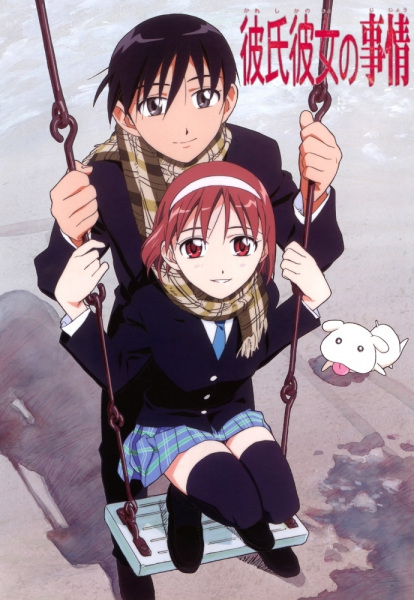
A 1998 shoujo directed by Hideaki Anno, animated by Gainax in the immediate wake of Evangelion, and abandoned mid-arc when its director and its mangaka stopped agreeing on what the show was — Kareshi Kanojo no Jijou is one of the most structurally incomplete works in the medium's canon, and also one of the most psychologically literate romances of its decade. Judged against one consistent rubric, Kareshi Kanojo no Jijou (His and Her Circumstances) is best understood by which criteria carry it and which drag it down — not by a single number.
The Consensus and the Gap
The MyAnimeList crowd scores it 7.60. The Codex puts it at 7.83. The 0.23-point gap is not a rounding error, and it is not a defense of the unfinished ending. It is a disagreement about what the early episodes actually accomplished — specifically, how much credit Yukino Miyazawa's interior monologues and Soichiro Arima's slow self-disclosure deserve when weighed against the storyboard-only finale that closes the 26-episode run.
The aggregator score reads the show as a whole and penalizes the collapse. The rubric weights character and themes more heavily for shoujo and refuses to discount strong work because the production around it failed. Both numbers describe the same artifact. They disagree about which parts of it count.
What Carries It: Character at 8.5
Yukino and Arima are the reason the show survives its own production. Yukino's premise — the top student whose entire identity is a vanity performance maintained for external praise — would be a one-note gag in a weaker writer's hands. Masami Tsuda's source material, and the early Anno episodes that adapt it most faithfully, treat her self-construction as labor: exhausting, addictive, and inseparable from the home life that taught her praise was the only reliable currency.
Arima is the harder achievement. His abandonment by his birth parents and the abuse that preceded his adoption are not deployed as backstory beats; they shape the way he performs perfection in public and the way he flinches in private. The hint of his darker arc — the self-loathing that the early episodes only begin to expose — is shoujo working at a depth most of the demographic does not attempt. The supporting cast (Tsubasa, Tsubaki, the school-play ensemble) is thinner by comparison, and the back half's diffusion into their subplots is a structural problem the character score does not paper over.
This is the same shape as several other Codex entries where one criterion carries the scorecard: Cross Game's 9.0 on character lifts an 8.08 above its production, and Gungrave's 9.0 saves a show its back half cannot. Kare Kano is a 8.5, not a 9.0, because the supporting roster never reaches the leads' depth — but the lifting is the same kind of lifting.
What Carries It: Themes at 8.0
The central theme is the exhausting labor of maintaining a constructed public self, and the relief — terrifying, addictive — of being truly seen by one other person. Yukino's interior monologues handle this with a directness that feels ahead of its time for 1998 shoujo. Self-worth contingent on external validation is now a well-trodden subject; it was not then, and it was not handled this honestly in the demographic.
The 8.0 rather than a higher mark reflects what the show does not finish. Arima's trauma is the heavier thematic thread, and the anime stops before it resolves. The exploration is real; the payoff is missing. The rubric credits the work that's on screen and declines to credit the resolution that isn't.
What Carries It: Animation at 8.0, With An Asterisk
Anno's direction is the show's signature and its trap. The chibi cutaways, paper-cutout still frames, on-screen kanji, theatrical paper-doll sequences, and live-action photo backgrounds are not stylistic flourishes layered onto a conventional production — they are the production, a self-aware comedic-emotional grammar that turns Gainax's budget constraints into the show's distinctive voice. The early episodes use these techniques with confidence; later romantic-comedy direction across the medium owes them more than it admits.
The asterisk is that the same techniques curdle. By the back half, the still frames are not stylistic choices but recap fillers. The storyboard-only finale is not avant-garde — it is a studio that has run out of money and time. The 8.0 credits the invention. It does not pretend the collapse is also art.
What Drags It Down: Story at 7.0 and Cultural Impact at 6.5
The opening arc is exceptional shoujo storytelling. Yukino's mask-versus-reality premise is a clean engine, and the inversion of the typical romance — couple together early, then explore what that actually means — was genuinely novel for the demographic in 1998. The 7.0 reflects what happens after. The narrative diffuses into Tsubasa and Tsubaki's subplots and the school-play arc, momentum decays, and the anime stops abruptly mid-arc because the Anno-Tsuda creative clash and Gainax's production collapse made continuation impossible.
The cultural score at 6.5 measures legacy, and the legacy is permanently shadowed. The show is cited as Anno's post-Evangelion TV work and as a touchstone for stylized fourth-wall-breaking romantic comedy direction. Tsuda's manga, complete at 21 volumes, retains its standing. The anime's reputation is the reputation of a brilliant first half and an unfinished second — closer in shape to Ouran's directorial-driven 7.83 than to a canon shoujo with a complete arc.
The Steelman: The Crowd Has a Point
The strongest version of the 7.60 position is that an unfinished show is a failed show, and that the rubric is being generous to a work that does not deliver a conclusion. There is a real argument that the early episodes' invention does not outweigh a finale that is literally storyboards, and that giving the character writing 8.5 credits potential more than execution.
The rubric reads it differently because it weights criteria independently rather than averaging vibes. Yukino's writing is finished. Arima's interiority through the episodes that exist is finished. The thematic work on performed selfhood is finished. The production collapse is real and is priced into the story score, the cultural score, and the asterisk on animation — three of six criteria absorb the penalty. The character and thematic work that survived the collapse is what the other three criteria measure, and those numbers are honest.
A 7.83 is not a defense of the ending. It is an accounting of which parts of the show the ending did not damage.
Verdict
Kare Kano is a shoujo with two near-great criteria, a distinctive directorial language, and a production failure that costs it the back half it was building toward. The 7.83 says exactly that: worth the early episodes for Yukino and Arima's interior writing and Anno's experimental grammar, taxed for an ending that exists only as paper. Watch it for what it finished, not for what it didn't.
Featured in the Codex






More from The Codex
The Seven Deadly Sins Is a 6.60 Wearing a 7.60 Costume: A One-Point Gap Earned by Groping Gags and Convenient Flashbacks
The Seven Deadly Sins scores 6.60 on the Codex against MyAnimeList's 7.60 because the crowd is grading a Netflix breakout and a Ban-and-King friendship, not the 24 episodes A-1 Pictures actually broadcast in 2014.
The 10.0 That Built a Sunday: How Sazae-san's Cultural Score Carries a 6.58 Scorecard
Sazae-san is a case study in how a single criterion — cultural — can define how a show is remembered, and the 10.0 the Codex hands Eiken's 1969 institution is doing every bit of the heavy lifting its other five scores refuse to.
The Sebastian Problem: Why Black Butler Sits 1.10 Below Its MAL Line and the Crowd Refuses to Notice
Black Butler (Kuroshitsuji) posts a 1.10-point gap between MyAnimeList's 7.65 and the Codex 6.55 because the crowd is grading Sebastian's silhouette and a Phantomhive aesthetic, not the anime-original finale A-1 Pictures actually shipped in 2009.
Discussion
Set a display name above to post.
Loading discussion…