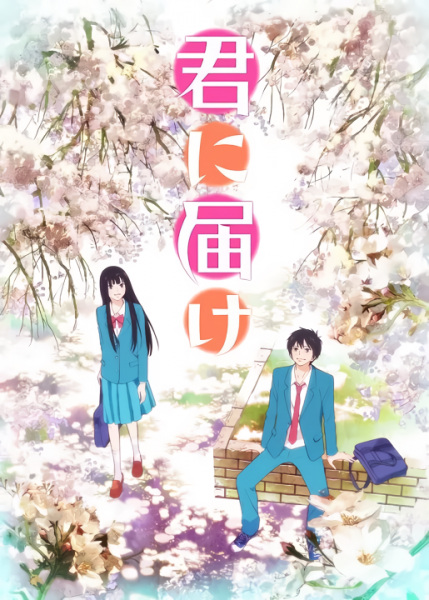
Kimi ni Todoke (From Me to You)
Is Kimi ni Todoke (From Me to You) worth watching?
Yes, it's worth watching. Anime Codex rates Kimi ni Todoke (From Me to You) 7.78 out of 10 — scored on six criteria (story, characters, themes, world-building, animation, and cultural impact), not crowd votes. 63rd of 226 on the Codex rubric — top 28% of the catalogue. The crowd rates it 0.23 higher than the rubric does — the Codex is harder on it than on 31% of the catalogue.
Where to watch
Trailer
What the data says
Computed from the Codex rubric across the whole catalogue.
Summary
Kimi ni Todoke stands among the more accomplished pure shoujo romances of its era, anchored by Sawako Kuronuma — a protagonist whose social anxiety, formal sincerity, and earnest gratitude make her growth from feared outcast to belonging genuinely moving. Its great strength is character: the friendships with Ayane and Chizuru carry real weight, and the show treats female friendship and self-worth as seriously as romance, which elevates it above lesser entries in the genre. Production I.G's soft, pastel direction and expressive close-up work serve the quiet emotional register well, even if the animation is conservative and mostly static. The show's defining weakness is pacing: the Sawako–Kazehaya romance crawls forward through repeated, sometimes frustrating misunderstandings, and the second cour in particular tests patience by stalling resolution that the audience can see coming for episodes. Kazehaya himself is warm but underwritten compared to the rich supporting cast. Within shoujo conventions, however, these are familiar tradeoffs in service of emotional accumulation rather than plot. The result is a sincere, well-observed, and emotionally resonant high-school romance that rewards patient viewers and remains a reliable genre touchstone — excellent at what it sets out to do, if not transcendent of its form.
Criterion breakdown
Story & narrative
The narrative arc of Sawako's gradual social integration — from feared 'Sadako' to genuinely belonging — is structured with patience and a strong emotional throughline, particularly in the early friendship-building with Ayane and Chizuru and the rumor arc that tests those bonds. However, the central Sawako–Kazehaya romance moves at an almost glacial pace driven by repeated misunderstandings, a recurring shoujo crutch that the second cour leans on too heavily, stalling momentum across multiple episodes. It is a well-told but deliberately slow story that prioritizes emotional accumulation over forward plot motion.
Character writing & growth
Sawako is one of the genre's most carefully realized protagonists: her timidity, formal speech patterns, and overwhelming gratitude for small kindnesses make her growth from isolation to friendship feel earned rather than convenient. The supporting cast is unusually strong for shoujo — Ayane and Chizuru are not mere sidekicks but have their own insecurities and loyalties, and the Kurumi rivalry arc complicates the cast without resorting to flat villainy. The main weakness is Kazehaya, who is decent and warm but comparatively thin, defined largely by his goodness and jealousy rather than deep interiority.
Themes & emotional resonance
The show explores how isolation distorts both self-perception and how others read you, with Sawako's misunderstood reputation functioning as a sincere meditation on social anxiety and the courage required for ordinary connection. The emotional resonance peaks in moments like Sawako tearfully realizing she has friends who will defend her against the rumors, scenes the direction earns through restraint rather than melodrama. It occasionally over-sentimentalizes, but the core theme of communication-as-bravery is genuinely affecting.
World-building & power system
Read as setting depth, the show builds a believable, granular high-school microcosm — classroom dynamics, seating, festival prep, and the social mechanics of how rumors spread feel internally consistent and grounded. The originality lies less in setting than in the inverted premise: making the 'scary girl' the gentlest character and mining drama from misperception. It is not an ambitious world but it is a coherent and convincingly observed one.
Animation & direction
Production I.G renders the show with a soft pastel palette, frequent shoujo flourishes (floral overlays, sparkle effects, exaggerated comedic chibi reactions) and expressive close-up work that conveys Sawako's interior states well. The direction excels at quiet emotional beats and visual gags around Sawako's 'Sadako' aura, though the animation is conservative and largely static, relying on held shots and limited motion typical of dialogue-driven romance. Polished and atmospheric rather than technically dazzling.
Cultural impact
A widely beloved and influential shoujo title from Bessatsu Margaret, it helped define the late-2000s 'pure' high-school romance wave and remains a frequent recommendation entry point for the genre, with strong manga sales and a live-action film adaptation. Its MAL standing (8.01, over a million members) reflects durable popularity, though its cultural footprint is significant within shoujo rather than medium-defining.
Synopsis (from MAL)
Known for her semblance to the Sadako character of The Ring series, Sawako Kuronuma is given the nickname "Sadako" and misunderstood to be frightening and malicious like her fictional counterpart, despite having a timid and sweet nature. Longing to make friends and live a normal life, Sawako is naturally drawn to the cheerful and friendly Shouta Kazehaya, the most popular boy in her class. From their first meeting, Sawako has admired Kazehaya's ability to be the center of attention and aspires to be like him. When Kazehaya organizes a test of courage for the entire class and encourages her to attend, Sawako sees this as an opportunity to get along with her classmates, starting with Ayane Yano and Chizuru Yoshida. Through each new encounter and emotion she experiences, Sawako believes that meeting Kazehaya has changed her for the better. Little does Sawako know, her presence has also changed Kazehaya. [Written by MAL Rewrite]
Ranked nearby




Explore rankings
Discussion
Set a display name above to post.
Loading discussion…