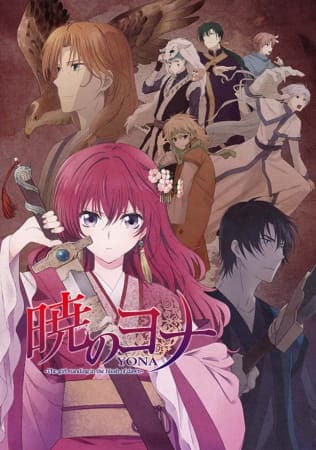
Akatsuki no Yona (Yona of the Dawn)
Is Akatsuki no Yona (Yona of the Dawn) worth watching?
Yes, it's worth watching. Anime Codex rates Akatsuki no Yona (Yona of the Dawn) 7.81 out of 10 — scored on six criteria (story, characters, themes, world-building, animation, and cultural impact), not crowd votes. 60th of 226 on the Codex rubric — top 27% of the catalogue. The crowd rates it 0.23 higher than the rubric does — the Codex is harder on it than on 31% of the catalogue.
Where to watch
Trailer
What the data says
Computed from the Codex rubric across the whole catalogue.
Summary
Yona of the Dawn stands among the stronger action-adventure shoujo of its era, anchored by a heroine whose growth from coddled princess to determined leader is convincingly gradual rather than instant. Its Korean-flavored kingdom of Kouka and the four-dragon-warrior legend give it a distinct identity within a demographic often confined to school settings, and the ensemble—particularly the layered Hak and the morally ambiguous Soo-won—elevates it above standard reverse-harem fare. The non-linear premiere and emotionally rich character beats reward investment. Its chief weakness is incompleteness: 24 episodes cover only the setup and early journey, ending on the Awa arc without resolution and front-loading flashbacks that slow the midsection. Pierrot's production is competent and atmospheric but rarely visually ambitious, and the romantic undercurrent, while compelling, is left deliberately simmering. Judged against the best adventure shoujo, it excels at character and premise while falling short on narrative completion and animation spectacle. For viewers seeking a female-driven fantasy quest with genuine stakes and a charismatic cast, it remains a highly recommendable entry point, even if the anime functions more as an enticing first chapter than a self-contained story.
Criterion breakdown
Story & narrative
The opening palace coup—Soo-won killing King Il before Yona's eyes—delivers a genuinely propulsive inciting incident, and the subsequent gathering of the four dragon warriors gives the narrative a clear quest spine. However, the 24-episode adaptation stalls in its second half, devoting heavy screen time to flashbacks (the Hak-Yona-Soo-won childhood triangle) and ending on the unresolved Awa pirate arc, leaving the story feeling like a prologue rather than a complete arc. The non-linear structure that opens mid-flight and rewinds is a smart shoujo hook.
Character writing & growth
Yona's transformation from sheltered, lovesick princess into someone who picks up a bow and chooses to fight is one of the genre's stronger heroine arcs, and crucially it is earned through incremental beats rather than a single epiphany. Hak is a standout—his loyalty, comedic deflection, and buried romantic ache give him real dimension—and the dragon warriors (Kija's pride, Shin-ah's isolation, Jae-ha's reluctance, Yoon's pragmatic non-warrior role) are individuated rather than archetypal. Soo-won's ambiguity as antagonist resists easy villainy.
Themes & emotional resonance
The show handles loss of innocence and the cost of vengeance-turned-purpose with more nuance than most shoujo adventures, particularly in Yona witnessing the suffering of Kouka's neglected provinces, which reframes her goal from personal revenge to genuine responsibility. Soo-won's coup is framed as morally complicated rather than evil, lending real weight. The emotional resonance occasionally leans on the unrequited-love undertone, which is affecting but underdeveloped within these episodes.
World-building & power system
The Korean-inspired setting of Kouka is a refreshing departure from generic pseudo-Japanese or Western fantasy worlds, and the founding myth of the Crimson Dragon King and his four dragon warriors gives the power system a clean, legend-rooted internal logic. The dragon abilities (Kija's claw, Shin-ah's eyes, Jae-ha's leg, Zeno's blood) are distinct and tied to the mythology. Worldbuilding around Kouka's troubled provinces adds texture, though political depth remains lightly sketched in this cour.
Animation & direction
Pierrot delivers solid, consistent character art with strong attention to Yona's red hair as a recurring visual motif, and the action choreography—especially Hak's spear work—is fluid in key moments. Direction shines in emotional close-ups and the striking cold-open structure, but the production is workmanlike rather than spectacular, with occasional flat backgrounds and conservative animation in lower-stakes episodes. The atmospheric soundtrack does notable heavy lifting.
Cultural impact
A long-running Hana to Yume property, Yona of the Dawn became a beloved touchstone for fans of action-adventure shoujo and is frequently cited as a gateway title for the genre. Its enduring manga popularity and strong female-led adventure framing gave it lasting fandom presence, though the anime's single incomplete cour limited its broader mainstream footprint compared to genre-defining shoujo classics.
Synopsis (from MAL)
The kingdom of Kouka is blessed with a beautiful princess whose childlike innocence charms all who come across her. Named Yona, she has grown up sheltered in the royal palace, shielded from any danger that may befall her. However, all good things must come to an end. Yona's perfect world comes crashing down when a heinous act of treason threatens to erase all that she holds dear, including her birthright as the princess of Kouka. Left with no one to trust but her childhood friend and loyal bodyguard Son Hak, she is forced to flee the palace. Faced with the perils of surviving in the wild with a target on her back, Yona realizes that her kingdom is no longer the safe haven it once was. Free from the shackles of naivety, Yona vows to do everything in her power to become strong enough to crush her enemies. With Hak by her side, she must piece together the remains of an ancient legend that might be the key to reclaiming her kingdom from those who conspired to steal it from her. [Written by MAL Rewrite]
Ranked nearby
Explore rankings
Discussion
Set a display name above to post.
Loading discussion…