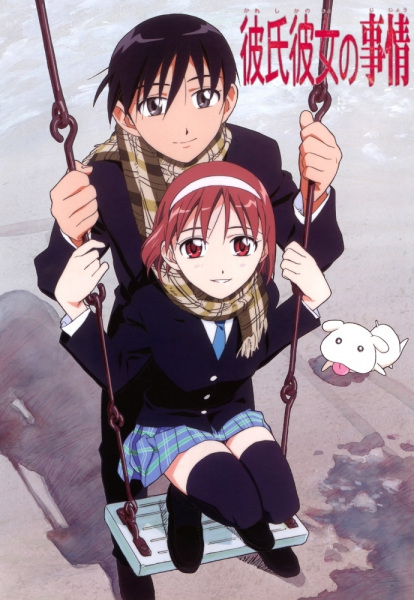
Kareshi Kanojo no Jijou (His and Her Circumstances)
Is Kareshi Kanojo no Jijou (His and Her Circumstances) worth watching?
Yes, it's worth watching. Anime Codex rates Kareshi Kanojo no Jijou (His and Her Circumstances) 7.83 out of 10 — scored on six criteria (story, characters, themes, world-building, animation, and cultural impact), not crowd votes. 58th of 226 on the Codex rubric — top 26% of the catalogue. The Codex rates it Δ +0.23 above its MAL score — more underrated than 91% of the catalogue.
Where to watch
Streaming availability varies by region — check your local services.
Trailer
What the data says
Computed from the Codex rubric across the whole catalogue.
Summary
His and Her Circumstances stands out in shoujo for subverting the genre's courtship template — its leads confess and pair off early, then the series dissects the harder question of intimacy between two people addicted to performing perfection. Yukino's vanity and Arima's hidden self-loathing make for a romance of unusual psychological honesty, and Hideaki Anno's direction transforms tight budgets into a striking visual language of chibi gags, paper-cutout theatre, text overlays, and live-action inserts that feels singular even today. The first half is among the best the demographic has produced. Its weaknesses are equally pronounced: the back half loses focus across supporting-character subplots, recap and still-frame episodes signal a crumbling production, and the creative friction between Anno and mangaka Masami Tsuda culminated in an abrupt, unresolved finale that abandons Arima's darkest thread entirely. The result is a brilliant, frustrating fragment — a show whose ambition and emotional intelligence outrun its ability to finish what it starts. Viewers seeking a complete arc must turn to the manga. As an anime, it is essential for its highs and its influence on stylized romantic-comedy direction, but it cannot be called whole.
Criterion breakdown
Story & narrative
The opening arc is exceptional shoujo storytelling: Yukino's mask-versus-reality premise and the inversion of the typical romance (the couple gets together early, then the show explores what comes after) is genuinely fresh for the demographic. However, the narrative loses momentum badly in the back half as it diffuses into Tsubasa, Tsubaki, and the school-play subplots, and the infamous unfinished ending — the anime stops abruptly mid-arc due to production collapse and the Anno-Tsuda creative clash — leaves the story structurally incomplete.
Character writing & growth
Yukino and Arima are among the most psychologically layered leads in shoujo: her vanity-driven perfectionism and his quietly damaged self-loathing (rooted in his abandonment and abusive birth parents) give the romance real interior weight rather than melodrama. The show excels at showing how two people performing perfection slowly let each other see the ugly truth, and Arima's darkness arc hints at depths most shoujo never attempt. The supporting cast is thinner and more functional by comparison.
Themes & emotional resonance
The central theme — the exhausting labor of maintaining a constructed public self and the relief of being truly seen — is handled with unusual honesty and resonates strongly through Yukino's interior monologues. The exploration of self-worth contingent on external praise feels ahead of its time for 1998 shoujo. The emotional payoff is undercut, though, by the show ending before its heavier threads (Arima's trauma especially) reach resolution.
World-building & power system
Read as premise originality and setting depth, the show is strong: the high-school student-council framework is ordinary, but the conceit of two rival 'perfect' students blackmailing each other into intimacy is a genuinely novel romantic engine for the demographic. The internal consistency of Yukino's family life and social dynamics is well-realized, though the world rarely extends beyond school and home.
Animation & direction
Anno's direction is the show's most distinctive feature: chibi cutaways, paper-cutout still frames, on-screen text, theatrical paper-doll segments, and live-action photo backgrounds turn budget limitations into a bold, self-aware comedic-emotional language. These experimental choices are inventive and influential, but the same constraints become painfully visible later as recap episodes, frozen frames, and the literal storyboard-only finale expose Gainax's production breakdown.
Cultural impact
It holds a notable place as Anno's immediate post-Evangelion TV work and as a touchstone for stylized, fourth-wall-breaking romantic comedy direction that later series echoed. The Masami Tsuda manga remains well-regarded, but the anime's reputation is permanently shadowed by its unfinished, troubled production, limiting its legacy relative to its early-episode brilliance.
Synopsis (from MAL)
Yukino Miyazawa is the female representative for her class and the most popular girl among the freshmen at her high school. Good at both academics and sports on top of being elegant and sociable, she has been an object of admiration all her life. However, in reality, she is an incredibly vain person who toils relentlessly to maintain her good grades, athleticism, and graceful appearance. She wants nothing more than to be the center of attention and praise—which is why she cannot stand Souichirou Arima, the male representative for her class and the only person more perfect than her. Since the first day of high school, she has struggled to steal the spotlight from her new rival but to no avail. At last, on the midterm exams, Yukino gets the top score and beats Souichirou. But, to her surprise, he congratulates her on her achievement, leading her to question her deceptive lifestyle. When Souichirou confesses his love to Yukino, she turns him down and gloats about it at home with only a hint of regret. But the very next day, Souichirou visits Yukino house to bring her a CD and sees her uninhibited self in action; now equipped with the truth, he blackmails her into completing his student council duties. Coerced into spending time with Souichirou, Yukino learns that she is not the only one hiding secrets. [Written by MAL Rewrite]
Ranked nearby


Explore rankings
Discussion
Set a display name above to post.
Loading discussion…