Is My Hero Academia More Good Than Great? The Codex Verdict on Bones' Eight-Season Shonen
Horikoshi's superhero epic built one of the strongest first seasons in modern shonen and then spent seven more chasing the high — landing closer to good than great.
Horikoshi's superhero epic built one of the strongest first seasons in modern shonen and then spent seven more chasing the high — landing closer to good than great.
Season 1 of My Hero Academia is one of the cleanest shonen openings of the last decade, and almost nothing the show did across the seven seasons that followed lived up to it. That is not a sentimental complaint. It is a structural one. Bones built a chassis in 2016 — the USJ raid, Aizawa getting dismantled, All Might arriving like weather — and Kōhei Horikoshi spent the rest of the run failing to cash the checks that opening wrote.
Is My Hero Academia More Good Than Great? The Consensus Says Yes. The Rubric Disagrees.
The popular position, on MyAnimeList and in the Reddit threads that still treat the final season as event television, is that My Hero Academia is a great show — a generational shonen that earned its place beside the Big Three's successors. The sharper version of that consensus also concedes Deku is plain, but argues the ensemble carries him. Both halves of that read are wrong in the same way. Deku is not just plain; he is static in a medium that demands evolution, and the comparison to Eren Yeager, Reiner Braun, and Armin Arlert is brutal once you make it. Attack on Titan's leads were unrecognizable from premiere to finale. Deku, eight seasons in, is still essentially the boy who cried in front of All Might on the rooftop, now with more punches. That is not character development. That is escalation.
Anime Codex departs from the consensus here because the rubric weights character and thematic follow-through heavily for shonen of this length. Eight seasons buys you the runway to grow people. Horikoshi mostly didn't use it.
The Season 1 Ceiling Was Set By Two Scenes, And The Show Never Cleared It
The villains' invasion of USJ remains, on the rubric, the single best sustained sequence in the franchise. Aizawa's fight against the Nomu — the moment his elbow gives out, the moment Shigaraki touches his face — is staged with a tactility that Bones rarely matched again outside of the All Might versus All For One climax. And All Might's intervention at the end of that arc is the cleanest "the hero arrives" beat the show ever animated. Splendid is not too strong a word.
The other ceiling-setter is the All Might versus All For One bout in Kamino Ward. The plus ultra punch, the steam dissipating off a hollowed-out frame, the finger pointed at the camera — that is the show operating at its actual maximum. Everything before it builds. Everything after it is, on some level, trying to recapture that compression.
In between, Chizome Akaguro — Stain — does something almost no other antagonist in this series manages. He arrives with a coherent ideology, forces Iida, Deku, and Todoroki into a fight that means something thematically, and exits before the writing can dilute him. For a villain the show framed as second-tier, his arc is one of the highest-functioning stretches of the run. He earns the Codex's character criterion in a way Overhaul never does.
Overhaul, Star and Stripe, and Toga: A Pattern Of Wasted Characters
Kai Chisaki should have been the show's defining mid-run antagonist. The Shie Hassaikai arc had everything — Eri as a genuinely disturbing piece of body-horror writing, a rare moment of moral ugliness from the hero side, Mirio Togata's downfall played as actual loss. And then Overhaul's quirk is reduced to a punching contest with Deku's percentages, and he's hauled off before the show interrogates what he actually represented about quirk society. Kaina Tsutsumi at least lands cleanly because the show never overpromises her. Overhaul was overpromised and underdelivered, and that gap is one of the rubric's loudest deductions against the middle seasons.
Star and Stripe is worse, because she's worse-conceived. Introduce the most powerful American hero, hand her a quirk that rewrites reality on contact, and then kill her in a single engagement to power up Shigaraki. That is not a story beat. That is a stat transfer. It reads on screen exactly the way it reads on the page — a plot device shaped like a character — and it is the most disappointing fight in the show's late run. There was no thought given to what she could have been. She was introduced to be killed.
Himiko Toga deserved better than the ending she got. Dabi and Shigaraki are the load-bearing villains the show actually built — Dabi's reveal, Shigaraki's awakening at the hospital — and they more or less earn the weight placed on them. Toga's resolution doesn't. The show had a thesis about her buried somewhere in the Liberation War arc and never quite surfaced it.
The Ensemble Was The Pitch. The Ensemble Got Abandoned.
Class 1-A was the structural promise of the early seasons — twenty kids, twenty quirks, a sports festival designed to showcase all of them. Tenya Iida had a complete arc waiting in the Hosu fallout and never got a second one. Ochaco Uraraka was set up as a thematic mirror to Deku's class anxiety and ended up a romantic placeholder. Denki Kaminari has a quirk the show could have done genuine tactical writing around and instead used him as comic relief through the final war. Fumikage Tokoyami is the most painful of these. Dark Shadow is one of the more interesting quirks in the entire series — a literal psychological externalization — and the show gestured at it during the training camp arc and then essentially stopped. He should have been a top-five character. He's a top-twenty one.
The cultural-impact criterion stays high — the franchise moved merchandise, films, and a Legendary live-action deal — but the character criterion is where the rubric punishes Horikoshi hardest. A show with a lot of good ideas but an equally or more wasted potential. That is the line the Codex keeps returning to, and it is the line that separates this show from the structurally rigorous shonen it shares shelf space with, like the one Fullmetal Alchemist: Brotherhood ran in a quarter of the runtime.
The Animation Is Inconsistent, And Bones Knows It
Bones is capable. The All Might fights prove it. But the back half of the run — particularly stretches of the Paranormal Liberation War — has visible compositing fatigue, stilted in-betweens during what should be apex moments, and a reliance on still frames the studio doesn't lean on in its better work. This is not the Ufotable problem of a show being carried by its animation past its writing's weight class. This is the opposite — animation that occasionally drops below the writing's ambition. Either failure mode is a rubric deduction.
I loved it but at time It was more. It's like that show you watch and love but you always feel there's something more they could've done better.
The Steelman: Maybe Deku Was Never Supposed To Evolve
The honest counter is that My Hero Academia is not Attack on Titan and was never trying to be. Horikoshi is writing a Silver Age superhero pastiche. Deku is Peter Parker — he's not supposed to undergo a Reiner-level moral collapse, he's supposed to embody constancy. By that read, the static protagonist is a feature. The ensemble is meant to rotate around a stable center the way Spider-Man rogues rotate around Spider-Man.
The rubric understands the argument. It rejects it on length. A 25-episode pastiche can ride a stable center. An eight-season, 150-plus-episode shonen cannot. The genre's contract at that scale is growth, and the show signed it the moment One For All started fragmenting into successor quirks and didn't pay it off in Deku himself.
Verdict
My Hero Academia is a good show with two great arcs, three great villains, and an ensemble it abandoned. The Codex lands it in the upper-good band, not the great band, and the gap between those two is exactly the space Star and Stripe, Overhaul, and Tokoyami were supposed to fill. Horikoshi built the cathedral and left half the windows blank.
Featured in the Codex
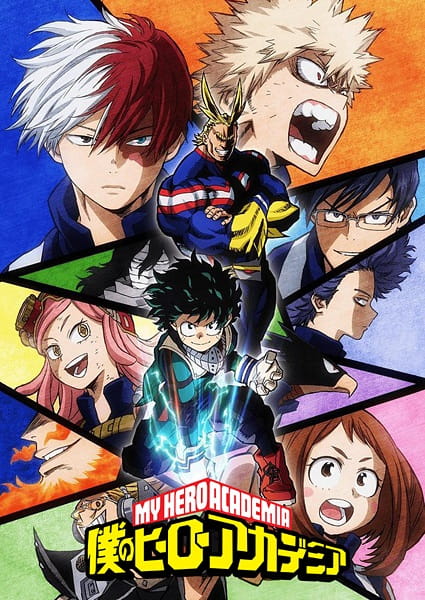

More from The Codex
The Seven Deadly Sins Is a 6.60 Wearing a 7.60 Costume: A One-Point Gap Earned by Groping Gags and Convenient Flashbacks
The Seven Deadly Sins scores 6.60 on the Codex against MyAnimeList's 7.60 because the crowd is grading a Netflix breakout and a Ban-and-King friendship, not the 24 episodes A-1 Pictures actually broadcast in 2014.
The 10.0 That Built a Sunday: How Sazae-san's Cultural Score Carries a 6.58 Scorecard
Sazae-san is a case study in how a single criterion — cultural — can define how a show is remembered, and the 10.0 the Codex hands Eiken's 1969 institution is doing every bit of the heavy lifting its other five scores refuse to.
The Sebastian Problem: Why Black Butler Sits 1.10 Below Its MAL Line and the Crowd Refuses to Notice
Black Butler (Kuroshitsuji) posts a 1.10-point gap between MyAnimeList's 7.65 and the Codex 6.55 because the crowd is grading Sebastian's silhouette and a Phantomhive aesthetic, not the anime-original finale A-1 Pictures actually shipped in 2009.
Discussion
Set a display name above to post.
Loading discussion…