The Hunter × Hunter (2011) Watch Order: One 148-Episode Spine and Two Movies the Rubric Won't Defend
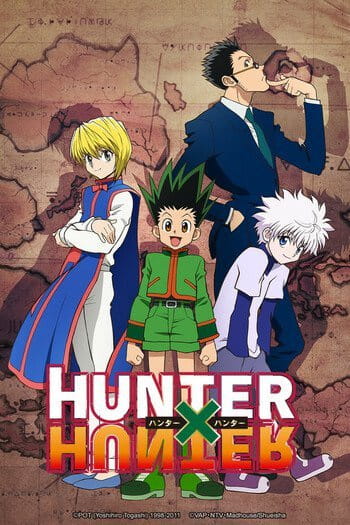
Franchise watch-order confusion is real; this lays out the [Hunter × Hunter (2011)](/shows/hunter-x-hunter-2011) entries in release order with what actually matters — the Madhouse TV run, and two 2013 films that don't.
Franchise watch-order confusion is real; this lays out the Hunter × Hunter (2011) entries in release order with what actually matters — the Madhouse TV run, and two 2013 films that don't.
The Hunter × Hunter (2011) franchise is one of the cleanest watch orders in modern shonen: a single TV production and two theatrical detours released in the same calendar year. The confusion isn't structural. It's that the two films sit in a canonicity limbo Togashi never endorsed, and viewers keep asking whether they slot into the Chimera Ant arc or precede it. They don't slot anywhere the rubric respects.
The Consensus, and Where It Frays
MyAnimeList puts the 2011 series at 9.03, which places it inside the platform's top tier and above almost every shonen it's genre-adjacent to. Anime Codex lands at 9.23 — one of the few cases where the Codex sits above the crowd rather than below it, because the rubric rewards what MAL undercounts: a 9.5 on story that survives the Chimera Ant arc's pacing risks, a 9.5 on character that stretches from Gon to Meruem to Morel, and a 9.5 on world-building that treats Hunter licenses, Nen categories, and the Dark Continent tease as one coherent system.
Where the discourse frays is the movies. Phantom Rouge and The Last Mission are treated by parts of the fandom as optional lore expansions, and by another part as skippable filler with Togashi's name attached to the character designs and nothing else. The rubric is closer to the second read, and this guide will say so plainly.
1. Hunter × Hunter (2011) — The Only Essential Entry
Madhouse's 148-episode run, directed by Hiroshi Kōjina, is the spine. Everything the Codex grades the franchise on lives here. The Hunter Exam introduces the show's structural trick — arcs that operate as self-contained genre experiments — and Heavens Arena converts a tournament frame into the Nen tutorial the rest of the series compounds interest on. Yorknew City is a heist arc that doubles as the Phantom Troupe's introduction and Kurapika's thematic center. Greed Island is a game arc that refuses to coast on its premise. Chimera Ant is the reason the story score sits at 9.5: sixty-one episodes of moral escalation that culminates in the Meruem–Komugi sequence, one of the strongest closed arcs in the medium, and the Election arc that follows is the rare shonen epilogue that actually interrogates its protagonist.
The animation score, 8.5, is the honest number. Madhouse's line quality is consistent rather than spectacular, and the Chimera Ant palace stretch leans on stills and voice performance — Rikiya Koyama's Netero, Nobunaga Shimazaki's Meruem, Hiroki Takahashi's Hisoka — more than on sakuga set pieces. The cultural score of 8.5 reflects a franchise whose footprint is real but whose reach is capped by Togashi's hiatus schedule and the anime's decision to stop at the Election arc rather than continue into Dark Continent material that doesn't exist in animated form.
This is essential. It is also the only entry in the franchise that clears the Codex's 9.0 threshold, and the gap between it and everything else with the Hunter × Hunter name on the poster is not narrow.
2. Hunter × Hunter: Phantom Rouge (2013) — Skippable
The first theatrical film, released in January 2013, is a Kurapika-adjacent side story set between Heavens Arena and Yorknew. Yūzō Satō directs; the Phantom Troupe features; Kurapika's backstory gets a partial retread. The problem is that the film's central conflict — a stolen pair of Scarlet Eyes, a former Kurta villager, a body-hopping antagonist — is invented for the movie and contradicts, or at minimum sits awkwardly against, the manga's Kurta lore. Togashi provided character designs. He did not write it.
For a franchise whose story score is 9.5 precisely because Togashi's structural instincts don't waste screen time, a ninety-minute detour that neither the manga nor the TV series references again is a rubric problem. It doesn't advance character in ways the Yorknew arc won't do better forty episodes later. It doesn't expand the world in ways the Chimera Ant or Election arcs won't do at higher fidelity. Skip it. If you're a completionist, watch it after Yorknew concludes on the TV side, so its retcons don't confuse the actual Kurta reveal.
3. Hunter × Hunter: The Last Mission (2013) — Skippable
The December 2013 film is a Netero-focused piece set at Heavens Arena, involving a shadow organization of Hunters expelled from the Association, and a villain named Jed whose grievance predates the current administration. Keiichirō Kawaguchi directs. The Zoldyck family appears. It is more competent than Phantom Rouge — the Netero material has genuine texture and the Killua–Illumi tension is at least on-model — but it remains structurally optional.
The Last Mission is closer to a well-produced OVA than to canon. Nothing it establishes about the Hunter Association's shadow history is referenced in the manga's ongoing Dark Continent arc, and the film's climax leans on a Netero setpiece that the TV series pays off more thoroughly in Chimera Ant. If you watch it, watch it after the Chimera Ant arc, when Netero's mythology is fully loaded and the film's stakes can borrow from that weight. This is a similar franchise-shape problem to the one that surfaces in the Demon Slayer watch order, where theatrical entries duplicate or sidestep TV material rather than extending it.
The Steelman: Movies as Character Texture
The strongest defense of Phantom Rouge and The Last Mission is that they give secondary and tertiary characters — Kurapika's past, Netero's Hunter Association politics, the Zoldycks in a non-Killua-centric frame — room the TV series doesn't allocate. This is true. It's also insufficient.
The rubric grades character at 9.5 because the TV run's 148 episodes already handle interiority at a density most shonen never approach. Kurapika's Yorknew arc is a character study that doesn't need a film-length prequel. Netero's death in Chimera Ant episode 121 doesn't need a Heavens Arena prologue. The films add texture; they don't add anything the TV production hasn't already priced into its own scorecard. Compare this to how JoJo's Bizarre Adventure uses part-to-part structure to redistribute character weight — Hunter × Hunter (2011) does that inside a single continuous production, and the movies are outside it.
Verdict
Watch the 148-episode Madhouse series. That's the franchise. Phantom Rouge and The Last Mission are 2013 theatrical releases whose canonicity is unofficial, whose character work duplicates ground the TV run covers at higher resolution, and whose absence from any subsequent Hunter × Hunter material — animated or manga — is the rubric's verdict rendered in negative space.
Featured in the Codex
More from The Codex
The Seven Deadly Sins Is a 6.60 Wearing a 7.60 Costume: A One-Point Gap Earned by Groping Gags and Convenient Flashbacks
The Seven Deadly Sins scores 6.60 on the Codex against MyAnimeList's 7.60 because the crowd is grading a Netflix breakout and a Ban-and-King friendship, not the 24 episodes A-1 Pictures actually broadcast in 2014.
The 10.0 That Built a Sunday: How Sazae-san's Cultural Score Carries a 6.58 Scorecard
Sazae-san is a case study in how a single criterion — cultural — can define how a show is remembered, and the 10.0 the Codex hands Eiken's 1969 institution is doing every bit of the heavy lifting its other five scores refuse to.
The Sebastian Problem: Why Black Butler Sits 1.10 Below Its MAL Line and the Crowd Refuses to Notice
Black Butler (Kuroshitsuji) posts a 1.10-point gap between MyAnimeList's 7.65 and the Codex 6.55 because the crowd is grading Sebastian's silhouette and a Phantomhive aesthetic, not the anime-original finale A-1 Pictures actually shipped in 2009.
Discussion
Set a display name above to post.
Loading discussion…