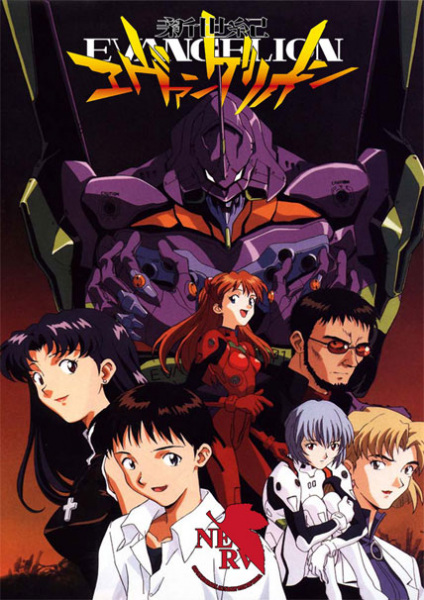
Neon Genesis Evangelion
Is Neon Genesis Evangelion worth watching?
Yes — a standout. Anime Codex rates Neon Genesis Evangelion 8.83 out of 10 — scored on six criteria (story, characters, themes, world-building, animation, and cultural impact), not crowd votes. 11th of 226 on the Codex rubric — top 5% of the catalogue. The Codex rates it Δ +0.46 above its MAL score — more underrated than 97% of the catalogue.
Where to watch
What the data says
Computed from the Codex rubric across the whole catalogue.
Summary
Neon Genesis Evangelion is arguably the most influential deconstruction of the mecha shonen, taking the giant-robot premise and turning it inward to examine trauma, depression, and the fear of human connection. Its greatest strength is character writing: Shinji, Asuka, Rei, and Misato are portrayed with a psychological candor rare in any demographic, and the show refuses the genre's usual arc of triumphant empowerment in favor of characters who struggle, regress, and only tentatively heal. Anno's direction wrings enormous tension from silence and stillness, and the biological horror of the Evas remains distinctive. Its weaknesses are real and well-documented: the SEELE conspiracy and much of the Angel mythology are left deliberately unresolved, the religious symbolism is atmospheric rather than systematic, and the infamous budget-starved final two episodes trade plot resolution for abstract introspection — a choice that is either visionary or frustrating depending on the viewer. Despite this, its thematic ambition and emotional honesty far exceed genre norms, and its cultural impact is nearly unmatched. It is not a clean or complete work, but it is a foundational one, essential viewing for understanding where modern anime's psychological and self-aware tendencies originated.
Criterion breakdown
Story & narrative
The monster-of-the-week Angel structure gradually inverts into a study of psychological collapse, with escalating stakes culminating in the Human Instrumentality Project. The narrative loses its footing in the final two episodes (25 and 26), which abandon plot resolution for abstract introspection due to Gainax's budget and Anno's mental state — a bold but divisive choice that leaves the SEELE conspiracy, Gendou's endgame, and the Angel mythology deliberately unresolved. Strong throughline, but the payoff is intentionally withheld.
Character writing & growth
Shinji's paralytic avoidance, Asuka's collapse from bravado into a self-worth crisis (peaking in her Unit-02 defeat in episode 22), Misato's performative maternal warmth masking her own trauma, and Rei's dissolving sense of self are rendered with rare psychological honesty for the demographic. Growth is not triumphant but excruciating and often regressive, subverting shonen's usual arc of empowerment. Few shonen titles commit this fully to characters who fail to overcome themselves.
Themes & emotional resonance
The hedgehog's dilemma, the fear of intimacy, depression, and the terror of being defined by others' expectations are woven directly into the mecha premise rather than layered on top. The AT Field literalizes emotional walls, and Instrumentality dramatizes the seductive death-wish of dissolving individual pain. The emotional resonance in Shinji's final self-acceptance ('congratulations') is genuine, though the abstraction dilutes its universal reach.
World-building & power system
Tokyo-3 as a retractable fortress-city, the biological horror of the Evas as living creatures rather than machines, and the LCL/sync-ratio mechanics are strikingly original within mecha. The dense Judeo-Christian and Kabbalistic iconography (Lilith, Adam, the Sephirot) is atmospheric rather than rigorously systematized, and much of the backstory is deliberately obscured. Internally coherent where it matters, but the mythology is more evocative texture than fully consistent system.
Animation & direction
Anno's direction is exceptional in its use of stillness, prolonged silences, telephone-pole shots, and repeated cuts to create discomfort and interiority — the elevator scene between Asuka and Rei is a masterclass in tension through inaction. Early Angel battles are fluidly animated, but the notorious budget collapse toward the end forces still frames, recycled footage, and text-on-black in the finale. Directorial genius partially undermined by production limitations.
Cultural impact
Evangelion permanently reshaped anime, deconstructing the mecha genre and inspiring decades of psychological and meta-aware works. Its imagery, merchandising empire, and the Rebuild films cement it as a foundational text, and its influence on creators from Bones to Trigger is inescapable. Few titles are as definitive of the medium's cultural footprint.
Synopsis (from MAL)
Fifteen years after a cataclysmic event known as the Second Impact, the world faces a new threat: monstrous celestial beings called Angels invade Tokyo-3 one by one. Mankind is unable to defend themselves against the Angels despite utilizing their most advanced munitions and military tactics. The only hope for human salvation rests in the hands of NERV, a mysterious organization led by the cold Gendou Ikari. NERV operates giant humanoid robots dubbed "Evangelions" to combat the Angels with state-of-the-art advanced weaponry and protective barriers known as Absolute Terror Fields. Years after being abandoned by his father, Shinji Ikari, Gendou's 14-year-old son, returns to Tokyo-3. Shinji undergoes a perpetual internal battle against the deeply buried trauma caused by the loss of his mother and the emotional neglect he suffered at the hands of his father. Terrified to open himself up to another, Shinji's life is forever changed upon meeting 29-year-old Misato Katsuragi, a high-ranking NERV officer who shows him a free-spirited maternal kindness he has never experienced. A devastating Angel attack forces Shinji into action as Gendou reveals his true motive for inviting his son back to Tokyo-3: Shinji is the only child capable of efficiently piloting Evangelion Unit-01, a new robot that synchronizes with his biometrics. Despite the brutal psychological trauma brought about by piloting an Evangelion, Shinji defends Tokyo-3 against the angelic threat, oblivious to his father's dark machinations. [Written by MAL Rewrite]
Ranked nearby




Explore rankings
Discussion
Set a display name above to post.
Loading discussion…