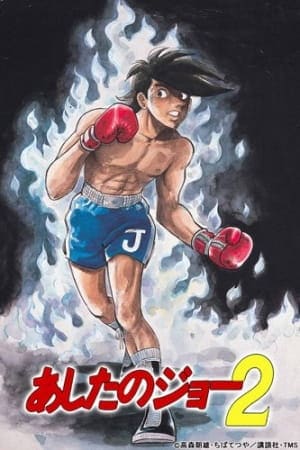
Ashita no Joe
Is Ashita no Joe worth watching?
Yes — a standout. Anime Codex rates Ashita no Joe 9.02 out of 10 — scored on six criteria (story, characters, themes, world-building, animation, and cultural impact), not crowd votes. 8th of 226 on the Codex rubric — top 4% of the catalogue. The Codex rates it Δ +0.19 above its MAL score — more underrated than 90% of the catalogue.
Where to watch
Trailer
What the data says
Computed from the Codex rubric across the whole catalogue.
Summary
Ashita no Joe (1980) is a landmark of shonen storytelling that, judged against the best of its demographic, ranks among the finest sports and coming-of-age dramas anime has produced. Continuing Joe Yabuki's saga after Rikiishi's death, it trades easy triumph for a tragic meditation on living intensely versus living long, anchored by Joe's psychological trauma and Carlos Rivera's harrowing decline into permanent brain damage — a mirror of the fate Joe courts. Osamu Dezaki's distinctive direction, with its freeze-frame postcard memories and stark shadow compositions, elevates limited-budget animation into something genuinely cinematic, while the grounded depiction of postwar slum poverty grants the boxing world real social texture. Its weaknesses are largely structural: across 47 episodes the pacing slackens through some mid-series bouts before the Mendoza climax, and the limited animation of the era shows its age. Yet the writing's refusal to flinch, its mature thematic ambition, and one of the most iconic endings in the medium's history make it definitive. Its cultural footprint — from real-life mourners at a fictional funeral to its adoption as a protest symbol — cements its status not merely as a great shonen, but as a foundational text of the entire form.
Criterion breakdown
Story & narrative
This 1980 continuation picks up after the death of Rikiishi and tracks Joe's psychological recovery through the Carlos Rivera arc and the climactic Mendoza bout, building inexorably toward one of the most famous endings in anime history. The narrative refuses the easy redemption arc — Joe's punch-drunk deterioration, his inability to throw the corkscrew blow after Rikiishi's death, and the looming threat of death-in-the-ring give the story a tragic gravity rare in shonen. It occasionally sags in pacing across its 47 episodes, with some mid-series bouts feeling like filler before the Mendoza confrontation.
Character writing & growth
Joe's arc from self-destructive drifter to a man fighting his own emptiness is extraordinary character writing — his guilt over Rikiishi, his bond with Yoko, Danpei's stubborn devotion, and especially Carlos Rivera's descent into brain damage all carry real weight. Carlos functions as a haunting mirror of Joe's possible fate, and Mendoza's quiet humanity elevates the final opponent beyond a mere obstacle. The supporting cast at the Doya district keeps Joe grounded, though some figures recede during the boxing-heavy stretches.
Themes & emotional resonance
The series interrogates living completely versus living long — Joe's desire to 'burn pure white' until nothing remains is articulated through his refusal to protect himself and his pursuit of a fatal intensity. Mortality, class poverty in the Doya slums, and the cost of devotion to a single passion run throughout, and the ending crystallizes these into an image of self-immolating fulfillment. The emotional resonance is unusually mature and uncompromising for its demographic.
World-building & power system
The setting depth is strong: postwar Japanese poverty, the cramped Doya-gai slums, and the grimy economics of professional boxing are rendered with social realism uncommon in shonen. Boxing itself is treated with internal consistency — weight-cutting, bantamweight politics, and the physiological toll of repeated head trauma are plot-critical rather than decorative. It lacks the fantastical originality some genre peers offer, but its grounded authenticity is its own form of distinctiveness.
Animation & direction
Director Osamu Dezaki's signature postcard memory freeze-frames, harsh shadow work, and dramatic split-screen compositions give the boxing sequences and emotional beats a striking stylization that defined an era. The fight choreography conveys impact through pose and shadow rather than fluid motion, an economical approach that mostly succeeds. By modern standards the limited animation shows its age, with reused cuts and occasional stiffness, but the direction consistently transcends the budget.
Cultural impact
Ashita no Joe is among the most culturally significant works in Japanese pop history — Rikiishi's funeral drew real mourners, and Joe became a symbol for the 1970s student protest generation and the Japanese Red Army. The final image of Joe slumped in his corner is one of the most iconic frames in all of anime, endlessly referenced and parodied. Its influence on every subsequent sports and underdog narrative is immeasurable.
Synopsis (from MAL)
Yabuki Joe is left downhearted and hopeless after a certain tragic event. In attempt to put the past behind him, Joe leaves the gym behind and begins wandering. On his travels he comes across the likes of Wolf Kanagushi and Goromaki Gondo, men who unintentionally fan the dying embers inside him, leading him to putting his wanderings to an end. His return home puts Joe back on the path to boxing, but unknown to himself and his trainer, he now suffers deep-set issues holding him back from fighting. In attempt to quell those issues, Carlos Rivera, a world renowned boxer is invited from Venezuela to help Joe recover.
Ranked nearby
Explore rankings
Discussion
Set a display name above to post.
Loading discussion…