The Demon Slayer Watch Order: One TV Spine, One Recap Movie You Can Skip, and a Trilogy Ufotable Hasn't Finished
Franchise watch-order confusion is real; this lays out the Demon Slayer: Kimetsu no Yaiba entries in release order with what actually matters — the ufotable TV spine, the Mugen Train duplication problem, and the Infinity Castle trilogy still in progress.
Franchise watch-order confusion is real; this lays out the Demon Slayer: Kimetsu no Yaiba entries in release order with what actually matters — the ufotable TV spine, the Mugen Train duplication problem, and the Infinity Castle trilogy still in progress.
The Demon Slayer franchise has a duplication problem no one wants to name: Mugen Train exists twice, in two forms, and both are canon in the sense that ufotable produced them and Aniplex sold them. That fact alone accounts for most of the confusion around how to watch Demon Slayer: Kimetsu no Yaiba in order. The rest is the standard shonen-franchise sprawl — arc-titled TV seasons, a theatrical finale split into three parts — and it resolves cleanly once you accept that release order and viewing order are, for once, the same thing.
The consensus position and where it thins out
MyAnimeList sits the 2019 TV series at 8.40, and the discourse around the franchise treats that number as the ceiling for the property. Anime Codex scores the same entry at 7.15, and the 1.25-point gap is where this guide actually lives. The crowd is grading Akaza's silhouette in the Mugen Train film, the Rengoku funeral scene, and ufotable's compositing pipeline. The rubric is grading a 6.8 story, a 6.5 on character, and a 7.0 on themes — a Gotouge structure that leans on set-piece animation to carry a protagonist whose arc is largely reactive. The same pattern shows up in the One Punch Man scorecard, where sakuga does most of the rhetorical work the writing doesn't quite finish, and in the Naruto gap, where one arc's reputation carries the memory of an entire run.
None of that changes the watch order. It only changes what you're being asked to watch for.
The Demon Slayer: Kimetsu no Yaiba watch order, in release order
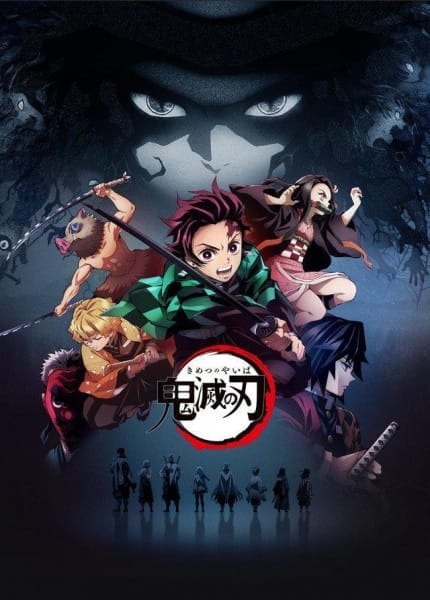
The 2019 TV series is the entry point and there is no version of this franchise you can start elsewhere. Twenty-six episodes, ufotable, directed by Haruo Sotozaki, covering Tanjiro's recruitment through the Natagumo Mountain arc and the Final Selection aftermath. Essential. This is the Codex 7.15 entry — the story score of 6.8 reflects a first cour that spends real time on the charcoal-seller framing and a second cour that leans harder on Nezuko-as-weapon than the writing can quite justify, but the Rui fight in episode 19 is the sequence that made the franchise's reputation and it earns the animation weight.
The 2020 theatrical film, Mugen Train, adapts the arc immediately following the TV series. It is essential in narrative terms and skippable in practice, because the 2021 TV recut of the same material — the seven-episode Mugen Train Arc — exists and adds a full prologue episode from Rengoku's perspective that the film does not contain. Watching both is redundant. If you want the theatrical grade of Akaza's fight with Rengoku, watch the film. If you want the fuller Rengoku characterisation before the train boards, watch the TV version. Watching both back to back means seeing the same six episodes of content twice with minor compositing differences. The rubric-honest answer: pick one, and the TV cut is the more complete artifact.
The Entertainment District Arc, eleven episodes in late 2021, is the strongest sustained stretch of the franchise on animation alone. Nakime, Daki, Gyutaro, and the Uzui three-wives dynamic push the character score above where the first season sits, and the episode 10 Sound Hashira set-piece is the ufotable production at its clearest peak. Essential. Skip nothing.
The Swordsmith Village Arc, eleven episodes in 2023, is where the seams show. Muichiro and Mitsuri get the material the series has been withholding from its Hashira roster, and the Hantengu multi-body fight is a compositing showcase — but the arc's pacing problem is real, and the story score for the franchise doesn't move because two Upper Moons are dispatched by a mechanism (dawn) the writing had already established. Essential for continuity, weakest for craft.
The Hashira Training Arc, eight episodes in 2024, is the entry the franchise's defenders quietly concede is a bridge. It exists to move characters into position for Infinity Castle. There is one Muzan-Tanjiro confrontation at the end that matters, and seven episodes of training montages that don't. Essential only because the Infinity Castle trilogy opens directly on its final scene.
Infinity Castle, the 2025 theatrical film, is the first of three planned features adapting the manga's final arc. Essential, and the current terminus of what's actually watchable. Infinity Castle Part 2 and Mugenjou-hen Movie 3 are the announced second and third entries of the trilogy — neither has released as of this writing, and the franchise's ending exists only in Gotouge's manga until they do. Treat entries eight and nine on this list as placeholders for a viewing plan, not as content you can currently sit through.
What this means practically
Nine release entries, seven of them currently watchable, one of them (Mugen Train) duplicated across two formats you should not both consume. That leaves six sittings: the 2019 TV series, one Mugen Train version, Entertainment District, Swordsmith Village, Hashira Training, and Infinity Castle. Everything else is either a re-cut or an unreleased sequel. Compared to the Gintama watch order, where fifteen entries genuinely require triage across specials and recap films, Demon Slayer's franchise map is disciplined. Ufotable has not produced side stories, filler OVAs, or non-canonical films. The confusion is entirely about the Mugen Train duplication and the Infinity Castle split.
The counter-argument
The steelman for watching both Mugen Train versions is that the theatrical cut is the definitive artifact — the version that broke Japanese box-office records and reset what a shonen film could earn — and the TV recut is a merchandising exercise. That case is coherent. The film's grading, sound mix, and pacing are calibrated for a cinema, and the TV version's episodic breaks disrupt the Enmu-to-Akaza structural handoff the film treats as one movement. The rubric reads it differently because the TV recut adds the Rengoku prologue episode, and that episode does more character work for the Flame Hashira than the film's flashbacks manage in their compressed form. Character score is where this franchise is weakest — 6.5 — and any version that strengthens it is the version the rubric prefers.
Verdict
Watch the 2019 TV series, then the Mugen Train TV recut (not the film), then Entertainment District, Swordsmith Village, Hashira Training, and Infinity Castle in release order. The Codex 7.15 is what it is because story and character underperform the animation ufotable ships, and no watch order fixes that — but this one at least stops you paying for the same six episodes twice.
Featured in the Codex



More from The Codex
The Seven Deadly Sins Is a 6.60 Wearing a 7.60 Costume: A One-Point Gap Earned by Groping Gags and Convenient Flashbacks
The Seven Deadly Sins scores 6.60 on the Codex against MyAnimeList's 7.60 because the crowd is grading a Netflix breakout and a Ban-and-King friendship, not the 24 episodes A-1 Pictures actually broadcast in 2014.
The 10.0 That Built a Sunday: How Sazae-san's Cultural Score Carries a 6.58 Scorecard
Sazae-san is a case study in how a single criterion — cultural — can define how a show is remembered, and the 10.0 the Codex hands Eiken's 1969 institution is doing every bit of the heavy lifting its other five scores refuse to.
The Sebastian Problem: Why Black Butler Sits 1.10 Below Its MAL Line and the Crowd Refuses to Notice
Black Butler (Kuroshitsuji) posts a 1.10-point gap between MyAnimeList's 7.65 and the Codex 6.55 because the crowd is grading Sebastian's silhouette and a Phantomhive aesthetic, not the anime-original finale A-1 Pictures actually shipped in 2009.
Discussion
Set a display name above to post.
Loading discussion…