Dorohedoro at 7.51: The Codex's Most Beautiful Almost-Masterpiece, Stranded Mid-Sentence
Q Hayashida built a world weirder than anything in modern seinen and MAPPA gave it twelve episodes — Dorohedoro is the rare anime where what's missing aches more than what's there.
Q Hayashida built a world weirder than anything in modern seinen and MAPPA gave it twelve episodes — Dorohedoro is the rare anime where what's missing aches more than what's there.
Dorohedoro is a 7.51 that should have been a 9, and that gap — between what Q Hayashida drew across twenty-three volumes and what MAPPA managed to fit into twelve episodes — is the most quietly mournful thing in the Codex catalogue. The show is hooked into your attention from its first minute and then taken away from you before it has finished introducing itself. You don't leave it satisfied. You leave it bereaved.
The Consensus on Dorohedoro Is Politely Wrong
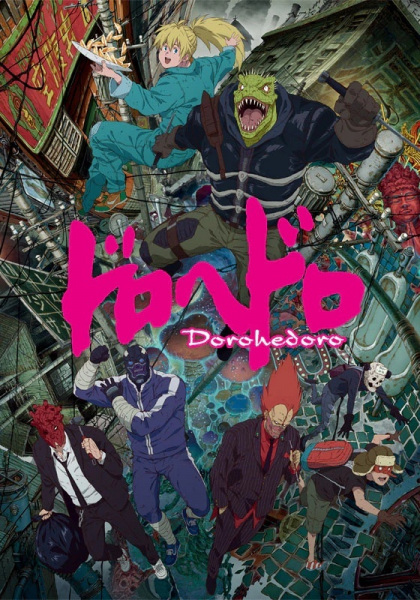
The Wikipedia entry pulls a respectable 2,400 monthly views, which tells you exactly what kind of cult this is: steady, returning, never viral. The five top-of-week Reddit posts in the current cycle are all variations on the same beat — first-time watchers finishing the Netflix run, asking what to read next, asking whether Caiman's identity ever gets answered. None of them are trending discourse. Dorohedoro sits permanently outside the rotating Top 50 conversation, gas-masked and patient, while Jujutsu Kaisen and Chainsaw Man burn through their news cycles.
AniList parks it at 79/100, which is the score a show gets when nobody wants to argue about it. The consensus take — "weird, fun, gory, the OP slaps" — flattens what Hayashida actually built. This is a seinen with a power system tied to personal psychology, a world that refuses every fantasy template the genre has ever defaulted to, and a tonal control most directors would kill for. Calling it the gas mask show is accurate and an insult at the same time.
The Caiman Hook Is the Most Original Premise of Its Decade
From the first scene you are hooked. Caiman swallows a Sorcerer's head whole, and the head, somehow alive inside his reptilian mouth, speaks to a second presence in there — a man Caiman cannot see, cannot remember, and cannot identify. Caiman spits the Sorcerer back out and asks, every time, the same question: what did the guy inside my head say? They never tell him. He kills them. He moves on to the next.
That is the engine. It is one of the most genuinely original premises in modern seinen, and it does the impossible thing of being a mystery box that earns its withholding because the withholding is the character. Caiman isn't searching for a MacGuffin; he is searching for the part of himself that has been edited out and shoved into his own throat. The Sorcerer/Hole dual narrative — En's mushroom-fueled hot pot dinners on one side, Caiman and Nikaido grinding through gyoza shifts and head-chomping on the other — runs in parallel until the geometry of the two worlds starts to collapse inward. Hiroshi Seko's series composition handles the cross-cutting with real discipline.
And then the season ends. Mid-arc. After the Curse-Devouring tournament, with Caiman's identity still locked, with the second man inside him still silent. Twelve episodes adapting a 23-volume manga is not adaptation; it is a trailer with a budget.
The World Is a 9.2 and Everything Else Is Just Standing In It
The world score is where the rubric stops hedging. Hole is one of the most distinctively realized settings in shonen-adjacent television — a grimy, rain-soaked underclass district where Sorcerers descend from their pastel dimension to test new spells on human bodies. The Smoke system, where every Sorcerer's magic manifests as a personalized output tied directly to their psychology — Shin's hammer-hands, Noi's healing touch, En's mushroom proliferation, Ebisu's spray paint — is one of the more elegant power frameworks the genre has produced.
It is not, however, as exhaustively engineered as what Togashi did with Nen. The architecture is there, but the show doesn't have the runtime to stress-test it the way Hunter × Hunter does across Chimera Ant and the Election arc, and it doesn't get the systematic taxonomy treatment that Jujutsu Kaisen's cursed-energy logic eventually formalizes. The bones are stronger than either. The flesh just hasn't grown over them yet.
Shinji Kimura's art direction earns every point. The blood-splattered restaurant interiors, the reptilian masks, the way En's mansion looks like a David Lynch fever filtered through Moebius — none of this resembles anything else airing in 2020.
The CG Is the Compromise the Show Could Not Avoid
MAPPA's full-CG approach is the load-bearing controversy. It does what cel animation could not have afforded — Shin and Noi's hospital raid is fluidly choreographed in a way traditional keyframe work would have ruined the budget on — but the textures look plasticky, the backgrounds lack the hatched filth of Hayashida's pages, and the character models occasionally drift into uncanny stiffness during dialogue. Kinichi Tsugawa's direction holds the tonal weirdness together — the cheerful violence, the hot pot scenes immediately after a beheading — and Yuuki Hayashi's brass-forward OST does heavier lifting than the visuals.
But the fights, for all their fluidity, are not memorable. They are violent. There is a difference. Nothing in the twelve episodes hits the way the Shibuya Incident hits, or the way Gon's transformation hits, or the way even a mid-tier Demon Slayer setpiece hits. The animation is 7.0 because the action is competent and the texture work isn't. The fights pass through you.
Counter-Argument: The Show Is Complete Enough on Its Own Terms
The strongest defense of Dorohedoro at twelve episodes is that the manga's mystery was never going to land cleanly anyway — Hayashida's plotting becomes structurally baroque in the late volumes, and the anime cutting off at the tournament leaves viewers with the show at its tonal peak rather than dragging them through the back-half reveals. Better a perfect prologue than a botched conclusion, the argument goes. Look at what happened when Attack on Titan tried to deliver its ending in full.
The rubric doesn't buy it. A 12-episode prologue to a 23-volume work is not a complete artistic statement; it is a Netflix deal. The themes score sits at 6.8 precisely because identity, dehumanization, and found-family-through-food are all introduced and none of them are paid off. A second season aired in 2026 and a third has been announced, which means the work of completion is now happening — but the standalone 2020 run, judged as the object it was when it aired, is structurally incomplete.
Verdict
Dorohedoro is the Codex's most wistful score: a 7.51 that mourns the 9 it could have been if MAPPA had been given the runtime Hayashida's world deserved. The premise is original, the setting is unmatched in its decade, the chemistry between Caiman and Nikaido is the warmest thing in seinen — and the fights are just violence, the themes are just gestures, and the ending is just a pause. You finish it curious about who Caiman is. You were supposed to finish it knowing.
Featured in the Codex
More from The Codex
Slam Dunk at 8.12: The 6.8 on Animation That Decides How Toei's Basketball Landmark Gets Remembered
Slam Dunk earns 9.5 on cultural impact and 9.0 on character, but Toei's 1993 production caps it at 8.12 — and the gap between manga and adaptation is measured in still frames.
The Promised Neverland Review: An 8.18 That Lives on Story and Direction, and Loses Ground on World and Legacy
Judged against one consistent rubric, The Promised Neverland is best understood by which criteria carry it and which drag it down — not by a single number.
Anime Like Re:Zero: 5 the Codex Rubric Says You'll Love
Fans of Re:Zero respond to its strongest criteria — character at 9.0, cultural weight at 9.0, story and themes at 8.5 — and these five picks deliver the same qualities, ranked by how close their critical profile sits to it, not by vibes.
Discussion
Set a display name above to post.
Loading discussion…


