Hunter × Hunter (2011) Is Not Underrated — It's Misfiled
The connoisseur's shonen earns its 9.20 not because Chimera Ant is great television, but because Togashi built a worldbuilding apparatus most of the genre still can't approach.
The connoisseur's shonen earns its 9.20 not because Chimera Ant is great television, but because Togashi built a worldbuilding apparatus most of the genre still can't approach.
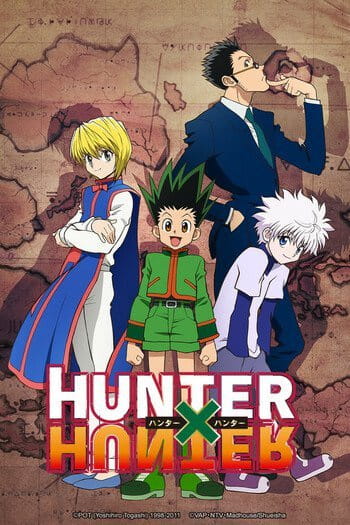
Calling Hunter × Hunter (2011) "underrated" is the laziest possible critical posture toward it — a show sitting at 9.04 on MyAnimeList, perpetually cited as the high-water mark of serialized shonen, cannot meaningfully be underrated. The honest question isn't whether HxH is good. It's whether the reasons people love it are the right reasons, and whether a 9.20 score holds up once you strip away the Chimera Ant mythologizing and audit the show criterion by criterion.
The Consensus Misreads Its Own Favorite Show
Ask whether Hunter × Hunter (2011) is good in any anime forum and you'll get a chorus pointing at the Chimera Ant arc, Meruem's death, the rooftop scene, Gon's transformation. That's not wrong, but it's a thin reading. The community framing treats HxH as a show that ascends from "fun shonen" to "masterpiece" somewhere around episode 90 — as if the Hunter Exam and Yorknew were a warm-up act for the real series. This is backwards. The Hunter Exam is one of the most efficient tournament-shonen openings ever produced, Yorknew is a heist thriller that would work as a standalone crime anime, and Greed Island is the rare arc that takes its own power system seriously enough to break it apart and rebuild it. Anime Codex scores the show 9.20, and the load isn't carried by Chimera Ant alone. It's carried by the fact that Togashi wrote four structurally different arcs and Madhouse, under Hiroshi Kōjina's direction, made all four legible.
The departure from consensus is this: the show's ceiling isn't its story (9.5, high but not the apex) — it's its worldbuilding, at 9.7. That number is the spine of the score, and almost nobody talks about it correctly.
Nen Is the Best Power System in Shonen, and It's Not Close
The worldbuilding criterion scores 9.7 because Nen is engineered, not invented. The six categories are not flavor — they constrain fights mechanically. Vows and restrictions make stronger Hatsu purchasable only at narrative cost. Specialization is rare precisely because the system says it must be. This is why the Kurapika vs. Uvogin fight in Yorknew works: Kurapika wins by stacking vows so severe they will kill him, and Togashi makes you understand the equation before the punch lands. It's why Knuckle's A.P.R. — a loan-shark Hatsu that lends aura at interest — is more interesting than any sword-beam in the genre. It's why Morel's smoke soldiers feel like a profession rather than a power.
Compare this to the elastic, retconnable "I just unlocked a new mode" systems most Jump titles run on. Nen fights are won by ingenuity inside published rules, which is the highest compliment you can pay a shonen power system. The Hunter Association politics, the Zodiacs, the V5, the Dark Continent expedition teased in the post-Election epilogue — all of it implies an institutional world that exists when the protagonists aren't looking at it. Few shonen even attempt this.
Character Work That Indicts Its Own Protagonist
The character criterion at 9.4 is where Togashi separates himself from his peers. Gon is not a hero you outgrow caring about — he's a hero the show itself eventually frames as the problem. His cheerfulness is recoded across the Chimera Ant arc as a kind of moral tunnel vision, and the Pitou confrontation in episode 131 is the payoff: Gon's transformation isn't power-up triumph, it's a child immolating himself out of unmediated rage. The narrative treats this as horror.
Killua is the actual protagonist by the end of Chimera Ant, and his arc — Illumi's needle, the Zoldyck estate, Alluka, the moment he chooses Gon over his family by choosing to leave Gon — is the most coherent character through-line in the series. Meruem and Komugi's gungi sessions, culminating in the rooftop death scene directed by Kōjina with deliberate, near-still pacing, do what most shonen villain arcs only gesture at: they make the antagonist's interior the emotional center of the climax. The score isn't a 9.7 here because Kurapika and Leorio effectively vanish after Yorknew, and the Phantom Troupe — Chrollo, Hisoka, Feitan, Shizuku — remain iconic silhouettes more than fully realized people. That's a real cost, and the rubric reflects it.
The Animation Score Is the Honest One
Here's where Anime Codex parts company with the fan consensus most sharply. Animation scores 8.3, not higher, and that's correct. Madhouse's work on Heavens Arena (Gon vs. Hisoka), the Yorknew auction night, and the Royal Guard sequences — Netero vs. Meruem especially, with its Zero Hand choreography — is genuinely first-rate. But the Chimera Ant arc, the arc most often cited as the show's animation peak, leans heavily on still frames, pan-overs, and extended narration to mask production strain. Episodes in the 120s in particular substitute Yoshihiro Tomita's narration for motion. This is a directorial save, not an animation triumph, and pretending otherwise inflates the show beyond what's on screen. The 8.3 is a feature of the rubric, not a flaw — it's what keeps the 9.20 honest.
The Strongest Case Against the Score
The serious counter-argument is pacing. Chimera Ant's narration in the back half is not a stylistic choice everyone accepts — for many viewers it's a structural failure, an arc that loses faith in its own ability to show events and starts telling them instead. The Election arc that follows is a tonal whiplash, more political procedural than emotional resolution, and the series simply stops rather than ends. If you score story purely on execution rather than ambition, 9.5 is defensible only if you accept that ambition counts. A stricter reading would dock the story criterion a full point for the narration crutch alone, and the show's overall score would slide toward the high 8s.
The rubric rejects this because cultural impact (8.5) and worldbuilding (9.7) are weighted to capture what a show contributes to its genre, not just how cleanly it executes its own runtime. HxH's influence on Jujutsu Kaisen's cursed-technique specificity, on Chainsaw Man's antagonist interiority, on the entire post-2015 wave of shonen that takes power-system rigor seriously, is a real and measurable contribution. The narration is a flaw. It is not a disqualifying one.
A 9.20 is not a generous score for Hunter × Hunter (2011) — it's a precise one, the number you arrive at when you refuse to let Chimera Ant alone do the work and refuse to let the narration problem off the hook. The show is the connoisseur's shonen because it earns the title on the mechanics, not the mythology. Anyone telling you it's underrated hasn't actually checked the math.
Featured in the Codex
More from The Codex
The Seven Deadly Sins Is a 6.60 Wearing a 7.60 Costume: A One-Point Gap Earned by Groping Gags and Convenient Flashbacks
The Seven Deadly Sins scores 6.60 on the Codex against MyAnimeList's 7.60 because the crowd is grading a Netflix breakout and a Ban-and-King friendship, not the 24 episodes A-1 Pictures actually broadcast in 2014.
The 10.0 That Built a Sunday: How Sazae-san's Cultural Score Carries a 6.58 Scorecard
Sazae-san is a case study in how a single criterion — cultural — can define how a show is remembered, and the 10.0 the Codex hands Eiken's 1969 institution is doing every bit of the heavy lifting its other five scores refuse to.
The Sebastian Problem: Why Black Butler Sits 1.10 Below Its MAL Line and the Crowd Refuses to Notice
Black Butler (Kuroshitsuji) posts a 1.10-point gap between MyAnimeList's 7.65 and the Codex 6.55 because the crowd is grading Sebastian's silhouette and a Phantomhive aesthetic, not the anime-original finale A-1 Pictures actually shipped in 2009.
Discussion
Set a display name above to post.
Loading discussion…