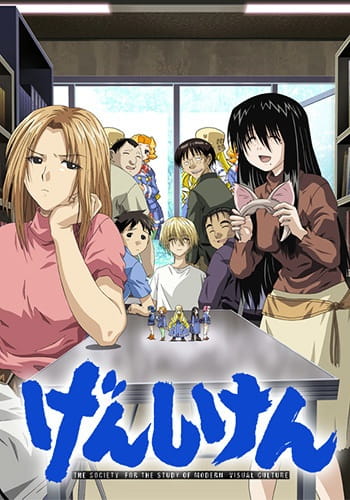
Genshiken
Is Genshiken worth watching?
Yes, it's worth watching. Anime Codex rates Genshiken 7.53 out of 10 — scored on six criteria (story, characters, themes, world-building, animation, and cultural impact), not crowd votes. 85th of 226 on the Codex rubric — top 38% of the catalogue. The crowd rates it 0.10 higher than the rubric does — the Codex is harder on it than on 22% of the catalogue.
Where to watch
What the data says
Computed from the Codex rubric across the whole catalogue.
Summary
Genshiken stands as one of the most authentic and affectionate portraits of otaku subculture ever animated, valuable precisely because it neither mocks nor idealizes its cast. Its strengths lie in character writing and setting depth: Sasahara's quiet journey from denial to self-acceptance, Madarame's painfully relatable social paralysis, and Saki's role as a skeptical outsider give the ensemble real texture, while the granular depiction of doujinshi creation, Comiket, and club hierarchy reads like field research. The result is warm, low-key, and unusually honest about the comfort of finding one's people. Its weaknesses are structural and technical. The narrative is deliberately plotless, and the 12-episode season ends without much resolution, functioning as a slice of a larger story rather than a self-contained arc. Kousaka remains a flat device, and the emotional register stays gentle rather than reaching the depth of the strongest seinen dramas. Palm Studio's modest, flat animation does the job but never elevates the material. Judged against the best slice-of-life seinen, Genshiken is a sincere, culturally significant, character-driven comfort show held back by minimal stakes and unremarkable production — notable for what it documents and how kindly it does so, rather than for ambition or polish.
Criterion breakdown
Story & narrative
The narrative is deliberately low-stakes, following the rhythms of club life across a school year — Comiket trips, doujinshi creation, the cosplay arc, and the steady erosion of Sasahara's denial about his own otaku identity. This episodic, slice-of-life structure suits the material and earns genuine warmth, but it lacks a strong dramatic spine; the first season ends without much resolution, feeling more like a slice extracted from the manga than a complete arc. The Comiket and self-published doujinshi episodes are the strongest, giving the show concrete forward momentum it otherwise lacks.
Character writing & growth
The ensemble is the show's true engine. Sasahara's quiet shift from embarrassment to acceptance is understated and believable, while Madarame functions as the comic and tragic heart — his crush on Saki, never spoken, is one of the most honest portrayals of otaku social paralysis in the medium. Saki's role as the outsider lens is essential, and her gradual, grudging tolerance (rather than full conversion) shows restraint; Kousaka, however, stays a static archetype, the unflappably handsome hardcore otaku used more as a device than a developing person.
Themes & emotional resonance
Genshiken's central theme — the search for belonging and the negotiation between an authentic self and social shame — is rendered with rare empathy and zero condescension toward its subjects. It refuses to either mock otaku or glorify them, instead treating fandom as an ordinary human refuge, embodied in Sasahara's denial and Saki's friction with Kousaka. The emotional resonance is gentle rather than profound, which caps its ceiling, but its sincerity about subculture identity is genuinely affecting.
World-building & power system
As setting depth, this is exceptional: the clubroom, the doujinshi production pipeline, Comiket logistics, figure collecting, and the social hierarchy of fandom are depicted with documentary-grade specificity and internal consistency. The premise — an unglamorous, accurate portrait of early-2000s otaku culture from the inside — was genuinely original for its time. Few shows commit so fully to the granular texture of a subculture as both backdrop and subject.
Animation & direction
Palm Studio's production is functional but modest, with flat color work, limited animation, and few visually ambitious moments — appropriate for a dialogue-driven comedy but unremarkable. Direction wisely centers character reactions and conversational timing, and the cosplay episodes get slightly more visual care, but the show never uses its medium expressively. It is the weakest pillar, serviceable rather than distinctive.
Cultural impact
Genshiken became something of a touchstone for otaku self-representation, beloved for portraying fandom with accuracy rather than caricature, and it helped popularize the affectionate insider-otaku comedy. Its influence is felt in later subculture works, and the term and characters retain recognition among fans, though its reach remains niche compared to genre-defining seinen titles.
Synopsis (from MAL)
Kanji Sasahara is an introverted college freshman just looking for a place to fit in. One day, he happens to stumble upon the club known as the Society for the Study of Modern Visual Culture—otherwise known as Genshiken—that serves to bring the full spectrum of otaku culture together. His first visit to the club, however, does not end well as Sasahara's pride is crushed by his senior, Harunobu Madarame, and he leaves the meeting in full denial of his otaku nature. However, after befriending club member Makoto Kousaka, who turns out to be a hardcore otaku despite his looks, Sasahara becomes more involved with club activities which include obsessing over their favorite anime, reading doujinshi, and attending conventions. There, he meets other interesting people like Kousaka's vehemently non-otaku girlfriend Saki Kasukabe, who strives to turn her boyfriend into a "normal guy." While Saki struggles to understand otaku culture and her boyfriend's love for it, Sasahara finds himself enjoying his time at Genshiken, gradually shedding any denial he once had about being an otaku and immersing himself in an otaku lifestyle. [Written by MAL Rewrite]
Ranked nearby



Explore rankings
Discussion
Set a display name above to post.
Loading discussion…