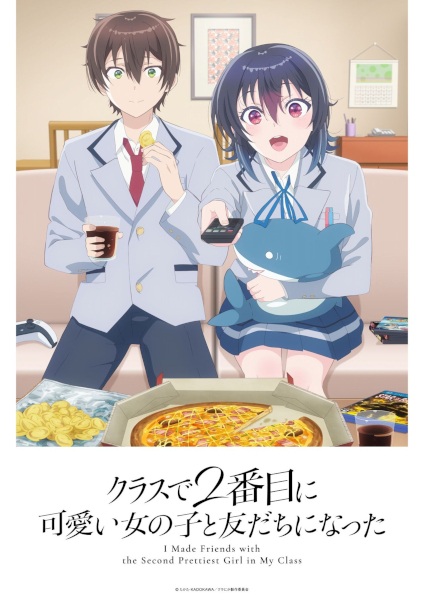
I Made Friends with the Second Prettiest Girl in My Class
Is I Made Friends with the Second Prettiest Girl in My Class worth watching?
Worth a look. Anime Codex rates I Made Friends with the Second Prettiest Girl in My Class 7.38 out of 10 — scored on six criteria (story, characters, themes, world-building, animation, and cultural impact), not crowd votes. 104th of 226 on the Codex rubric — top 46% of the catalogue. The crowd rates it 0.55 higher than the rubric does — the Codex is harder on it than on 50% of the catalogue.
Where to watch
Trailer
What the data says
Computed from the Codex rubric across the whole catalogue.
Summary
I Made Friends with the Second Prettiest Girl in My Class is a quietly confident entry in the seinen comfort-romance space, notable for refusing the harem and escalation tropes its premise could have invited. Its central strength is the relationship between socially anxious Maki and the wonderfully unglamorous Asanagi, whose decision to protect their hidden Friday ritual gives the show a genuine thematic spine: that being unseen by the world can be sanctuary rather than shame. Connect's warm, food-detailed direction and Asanagi's expressive face-acting sustain episodes that often have little plot, and the back third's tension around Amami and exposure earns real emotional payoff. The weaknesses are clear: a saggy midsection that recycles comfort beats, an underwritten Amami who serves as obstacle more than person, conservative visuals that occasionally show budget strain, and a finale that opts for reassurance over the harder question its 'messy' framing raises. It is not definitive of its genre, but within the well-trodden slice-of-life romance mold it executes with unusual restraint and sincerity. A good, gently flawed show that rewards viewers seeking intimacy over incident, and a strong example of doing a familiar premise with care.
Criterion breakdown
Story & narrative
The premise wisely sidesteps harem mechanics by anchoring the narrative in the low-stakes intimacy of weekly Friday hangouts, letting episodes breathe through small rituals—pizza, co-op games, shared manga—rather than contrived romantic escalation. The slow-burn structure pays off in the back third when Amami's 'cutest girl' presence introduces genuine tension about whether Maki and Asanagi's hidden time can survive exposure, but the show stumbles in its midsection with two filler-feeling episodes that recycle the same comfort beats without advancing anything. It resolves warmly but predictably, never quite risking the messiness its own framing promises.
Character writing & growth
Asanagi is the standout—her choice to spend Fridays away from her best friend is given real interiority rather than treated as mere quirk, and the show lets her be unglamorously herself (sprawled out, junk-food sated) in a way that earns the 'messy to the outside world' thesis. Maki's social anxiety is rendered with restraint instead of comedic exaggeration, and his gradual willingness to be perceived is the emotional spine. Amami, however, is underwritten, functioning more as a structural obstacle than a person until very late.
Themes & emotional resonance
The show's strongest idea is that being unseen by the world can be a refuge rather than a tragedy—the 'hidden time' is framed as something worth protecting, not escaping. It resonates most in quiet scenes where neither character performs for anyone, capturing a specific loneliness-into-belonging arc that seinen comfort dramas often gesture at but rarely sustain. It pulls its punches near the end, opting for reassurance over the harder question of whether such private worlds can endure adulthood.
World-building & power system
Read as setting depth, the show invests heavily in the texture of Maki's home as a sanctuary—the specific clutter, the worn game controllers, the recurring food rituals build a believable, lived-in space. The classroom social hierarchy ('second cutest,' 'cutest') is a sharp, recognizable observation of high-school status economies, though the show never interrogates it beyond using it as a label. Originality is modest; the premise is a refinement of a familiar slice-of-life mold rather than a genuinely new one.
Animation & direction
Connect delivers warm, soft-lit interiors that make the Friday apartment feel tactile, with strong attention to food animation and the small physical comedy of two people lounging. Director's choices favor static, lingering shots and naturalistic pacing that suit the intimacy, and Asanagi's expressive face-acting carries scenes that have no plot to lean on. The palette is consistent but visually conservative, and a couple of episodes betray budget conservation with held frames and repeated layouts.
Cultural impact
A solid 7.93 from 130k members signals strong reception within the comfort-romance niche, and its title became something of a meme shorthand for the 'second girl wins' subgenre conversation. Its impact is real but contained to seasonal slice-of-life discourse rather than broad cultural penetration, and it arrives in a crowded field of similar low-stakes romances without decisively redefining the form.
Synopsis (from MAL)
I, Maehara Maki, struggled to connect with anyone during my high school years, finding it hard to make friends. Then, a turning point arrived. A girl named Asanagi entered my life. Despite being clandestinely referred to as the "second cutest girl in class" by the boys, she chose to spend her Fridays with me instead of her best friend Amami, who held the "cutest girl in class" title. In the comfort of my home, we delved into the realm of games, watched movies, immersed ourselves in manga, indulged in junk food—pizza, hamburgers—and guzzled cola, carefree and content. To the outside world, we might have seemed a bit messy, but to both Asanagi and me, it was a cherished, hidden time together. (Source: MAL News)
Ranked nearby




Explore rankings
Discussion
Set a display name above to post.
Loading discussion…