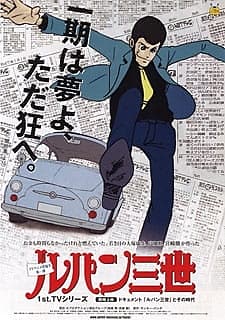
Lupin III Part 1
Is Lupin III Part 1 worth watching?
Worth a look. Anime Codex rates Lupin III Part 1 7.26 out of 10 — scored on six criteria (story, characters, themes, world-building, animation, and cultural impact), not crowd votes. 115th of 226 on the Codex rubric — bottom 50% of the catalogue. The crowd rates it 0.37 higher than the rubric does — the Codex is harder on it than on 38% of the catalogue.
Where to watch
What the data says
Computed from the Codex rubric across the whole catalogue.
Summary
Lupin III Part 1 is the seminal launch of a franchise that would help define adult-oriented anime, trading the era's typical heroics for a cynical, jazz-scored world of master thieves, double-crosses, and gentleman-criminal cool. Judged against the best seinen of its kind, its strengths lie in its effortlessly charismatic ensemble — Lupin, Jigen, Goemon, Fujiko, and Zenigata are archetypes so well-realized they remain the template decades later — and in inventive, violence-light capers that prize cleverness. Its historical weight is immense, not least because Miyazaki and Takahata took over mid-run, sharpening the action and comedy while leaving fingerprints that would surface in their later work. The show's chief weakness is tonal inconsistency: the hardboiled, noir-leaning early episodes clash with the lighter gag sensibility of the back half, and the 23-episode arc never coheres into a unified statement. Character growth is minimal by design, Fujiko is underwritten as a person, and the production reveals its budget through reused animation. Still, for establishing an entire mode of stylish, amoral adult adventure and incubating future legends, it remains a foundational and genuinely entertaining work that rewards viewing on its own terms.
Criterion breakdown
Story & narrative
The episodic heist structure is consistently inventive, with standout capers like the prison break in episode 5 and the casino con games that lean on cleverness over violence. However, the season suffers from a tonal split between its darker, more hardboiled early Otsuka-directed episodes and the lighter, gag-driven Miyazaki/Takahata episodes from 'Twilight Gemini' onward, which undermines narrative cohesion across the 23-episode run.
Character writing & growth
This is the foundational text that establishes the entire Lupin ensemble dynamic — Lupin's roguish charm, Jigen's terse loyalty, Fujiko's untrustworthy seduction, Goemon's introduction as an enemy-turned-ally, and Zenigata's obsessive pursuit. The cast has genuine chemistry, though character growth is minimal by design; these are archetypes refined to perfection rather than figures who evolve, and Fujiko in particular is written more as a plot device than a person here.
Themes & emotional resonance
The show trades in cynical, adult themes of betrayal, greed, and the gentleman-thief code, with episodes like the diamond heists exploring loyalty among criminals who can never fully trust one another. Emotional resonance is intentionally muted in favor of cool detachment, so while it captures a stylish amorality, it rarely reaches for deeper pathos beyond the occasional flicker of melancholy in Lupin and Fujiko's relationship.
World-building & power system
The premise of a globe-trotting master thief operating in a jazz-inflected, internationally textured world is highly original for 1971 and internally consistent in its rules of capers, gadgets, and rivalries. The setting borrows from European crime fiction and noir while feeling distinctly its own; the 'no superpowers, just skill' framework keeps stakes grounded in ingenuity rather than escalation.
Animation & direction
The animation is remarkably sophisticated for its era, with fluid car chases, expressive character acting, and a now-iconic visual style. The mid-season directorial handoff to Miyazaki and Takahata is historically significant and visible in the tighter action choreography and comedic timing, though the production shows budget limitations in repeated cels and inconsistent quality across episodes.
Cultural impact
As the origin point of one of anime's longest-running and most beloved franchises, this is enormously influential, launching a property still producing films and series five decades later. It also served as an early proving ground for Miyazaki and Takahata, directly informing the DNA of later Ghibli adventure cinema, and its theme music and character iconography are permanently embedded in pop culture.
Synopsis (from MAL)
Arsène Lupin III is the grandson of world-famous thief Arsène Lupin, and he's living up to his grandfather's memory as a high-profile thief himself. Due to his infamy, Lupin III attracts the attention of the persistent Inspector Zenigata of the ICPO, as well as rival criminals. Lupin III's criminal lifestyle even seeps into his love life. The main woman in Lupin III's world is femme fatale Fujiko Mine, who Lupin III can never tell is working with or against him. Follow Lupin and his gunman partner Daisuke Jigen on their quest to own the world-or at least the valuable bits!
Ranked nearby

Explore rankings
Discussion
Set a display name above to post.
Loading discussion…