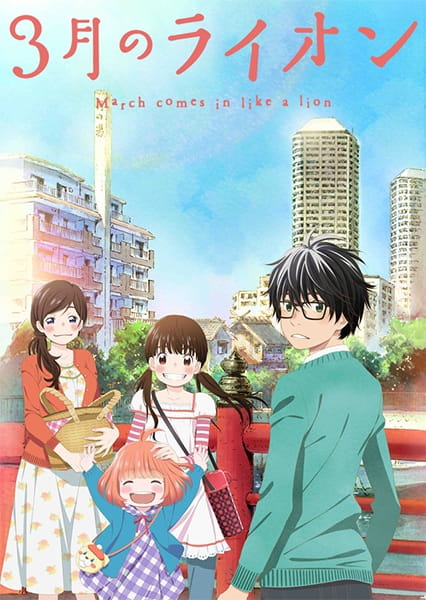
March Comes In Like a Lion
Is March Comes In Like a Lion worth watching?
Yes, it's worth watching. Anime Codex rates March Comes In Like a Lion 8.45 out of 10 — scored on six criteria (story, characters, themes, world-building, animation, and cultural impact), not crowd votes. 25th of 226 on the Codex rubric — top 11% of the catalogue. The Codex rates it Δ +0.08 above its MAL score — more underrated than 86% of the catalogue.
Where to watch
Trailer
What the data says
Computed from the Codex rubric across the whole catalogue.
Summary
March Comes In Like a Lion is among the finest character studies in seinen anime, using competitive shogi as a lens for examining depression, grief, and the slow work of healing through connection. Chica Umino's writing gives Rei Kiriyama uncommon psychological depth, refusing easy catharsis as he navigates a manipulative adoptive family and tentatively accepts the Kawamoto sisters' found-family warmth. Shaft's direction externalizes his inner turbulence through surreal water imagery and shifting visual styles, though these flourishes occasionally tip into indulgence and tonal whiplash. The professional shogi world is rendered with researched authenticity, populated by fully realized rivals rather than mere opponents. Its chief weakness is pacing: the first season meanders through tangential vignettes that dilute narrative momentum, and viewers seeking plot propulsion may find it slow. But its emotional accumulation is its purpose — the bullying arc surrounding Hinata delivers one of the medium's most affecting statements on moral courage. Measured against the best quiet seinen dramas, it is a standout, distinguished by its tenderness, restraint, and refusal to simplify mental illness. Not flawless, but deeply humane and visually distinctive, it rewards patience with profound emotional payoff.
Criterion breakdown
Story & narrative
The narrative weaves Rei's shogi career with his slow integration into the Kawamoto household, balancing tournament arcs like the match against Nikaidou and the Shimada-Gotou storyline with quieter domestic beats. The first season's structure can feel meandering and episodic, occasionally stalling Rei's arc with tangential vignettes, but the deliberate pacing serves the mood. It excels not in plot momentum but in emotional accumulation, where individual matches become vehicles for character revelation rather than mere competition.
Character writing & growth
Rei is a remarkably layered depiction of depression, survivor's guilt, and social paralysis, with his relationship to the manipulative Kyouko and adoptive father Kouda given real psychological weight. The Kawamoto sisters avoid pure idealization — Akari's caretaking masks her own grief, and Hinata's later bullying arc gives her genuine moral courage. Supporting players like Nikaidou, Shimada, and Gotou are written with full interior lives, making the shogi world feel populated by people rather than rivals.
Themes & emotional resonance
The show's treatment of loneliness, found family, and the labor of recovery is exceptionally tender without becoming saccharine, using shogi as metaphor for isolation and the discipline of carrying on. Rei's grief over his birth family and his hesitant acceptance of the Kawamotos' warmth resonates deeply. The bullying subplot involving Hinata's friend Chiho elevates the emotional stakes and articulates a clear ethical statement about standing by others.
World-building & power system
The professional shogi milieu is rendered with genuine authenticity — ranking systems, title matches, and the psychology of veteran players like Shimada with his stomach ulcers feel researched and lived-in. The contrast between the cold shogi hall and the warm, wagashi-scented Kawamoto home gives the setting internal coherence. It is grounded rather than inventive, so it doesn't break new conceptual ground, but its specificity is its strength.
Animation & direction
Shaft's signature stylization — surreal water imagery, abstract emotional landscapes, and shifting art styles — externalizes Rei's psychology with striking effect, as in the recurring drowning motifs. The direction by Akiyuki Shinbou's team modulates between cozy domestic warmth and stark visual metaphor skillfully, though the experimental flourishes occasionally feel indulgent and tonally jarring. The understated character animation and expressive use of color carry much of the emotional load.
Cultural impact
The series earned strong critical acclaim and a devoted following, with its high MAL score and two seasons reflecting durable respect, plus a live-action film adaptation. It stands as a benchmark for the quiet-drama strand of seinen alongside works like Honey and Clover, sharing creator Chica Umino. Its reach remains more niche than landmark titles, but within its lane it is highly regarded.
Synopsis (from MAL)
Having reached professional status in middle school, Rei Kiriyama is one of the few elite in the world of shogi. Due to this, he faces an enormous amount of pressure, both from the shogi community and his adoptive family. Seeking independence from his tense home life, he moves into an apartment in Tokyo. As a 17-year-old living on his own, Rei tends to take poor care of himself, and his reclusive personality ostracizes him from his peers in school and at the shogi hall. However, not long after his arrival in Tokyo, Rei meets Akari, Hinata, and Momo Kawamoto, a trio of sisters living with their grandfather who owns a traditional wagashi shop. Akari, the oldest of the three girls, is determined to combat Rei's loneliness and poorly sustained lifestyle with motherly hospitality. The Kawamoto sisters, coping with past tragedies, also share with Rei a unique familial bond that he has lacked for most of his life. As he struggles to maintain himself physically and mentally through his shogi career, Rei must learn how to interact with others and understand his own complex emotions. [Written by MAL Rewrite]
Ranked nearby

Explore rankings
Discussion
Set a display name above to post.
Loading discussion…