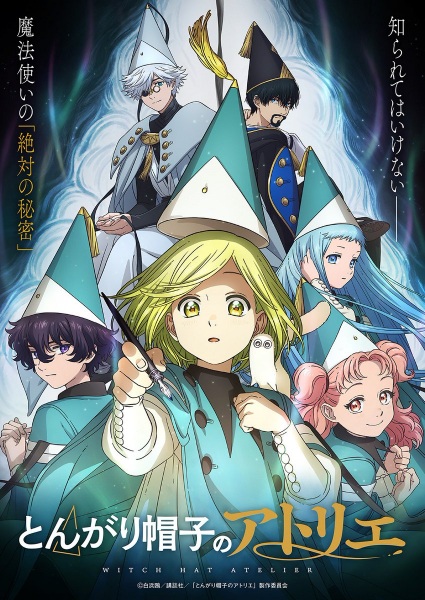
Tongari Boushi no Atelier
Is Tongari Boushi no Atelier worth watching?
Yes — a standout. Anime Codex rates Tongari Boushi no Atelier 8.50 out of 10 — scored on six criteria (story, characters, themes, world-building, animation, and cultural impact), not crowd votes. 23rd of 226 on the Codex rubric — top 10% of the catalogue. The crowd rates it 0.19 higher than the rubric does — the Codex is harder on it than on 27% of the catalogue.
Where to watch
Trailer
What the data says
Computed from the Codex rubric across the whole catalogue.
Summary
Tongari Boushi no Atelier stands out in seinen fantasy by replacing combat spectacle with craft, mystery, and ethics. Its central conceit — that magic is drawn, not spoken, and its knowledge violently gatekept — is among the most original and rigorously consistent systems in recent anime, driving both plot and moral stakes. Coco's journey from the guilt of accidentally petrifying her mother to disciplined apprentice is told through tangible process rather than shortcuts, and the supporting apprentices are given genuine interiority. Qifrey's warm-mentor exterior masking vengeful obsession supplies a quiet undercurrent of dread that elevates the slow-burn conspiracy around the Brimmed Caps. BUG FILMS honors Shirahama's ornate linework, animating spellcraft as calligraphic ritual and staging set pieces like the testing cave with painterly restraint. The chief limitation is structural: thirteen episodes can only seed the manga's larger machinery, so the conspiracy reads more as foundation than resolution, and some secondary witches and the antagonists' ideology remain underexplored within the runtime. A few dialogue scenes lean on static compositions. Even so, it is a confident, beautifully realized adaptation that judges magic as labor and knowledge as moral weight — a distinctive, intelligent entry in its demographic.
Criterion breakdown
Story & narrative
The narrative builds elegantly from Coco's accidental petrification of her mother into a layered mystery about the Brimmed Caps and the suppressed history of magic, with the seam-ripping cliffhanger and the early arcs around Coco's apprenticeship pacing reveals patiently. The detective-exam structure of the testing arc gives episodic momentum without sacrificing the slow-burn central question of Qifrey's hidden motives. It loses a fraction because a 13-episode adaptation can only gesture at the manga's larger conspiracy, leaving the central plot engine more setup than payoff.
Character writing & growth
Coco's growth from guilt-ridden novice to deliberate problem-solver is rendered through process rather than montage — her struggles with drawing precise glyphs externalize her internal resolve. The supporting apprentices (Agott's prickly pride, Tetia's warmth, Richeh's contrarian streak) each get distinct arcs rather than functioning as set dressing, and Qifrey's gentle mentor facade concealing obsessive vengeance is the show's most quietly unsettling thread. Some secondary witches remain underdeveloped within the cour's runtime.
Themes & emotional resonance
The series interrogates knowledge as both empowerment and danger — magic's gatekeeping mirrors real anxieties about access, consent, and the ethics of forbidden information. Coco's mother's petrification grounds these abstractions in tangible grief and accountability rather than sloganeering. It stops just short of the top tier because the moral weight of the Brimmed Caps' ideology is still being seeded rather than fully tested.
World-building & power system
The premise that magic is drawn rather than incanted, with spells rendered as ink sigils whose secrets are physically guarded, is one of the most internally consistent and original systems in recent fantasy — the prohibition against magic affecting the body directly drives both plot and ethics. Kamome Shirahama's design sensibility translates into a cohesive guild society, pointed-hat hierarchy, and tactile workshop culture. The setting feels lived-in and rule-bound rather than decorative.
Animation & direction
BUG FILMS commits to the manga's intricate linework, animating the act of spell-drawing as deliberate, almost calligraphic motion, which makes magic feel earned rather than flashy. The petrification sequence and the underwater testing-cave set piece use color and light to convey wonder and dread without over-relying on action spectacle. Occasional reliance on still compositions during dialogue-heavy stretches slightly undercuts the otherwise sumptuous direction.
Cultural impact
The source manga is an Eisner and Harvey Award winner with significant Western and Japanese acclaim, lending the adaptation immediate prestige, and the strong MAL reception (8.69) reflects high anticipation meeting execution. As an ongoing single-cour work it hasn't yet generated the lasting fandom footprint of established seinen landmarks, so its impact remains promising rather than proven.
Synopsis (from MAL)
In a world where witches wield breathtaking magic, Coco, coming from a humble background, often wishes she were born one herself. After all, the secret behind casting magic is strictly guarded from non-witches. But when Coco manages to catch a glimpse of the witch Qifrey casting a spell, her revelation on the truth behind magic drastically alters the course of her life. However, Coco's curiosity pays a steep price when a disastrous spell cast in ignorance brings a tragic fate upon her beloved mother. Qifrey takes the shaken girl in, recognizing both her resolve to save her mother and her link to a group of forbidden magic heretics. Secrets are a heavy burden, and between navigating a society that views her as an uninvited guest and mastering the art of magic, Coco must give her all to prove her worth as a witch. [Written by MAL Rewrite]
Ranked nearby
Explore rankings
Discussion
Set a display name above to post.
Loading discussion…