Anime Like Kuroko's Basketball: 5 the Rubric Says You'll Love, Ranked by Critical Proximity
Fans of Kuroko's Basketball respond to its strongest criteria — a 7.5 on Kuroko and Kagami's light-and-shadow dynamic, Production I.G's 7.5 court choreography, a 7.0 cultural footprint — and these five picks deliver the same qualities, ranked by how close their critical profile sits to it, not by vibes.
Fans of Kuroko's Basketball respond to its strongest criteria — a 7.5 on Kuroko and Kagami's light-and-shadow dynamic, Production I.G's 7.5 court choreography, a 7.0 cultural footprint — and these five picks deliver the same qualities, ranked by how close their critical profile sits to it, not by vibes.
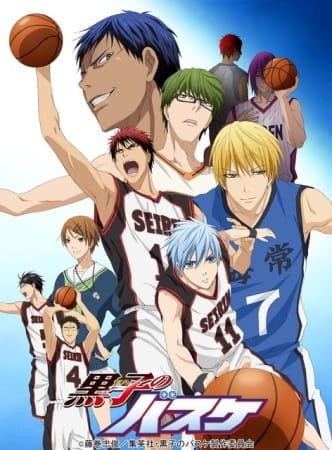
Kuroko's Basketball works because of two things the Codex 7.13 actually rewards, and neither of them is the Emperor Eye. It's the character axis at 7.5 — Kuroko's misdirection paired with a real ideological argument against the Generation of Miracles' isolating talent — and Production I.G's 7.5 on court motion under Shunsuke Tada's direction, where the fast breaks legibly track eight bodies at once. Everything else on the 2012 scorecard is a competent-to-solid 7.0, with the world at 6.5 dragged by a generic high-school setting propping up increasingly implausible power creep.
What the consensus keeps missing about anime like Kuroko's Basketball
The MyAnimeList 8.04 grades a franchise — three Production I.G seasons, a film, a stage adaptation, 31 million manga copies in circulation. The Codex 7.13 grades the twenty-five episodes that aired in 2012, which is a first cour that sags in early practice-match episodes and doles out the Teikou backstory as escalating boss-fight motivation. That gap isn't a takedown; it's a diagnosis. When people search for anime like Kuroko's Basketball, they're usually chasing the character duo and the animation of impact — the two criteria that actually clear 7.5 — not the world-building at 6.5 or the by-the-numbers tournament spine at 7.0.
So the recommendations below aren't sorted by which sports anime is most beloved. They're sorted by which titles' Codex scorecards sit closest to Kuroko's — starting with the one that shares its DNA almost exactly, and moving outward to the ones that share a spirit but a different distribution of strengths. This is the same method behind the Dragon Ball recommendation list and the Jujutsu Kaisen one: critical proximity, not vibes.
Haikyuu!! — the light-and-shadow duo, engineered properly
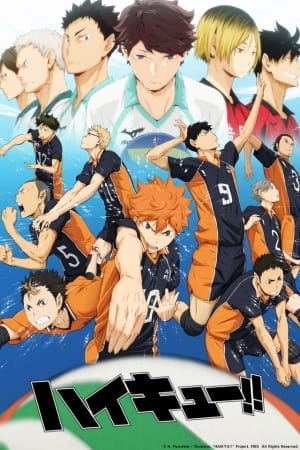
Codex 8.27 to Kuroko's 7.13, and it's the closest tonal cousin the rubric has. Same studio — Production I.G, this time in 2014 with a 25-episode first season — same commitment to legible court geometry, same central conceit of a small, low-presence player paired with a hot-blooded scorer. Hinata and Kageyama are what Kuroko and Kagami would look like if the show cared as much about the setter-spiker relationship as Kuroko does about misdirection.
Where Kuroko's posts a 7.5 on character, Haikyuu answers with an 8.7 — the Karasuno bench isn't decoration, it's the point. Tanaka, Sugawara, Tsukishima and Nishinoya all get individual arcs the Seirin supporting cast (Hyuuga, Riko, Izuki) never quite receives. Animation moves from 7.5 to 8.3; themes from 7.0 to 8.5; cultural from 7.0 to a 9.0 that reflects how thoroughly Haikyuu re-set what a modern sports shonen looks like. If you liked Kuroko's for what it does best, Haikyuu does those exact things harder.
Slam Dunk — the ancestor that carries everything on character
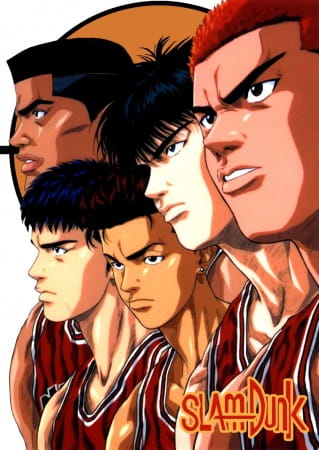
Codex 8.12, and the reason both Kuroko's and Haikyuu exist. Toei Animation's 101-episode 1993 run is where the character axis peaks at 9.0 — Sakuragi, Rukawa, Akagi, Miyagi and Mitsui are five of the most fully written protagonists in the sports genre, full stop. Compare that to Kuroko's 7.5 character score, where the show's own justification concedes several Generation of Miracles function as escalating boss puzzles rather than developed people.
Slam Dunk trades animation for character. Its 6.8 on animation sits nearly a full point below Kuroko's 7.5 — Toei in 1993 doesn't move like Production I.G in 2012, and the recycled cuts show. But the 8.3 on themes and the 9.5 cultural score — Slam Dunk is genuinely the reason Japan started building basketball courts — carry a scorecard that has nothing to apologize for. Kagami's American-import backstory reads as a direct nod to Sakuragi's redshirt-freshman arc. Watch it in that order and the lineage becomes obvious.
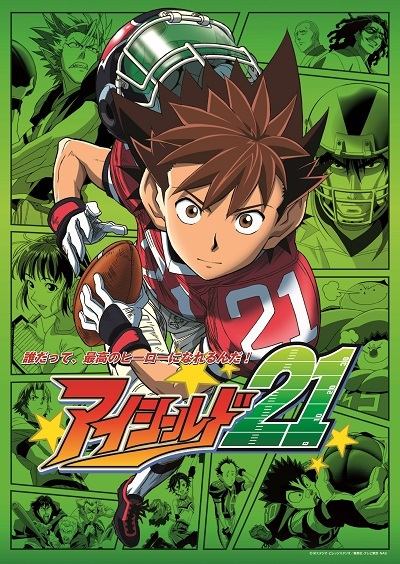
Eyeshield 21 — the closest scorecard shape
Codex 7.33, and by pure rubric geometry the tightest match on this list — a 7.5 on story, an 8.0 on character, a 7.0 on themes, a 7.5 on world. Gallop's 145-episode 2005 run does for American football what Kuroko's does for basketball: hero with an unusual physical gift (Sena's speed instead of Kuroko's absence), a monstrous ensemble cast, and opponents built as escalating specialty puzzles — Shin's spear tackle, Agon's dreadlocked genius, Hiruma's psychological warfare.
The 7.5 on world beats Kuroko's 6.5, and it's earned. Football has more positional variety to organize a power system around than basketball does, and Eyeshield 21 uses that — the Devil Bats' roster is a coherent tactical unit rather than a superhero team. If the Generation of Miracles conceit is what hooked you, the Ojou White Knights and the Shinryuuji Nagas will land the same way.
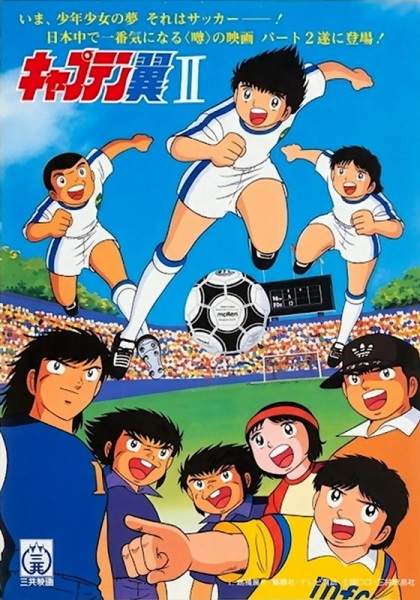
Captain Tsubasa — the ur-text of the escalating opponent
Codex 6.68, and the reason every rival in Kuroko's Basketball has a signature move. Tsuchida Productions' 128 episodes from 1983 essentially invented the sports-shonen grammar Kuroko's Basketball operates in — the tournament ladder, the childhood-friend rival (Wakabayashi to Tsubasa is Kuroko to Aomine), the impossible signature technique that requires a specific counter.
The scorecard is where you feel the years: 6.5 story, 6.8 character, 6.7 themes. It doesn't hit Kuroko's numbers on any single axis. But if the Generation of Miracles framework is what pulled you in — rivals as escalating hierarchies of technique — Tsubasa is the blueprint. Watch it as history, not as replacement.
Whistle! — the smaller, quieter cousin
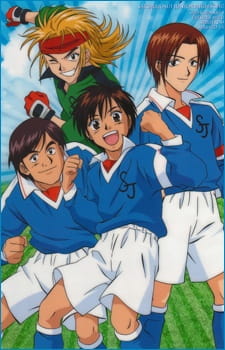
Codex 6.50, the lowest on this list, and the pick that trades scale for intimacy. Studio Comet's 39-episode 2002 run follows Shou Kazamatsuri, a middle-school soccer player with no natural talent — closer in spirit to Kuroko than Kagami, actually, because the entire premise is that grinding effort has to substitute for genius.
The 6.0 world score is real; this is the least ambitious production on the list, and it looks it. But the small-scale character focus is exactly what the Seirin locker-room scenes are doing between matches. If you watch Kuroko's for the practice sequences more than the Interhigh, Whistle! sits on that register for its entire run.
The counter-argument: aren't half of these older or smaller?
Yes — and this is where "critical proximity" beats "biggest name." A recommendation engine that just aggregated popularity would put Haikyuu at the top and stop. The rubric puts Haikyuu at the top too, but for reasons: same studio, same production pipeline, same first-cour episode count, same criterion strengths ranked in the same order. The Captain Tsubasa and Whistle! picks lower on the list aren't filler — they're the two titles that share Kuroko's specific interest in the underdog-with-a-trick over the prodigy-with-a-move. This is the same logic behind the Frieren list: match the shape, not the reputation.
The 7.13 Kuroko's Basketball earned in 2012 is a scorecard about two things done well and four things done competently. Haikyuu does those same two things better; Slam Dunk trades one for the other and wins on the trade; Eyeshield 21 matches the shape almost exactly; Tsubasa and Whistle! serve the fans who came for the specific parts, not the whole. Watch in that order.
Featured in the Codex
More from The Codex
The Seven Deadly Sins Is a 6.60 Wearing a 7.60 Costume: A One-Point Gap Earned by Groping Gags and Convenient Flashbacks
The Seven Deadly Sins scores 6.60 on the Codex against MyAnimeList's 7.60 because the crowd is grading a Netflix breakout and a Ban-and-King friendship, not the 24 episodes A-1 Pictures actually broadcast in 2014.
The 10.0 That Built a Sunday: How Sazae-san's Cultural Score Carries a 6.58 Scorecard
Sazae-san is a case study in how a single criterion — cultural — can define how a show is remembered, and the 10.0 the Codex hands Eiken's 1969 institution is doing every bit of the heavy lifting its other five scores refuse to.
The Sebastian Problem: Why Black Butler Sits 1.10 Below Its MAL Line and the Crowd Refuses to Notice
Black Butler (Kuroshitsuji) posts a 1.10-point gap between MyAnimeList's 7.65 and the Codex 6.55 because the crowd is grading Sebastian's silhouette and a Phantomhive aesthetic, not the anime-original finale A-1 Pictures actually shipped in 2009.
Discussion
Set a display name above to post.
Loading discussion…