Anime Like Frieren: Beyond Journey's End: 5 the Rubric Says You'll Love, Ranked by Critical Proximity
Fans of Frieren respond to its strongest criteria — a 9.5 on themes, a 9.3 on character, Madhouse's 9.2 palette work — and these five picks deliver the same qualities, ranked by how close their critical profile sits to it, not by vibes.
Fans of Frieren respond to its strongest criteria — a 9.5 on themes, a 9.3 on character, Madhouse's 9.2 palette work — and these five picks deliver the same qualities, ranked by how close their critical profile sits to it, not by vibes.
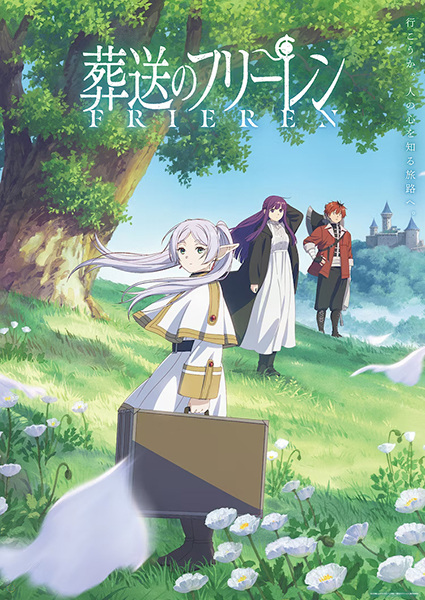
Frieren: Beyond Journey's End is not a fantasy show that happens to be sad. It is a meditation on memory and mortality that borrowed a fantasy shell because the shell allowed for centuries between griefs. That distinction is why most recommendation lists for it fail: they hand you high fantasy with elves and call it a match, when what actually made Frieren a 9.03 on the Codex is a much narrower cluster of criteria — themes at 9.5, character at 9.3, Madhouse's animation and Evan Call's score locking in a 9.2, and a cultural weight of 9.0 that redefined what a shonen headliner could look like in 2023.
What the consensus keeps getting wrong about anime like Frieren: Beyond Journey's End
Walk any thread of "anime like Frieren: Beyond Journey's End" and you get the same reflex: Mushishi, Natsume's Book of Friends, Violet Evergarden, whatever else touches melancholy. Some of those are real thematic siblings. But they're picked on mood alone, and mood is the least defensible axis a recommendation can travel on. Frieren's MyAnimeList score of 9.26 rewards a specific engine — Keiichirō Saitō's willingness to hold on a face for six seconds, the funeral-first inversion in the pilot, the Aura confrontation earning its catharsis because Qual and the demon-as-linguistic-parasite framework had already done the thematic setup. The recommendation question is not "what feels like this." It is: which shows score high on the criteria that carried Frieren to 9.03?
That is a rubric question, and the rubric answers it in an order.
Fullmetal Alchemist: Brotherhood — the character and thematic ceiling
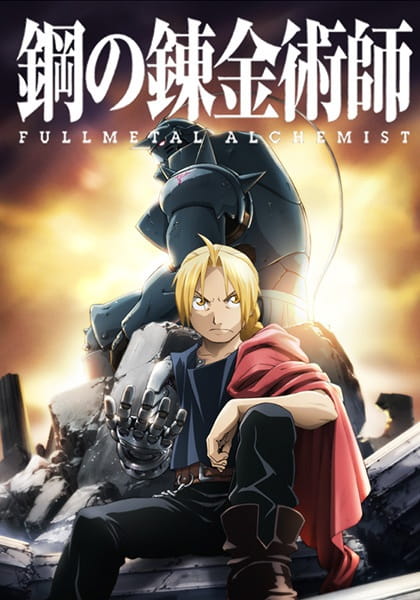
The closest critical profile to Frieren in the catalogue is Fullmetal Alchemist: Brotherhood at a Codex 9.25. It sits above Frieren's 9.03 for a reason the two shows share: it scores 9.4 on character and 9.2 on themes, which is exactly the axis Frieren wins on. Bones' 64-episode run in 2009 does what Frieren does on a different tempo — it lets a protagonist's understanding of loss compound across dozens of hours, so that Hughes' death, Nina, and the Promised Day all land as accumulated grief rather than plot mechanics. Where Frieren externalizes memory through Frieren's habit of writing down who people were, Brotherhood externalizes it through equivalent exchange as a moral system rather than a magic one. And its cultural score of 9.5 mirrors Frieren's 9.0 — both are shows the medium had to reorganize around.
If you loved the funeral inversion in Frieren's first episode, Brotherhood is the show whose thematic weight most closely matches the Codex's read of Yamada's source material.
Hunter × Hunter (2011) — Madhouse doing its other masterpiece
The second-closest profile belongs to Hunter × Hunter (2011), Codex 9.23, and the overlap is not accidental — same studio. Madhouse's fingerprints on Frieren's environmental art and restrained pacing are the same hands that spent 148 episodes turning Chimera Ant into one of the most sustained tonal experiments in the medium. Hunter × Hunter scores 9.5 on story, 9.5 on character, and 9.5 on world; Frieren posts 9.0, 9.3, and 8.0 respectively. The distance is real, but the direction is identical: both shows treat their genre conventions as scaffolding for something the genre isn't supposed to attempt.
The Chimera Ant arc in particular does what the Aura duel does in miniature — it uses the vocabulary of shonen combat to interrogate what humanity means, and it earns Meruem's ending the same way Frieren earns Himmel's funeral: by refusing to shortcut the setup. If you're watching Frieren for the way Madhouse holds silence, this is the other Madhouse show that knows how.
One Piece — the character-work argument you didn't expect
One Piece at Codex 8.58 is a stranger recommendation on paper and an obvious one on the rubric. It scores 9.0 on character and 8.7 on themes — numbers that sit inside Frieren's neighborhood on the two axes Frieren wins on. Toei Animation's problem has always been the medium of the delivery, not the writing; what Oda does with Robin's backstory in Enies Lobby, or with Vivi's goodbye at the end of Alabasta, is the same emotional grammar Frieren uses at Himmel's grave. Long acquaintance. Delayed grief. The realization that the journey mattered because of who you took it with.
The tempo is opposite — Frieren is 28 episodes of restraint, One Piece is a decades-long accumulation — but the underlying claim about what memory does to a party of adventurers is nearly the same claim. Watch Merry's funeral at Water 7 and tell me it isn't a distant cousin of Frieren learning the flower spell.
Tegami Bachi: Letter Bee — the thematic sibling, without the budget
This is where the rubric's honesty starts costing something. Tegami Bachi: Letter Bee posts a Codex 6.88 — nowhere near Frieren's 9.03 — but its 8.0 world-building and 7.5 themes are doing recognizable Frieren work. It's a 25-episode Pierrot Plus production from 2009 about a courier delivering letters across a permanently-nightbound world, and the thematic engine is memory-as-cargo: what a letter carries, what the recipient has already lost by the time it arrives. That is thematically adjacent to Frieren recording the names of people she'll outlive.
Its 6.0 animation is the honest reason it doesn't clear 8.00, and the story score of 6.8 admits the show never fully resolves what its premise sets up. But if you want the meditative-fantasy premise on a smaller scale, this is a legitimate pick and the rubric will not pretend otherwise.
The Heroic Legend of Arslan — the world-building bridge
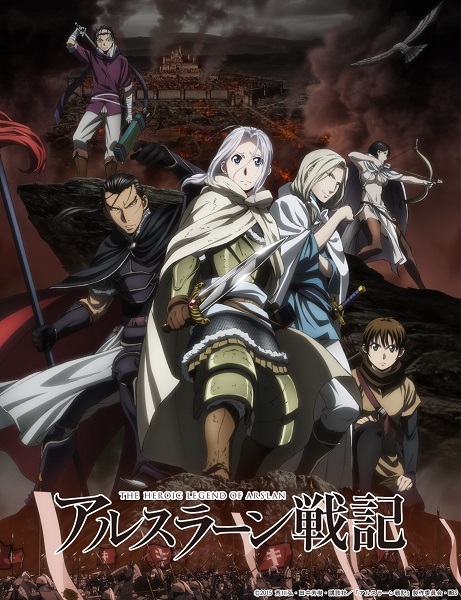
The Heroic Legend of Arslan, Codex 6.93, is the outermost recommendation and the one that requires a caveat we've made before at length in the Arslan review. It scores 7.5 on world — the highest number on its scorecard — and that world-building instinct, rooted in Yoshiki Tanaka's novelistic source material, is what earns it a spot here. Frieren's 8.0 world was built on the demon-as-linguistic-mimic framework and spell-collection as an externalization of time; Arslan's is built on a Persian-inflected setting with actual political geography behind it.
The 6.0 animation from SANZIGEN's 25-episode 2015 run is the ceiling, and character at 7.2 does not approach Frieren. But for viewers who latched onto Frieren for its considered fantasy premise rather than its emotional register, Arslan is the closest world-building profile the catalogue offers below the top tier.
The counter-argument: mood is a real axis, and the rubric is undercounting it
The honest objection to this list is that Frieren's power lives in a register — Evan Call's score, the autumnal palette, the breathing pace — that a scorecard flattens. A rubric that puts Fullmetal Alchemist: Brotherhood next to Frieren because both post high on themes and character misses that watching them feels nothing alike. Brotherhood is loud; Frieren is quiet. Register matters.
The rubric's answer is that register is downstream of criteria, not parallel to them. Frieren's 9.2 animation score is Madhouse's palette and pacing; its 9.5 themes score is what those palette choices are in service of. When we recommend Brotherhood, we're claiming the underlying thematic and character mechanics will land for you, even if the volume is different. That is a defensible bet — and it is a better bet than recommending on vibes.
Frieren at 9.03 is a themes-and-character show first, an animation-and-cultural-weight show second, and a world-building show a distant third. These five recommendations are ordered by how closely their scorecards mirror that hierarchy, and Brotherhood and Hunter × Hunter are on top of the list because the rubric says they belong there. The rest of the medium can catch up.
Featured in the Codex



More from The Codex
The Seven Deadly Sins Is a 6.60 Wearing a 7.60 Costume: A One-Point Gap Earned by Groping Gags and Convenient Flashbacks
The Seven Deadly Sins scores 6.60 on the Codex against MyAnimeList's 7.60 because the crowd is grading a Netflix breakout and a Ban-and-King friendship, not the 24 episodes A-1 Pictures actually broadcast in 2014.
The 10.0 That Built a Sunday: How Sazae-san's Cultural Score Carries a 6.58 Scorecard
Sazae-san is a case study in how a single criterion — cultural — can define how a show is remembered, and the 10.0 the Codex hands Eiken's 1969 institution is doing every bit of the heavy lifting its other five scores refuse to.
The Sebastian Problem: Why Black Butler Sits 1.10 Below Its MAL Line and the Crowd Refuses to Notice
Black Butler (Kuroshitsuji) posts a 1.10-point gap between MyAnimeList's 7.65 and the Codex 6.55 because the crowd is grading Sebastian's silhouette and a Phantomhive aesthetic, not the anime-original finale A-1 Pictures actually shipped in 2009.
Discussion
Set a display name above to post.
Loading discussion…