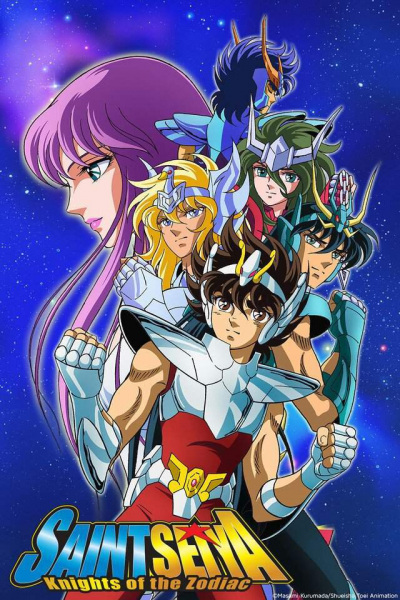
Saint Seiya
Is Saint Seiya worth watching?
Worth a look. Anime Codex rates Saint Seiya 7.11 out of 10 — scored on six criteria (story, characters, themes, world-building, animation, and cultural impact), not crowd votes. 122nd of 226 on the Codex rubric — bottom 47% of the catalogue. The crowd rates it 0.67 higher than the rubric does — the Codex is harder on it than on 58% of the catalogue.
Where to watch
What the data says
Computed from the Codex rubric across the whole catalogue.
Summary
Saint Seiya is a landmark 1980s battle shonen whose greatest contribution is mythological imagination: recasting Greek constellations as Cosmo-powered armors created an instantly iconic, internally coherent world that influenced generations of action anime. Its high point, the Sanctuary arc's ascent through the 12 Zodiac Houses, delivers tense pacing, memorable antagonists in the Gold Saints, and sincere themes of brotherhood and sacrifice that give its battles genuine emotional weight. The Bronze Saints are distinct and likable, even when the Gold Saints frequently steal their thunder. Its weaknesses are real and characteristic of its era and length: character growth is largely measured in escalating power-ups rather than internal change, later arcs (notably the anime-original Asgard saga and Poseidon) recycle the same guardian-by-guardian structure to the point of fatigue, and the animation, while visually distinctive thanks to Araki and Himeno, leans heavily on stills and recycled cuts. Within its demographic it stands as a hugely important, atmospheric, and emotionally earnest classic—better appreciated for its mythos and iconography than for narrative sophistication—and its outsized international cultural footprint, especially in Europe and Latin America, secures its status as a genre cornerstone despite its structural and production shortcomings.
Criterion breakdown
Story & narrative
The escalating tournament-to-cosmic-war structure works well, with the Sanctuary arc's 12 Houses gauntlet standing as the series' narrative peak—a brilliantly paced race against time as Seiya and company ascend through each Gold Saint's temple to reach the Pope. However, the early Galaxian Wars and Black Saints arcs are formulaic, and the later Asgard (anime-original) and Poseidon arcs visibly repeat the same 'climb and defeat themed guardians one by one' template, exposing structural fatigue and padding across 114 episodes.
Character writing & growth
The five Bronze Saints are distinctly drawn—Seiya's stubborn drive, Shun's pacifism, Ikki's lone-wolf brutality—and the Gold Saints often outshine the protagonists, with Aiolia, Shaka, and especially the tragic Gemini Saga and the dying Cancer/Aquarius confrontations carrying real weight. Growth is largely incremental power-ups rather than deep internal change, though, and several heroes plateau emotionally; the show leans on backstory flashbacks (the orphan brotherhood, Shiryu and his master) rather than ongoing arc development.
Themes & emotional resonance
Brotherhood, self-sacrifice, and devotion to Athena give the fights genuine emotional stakes, and moments like Shiryu sacrificing his sight or the Bronze Saints burning their Cosmo beyond mortal limits land with sincere pathos. The recurring idea that resolve and the seventh sense can transcend raw power is thematically consistent, even if the show occasionally undercuts its weight through repetitive last-second revivals.
World-building & power system
The Cosmo and Cloth mythology is genuinely original for its era—armors based on the 88 constellations, the seventh sense, and the Greco-mythological pantheon recast as a martial hierarchy created an instantly iconic and influential system. The Zodiac Gold Saints, ranked Bronze/Silver/Gold structure, and astrological cosmology give the world real internal logic and identity, though the anime-original Asgard detour dilutes the otherwise tight mythos.
Animation & direction
Shingo Araki and Michi Himeno's character designs are striking and the elaborate Cloth designs remain visually memorable, with the Sanctuary arc featuring dynamic, light-streaked Cosmo effects that defined a visual language for later battle anime. Production is uneven, however—frequent stills, recycled attack cuts, and budget-saving freeze-frames are common, typical of weekly 1980s Toei output.
Cultural impact
Saint Seiya is a foundational pillar of 1980s shonen, immensely influential across Europe and Latin America where it remains a cultural touchstone, and it pioneered the armor-clad warrior aesthetic and constellation-power template echoed for decades. It also launched a massive merchandise legacy, including the long-running Myth Cloth figure line, cementing enduring fandom.
Synopsis (from MAL)
In ancient times, a group of young men devoted their lives to protecting Athena, the Goddess of Wisdom and War. These men were capable of fighting without weapons—a swing of their fist alone was powerful enough to rip the very sky apart and shatter the earth beneath them. These brave heroes became known as Saints, as they could summon up the power of the Cosmos from within themselves. Now, in present day, a new generation of Saints is about to come forth. The young and spirited Seiya is fighting a tough battle for the Sacred Armor of Pegasus, and he isn't about to let anyone get in the way of him and his prize. Six years of hard work and training pay off with his victory and new title as one of Athena's Saints. But Seiya's endeavor doesn't end there. In fact, plenty of perils and dangerous enemies face him and the rest of the Saints throughout the series. What new quests await the heroes of the epic Saint Seiya saga?
Ranked nearby

Explore rankings
Discussion
Set a display name above to post.
Loading discussion…