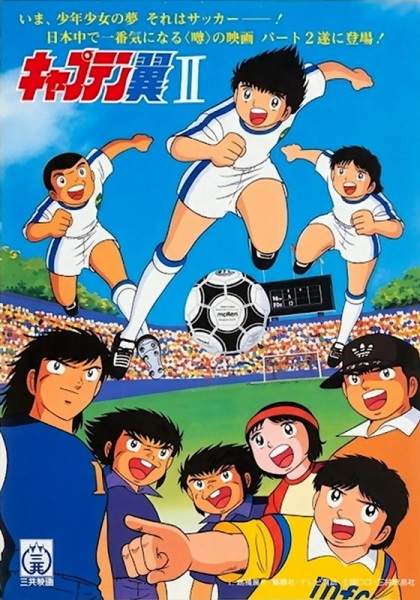
Captain Tsubasa
Is Captain Tsubasa worth watching?
Worth a look. Anime Codex rates Captain Tsubasa 6.68 out of 10 — scored on six criteria (story, characters, themes, world-building, animation, and cultural impact), not crowd votes. 163rd of 226 on the Codex rubric — bottom 29% of the catalogue. The crowd rates it 0.71 higher than the rubric does — the Codex is harder on it than on 60% of the catalogue.
Where to watch
What the data says
Computed from the Codex rubric across the whole catalogue.
Summary
Captain Tsubasa is the foundational sports shonen, and its importance is hard to overstate: it codified the genre's tournament structure, rival-driven drama, and signature-technique spectacle that countless successors would inherit, while inspiring a generation of real footballers across the globe. Judged within shonen, its strengths are sincerity and momentum — the wholesome 'ball is my friend' ethos, the respectful rivalries with Hyuga, Wakabayashi, and Misaki, and the aspirational climb from Nankatsu's schoolyards toward the World Cup. Its weaknesses are equally clear. The 1983 animation is budget-constrained, leaning on stock footage and the famously endless field, and the pacing stretches single plays across episodes to a fault. Tsubasa himself is a near-perfect, low-friction hero, and most characters grow in technique rather than in interior life, while the relentless optimism keeps emotional stakes shallow. The physics-defying shots are iconic but absurd. The result is a series that is historically monumental and warmly entertaining, yet uneven as a viewing experience by modern standards — a show better remembered for what it started than for the moment-to-moment execution of any single arc. Essential as a genre cornerstone; flawed as a standalone watch.
Criterion breakdown
Story & narrative
The narrative follows a clear escalation from Nankatsu's local elementary tournaments to the national stage and eventual international play, giving the series a satisfying ladder of increasingly stakes-driven matches. However, the pacing is heavily padded — single shots and breakaways can consume multiple episodes, and the formula of 'rival appears, match is won at the buzzer' repeats with diminishing surprise across 128 episodes. The Nankatsu vs. Toho final against Hyuga is the structural high point, but the overall arc is more a string of tournaments than a tightly woven plot.
Character writing & growth
Tsubasa is an idealized, almost frictionless protagonist whose growth is mostly technical rather than emotional, but the supporting cast carries real weight: Hyuga's volatile intensity and family burden, Wakabayashi's pride and pursuit of perfection, and Misaki's golden-duo partnership with Tsubasa give the rivalries genuine personality. Rival-of-the-week characters like Misugi and Matsuyama get enough backstory to register as more than obstacles. The downside is that few characters truly transform — they are defined early and largely static, with development expressed through new techniques rather than inner change.
Themes & emotional resonance
The show's emotional core — 'the ball is my friend,' sportsmanship, and pure devotion to a single dream — is sincere and unusually wholesome for the era, prizing mutual respect between rivals over villainy. Hyuga's storyline, where soccer is tied to supporting his fatherless family, lands the strongest emotional beats. Yet the relentless optimism flattens stakes; defeat rarely carries lasting consequence, and the thematic register stays narrow, rarely probing failure or doubt with real depth.
World-building & power system
Read as premise originality, Captain Tsubasa essentially invented the template for the modern sports shonen, and its 'setting' — the structured Japanese youth soccer pyramid leading toward the World Cup dream — is internally coherent and aspirational. Its signature 'power system' is the roster of named hyperbolic techniques (Drive Shoot, Tiger Shot, Skylab Hurricane) which, while physically absurd, are consistent and memorable. Originality is high for its time, though the physics-defying moves strain credulity and the world rarely extends beyond the pitch itself.
Animation & direction
The 1983 Tsuchida production is hampered by limited budgets: heavy reliance on still frames, repeated stock footage of running and shots, and the infamous elongated fields where players seem to sprint forever without arriving. Direction does generate tension through dramatic angles, impact lines, and held close-ups on determined faces, and the iconic overhead bicycle kicks and signature shots are staged for maximum drama. Still, by the standard of even contemporaneous shonen the motion is sparse and the animation noticeably dated.
Cultural impact
Few anime can claim comparable real-world influence: Captain Tsubasa is widely credited with igniting soccer's popularity across Japan and is cited by professional players worldwide — Hidetoshi Nakata, Alessandro Del Piero, Fernando Torres, and Lionel Messi among them — as inspiration to take up the sport. It effectively founded the modern sports-anime genre and remains a touchstone decades later. Within its demographic, its impact is genuinely outsized.
Synopsis (from MAL)
Captain Tsubasa is the passionate story of an elementary school student whose thoughts and dreams revolve almost entirely around the love of soccer. 11-year-old Tsubasa Oozora started playing soccer at a very young age, and while it was mostly just a recreational sport for his friends, for him, it developed into something of an obsession. In order to pursue his dream to the best of his elementary school abilities, Tsubasa moves with his mother to Nankatsu city, which is well-known for its excellent elementary school soccer teams. But although he was easily the best in his old town, Nankatsu has a lot more competition, and he will need all of his skill and talent in order to stand out from this new crowd. He encounters not only rivals, but also new friends like the pretty girl Sanae Nakazawa and the talented goalkeeper, Genzo Wakabayashi, who shares the same passion as Tsubasa, and will prove to be a treasured friend in helping him push towards his dreams. Representing Japan in the FIFA World Cup is Tsubasa’s ultimate dream, but it will take a lot more than talent to reach it.
Ranked nearby



Explore rankings
Discussion
Set a display name above to post.
Loading discussion…