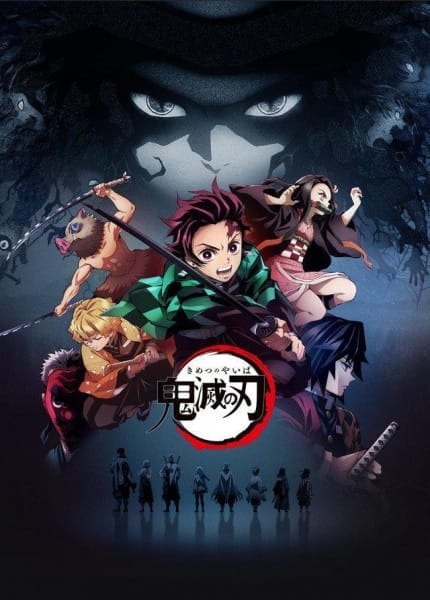
Demon Slayer: Kimetsu no Yaiba
Is Demon Slayer: Kimetsu no Yaiba worth watching?
Worth a look. Anime Codex rates Demon Slayer: Kimetsu no Yaiba 7.15 out of 10 — scored on six criteria (story, characters, themes, world-building, animation, and cultural impact), not crowd votes. 118th of 226 on the Codex rubric — bottom 49% of the catalogue. The crowd rates it 1.25 higher than the rubric does — the Codex is harder on it than on 84% of the catalogue.
Where to watch
Trailer
What the data says
Computed from the Codex rubric across the whole catalogue.
Summary
Demon Slayer's first season is a case study in how superlative execution can elevate familiar material. Narratively, it is an orthodox battle shonen—Final Selection trials, mission-of-the-week demon hunts, and a stoic protagonist whose moral compass never wavers. What distinguishes it within the genre is Tanjirou's compassion, extending even to the demons he slays, and the consistent thread of family tragedy that humanizes both heroes and villains, most movingly in Rui's backstory. Against the best of shonen, its writing is solid rather than exceptional: Zenitsu and Inosuke's comedy is hit-or-miss, character growth is thin, and the power system remains underdeveloped this early. Its overwhelming strength is ufotable's animation, which transformed a standard Jump property into a visual spectacle—the Hinokami sequence in episode 19 reset expectations for what television anime could look like. Add a richly rendered Taisho-era atmosphere and a cultural impact that reshaped the industry's commercial landscape, and the result is a show that is more remarkable for how it tells its story than for the story itself. A genuinely great-looking, emotionally sincere entry whose conventional bones keep it from the top tier of its demographic.
Criterion breakdown
Story & narrative
The first season follows a conventional shonen structure: the family massacre opening (episode 1) is genuinely affecting, but the Final Selection and subsequent mission-of-the-week format is familiar territory. The Natagumo Mountain arc (episodes 15-21) escalates stakes effectively, yet the narrative leans heavily on standard 'fight a stronger demon, gain a Hashira' beats. It is competently paced and emotionally clear but rarely surprising structurally.
Character writing & growth
Tanjirou's defining trait—empathy even toward demons he kills, as seen in the Swamp Demon and Rui confrontations—gives him a warmth uncommon among shonen leads, but he undergoes little internal change, remaining morally fixed from start to finish. Zenitsu and Inosuke provide reliable comic relief that sometimes overstays its welcome, and Nezuko is more symbol than character. The demons' backstory flashbacks, especially Rui's family, do meaningful work to humanize antagonists.
Themes & emotional resonance
The show's compassion-for-the-monstrous theme—Tanjirou offering kindness to dying demons—is its emotional core and elevates it above pure revenge fantasy. The bond between Tanjirou and Nezuko, and the recurring motif of family loss across both heroes and villains, lands with sincerity. However, the thematic register stays consistent rather than deepening, and the messaging is delivered with a directness that lacks ambiguity.
World-building & power system
The Taisho-era Japanese setting is atmospheric and the Breathing Style swordsmanship is visually distinct, but as a power system it is fairly shallow in season one—techniques are largely elemental flourishes without deep internal rules. The demon hierarchy (Twelve Kizuki) is teased but underexplored here, and the Wisteria/sunlight weaknesses are functional rather than inventive. Solid foundation, limited mechanical originality at this stage.
Animation & direction
This is the show's defining strength. Ufotable's fusion of 2D character work with CG-assisted compositing produces the standout 'water breathing' sequences and the climactic Tanjirou vs. Rui fight (episode 19, 'Hinokami'), widely regarded as a watershed moment in TV anime production. Color, particle effects, and camera movement are consistently theatrical-tier, far exceeding typical Weekly Shonen Jump adaptations.
Cultural impact
Demon Slayer became a generational phenomenon, with the franchise's Mugen Train film later breaking Japanese box-office records. The 2019 series ignited that momentum, dramatically raising mainstream expectations for action-anime production values and drawing in audiences far beyond the core shonen demographic. Its commercial and merchandising footprint is enormous.
Synopsis (from MAL)
Ever since the death of his father, the burden of supporting the family has fallen upon Tanjirou Kamado's shoulders. Though living impoverished on a remote mountain, the Kamado family are able to enjoy a relatively peaceful and happy life. One day, Tanjirou decides to go down to the local village to make a little money selling charcoal. On his way back, night falls, forcing Tanjirou to take shelter in the house of a strange man, who warns him of the existence of flesh-eating demons that lurk in the woods at night. When he finally arrives back home the next day, he is met with a horrifying sight—his whole family has been slaughtered. Worse still, the sole survivor is his sister Nezuko, who has been turned into a bloodthirsty demon. Consumed by rage and hatred, Tanjirou swears to avenge his family and stay by his only remaining sibling. Alongside the mysterious group calling themselves the Demon Slayer Corps, Tanjirou will do whatever it takes to slay the demons and protect the remnants of his beloved sister's humanity. [Written by MAL Rewrite]
Ranked nearby


Explore rankings
Discussion
Set a display name above to post.
Loading discussion…