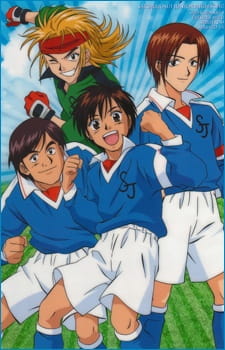
Whistle!
Is Whistle! worth watching?
Worth a look. Anime Codex rates Whistle! 6.50 out of 10 — scored on six criteria (story, characters, themes, world-building, animation, and cultural impact), not crowd votes. 179th of 226 on the Codex rubric — bottom 22% of the catalogue. The crowd rates it 1.01 higher than the rubric does — the Codex is harder on it than on 75% of the catalogue.
Where to watch
Streaming availability varies by region — check your local services.
What the data says
Computed from the Codex rubric across the whole catalogue.
Summary
Whistle! is a sincere, character-driven underdog sports drama whose chief distinction is its protagonist: Shou succeeds through effort, field intelligence, and humility rather than hidden genius, making his slow climb from benchwarmer to select-team contender genuinely satisfying within shonen conventions. The ensemble — reformed rival Tatsuya, the stamina-challenged Mizuno, and an array of teammates who grow alongside Shou — receives more thoughtful development than the genre often bothers with, and the show's themes of perseverance and mutual respect are delivered earnestly without melodrama. Its weaknesses are real, however. Studio Comet's animation is budget-constrained, leaning on still frames and recycled motion that rob the matches of kinetic impact. The narrative, while pleasant, is incremental and predictable, lacking the escalating tournament architecture of the genre's heavyweights, and the 39-episode anime adapts only part of the manga, leaving the story without true closure. The result is a warm, watchable, and emotionally honest series that prioritizes growth and friendship over spectacle. It rewards viewers who value heart and realistic effort over flashy ability, but it falls short of the polish and ambition that define the very best sports anime, settling comfortably as a good-but-flawed entry in its category.
Criterion breakdown
Story & narrative
Whistle! follows a classic underdog progression — Shou's transfer from Musashi no Mori's third string to becoming a contributing player at Sakura Jousui — and structures itself well around the Tokyo Select Team selection arc, which gives the back half real stakes. However, the narrative leans heavily on incremental match-and-training beats without the larger tournament architecture or escalating tension of genre standouts, and the anime's 39 episodes adapt only a fraction of the manga, ending without true resolution. The episodic rhythm is satisfying but rarely surprising.
Character writing & growth
Character writing is the show's strongest pillar: Shou's defining trait is not talent but relentless effort and field vision, which differentiates him from the natural-genius archetype, and his humility makes his growth feel earned rather than granted. The supporting cast — Sho Tatsuya's reformation from rival to friend, Mizuno's stamina struggles, and Katori's keeper development — receive genuine arcs, and the Tokyo Select Team brings in nuanced figures like Tenjou. The cast occasionally falls into stock roles, but the ensemble's mutual respect and shared improvement carry the series.
Themes & emotional resonance
The core theme — that determination and work ethic can narrow the gap with innate talent — is delivered sincerely and avoids preaching, with Shou's positivity reframing teammates' self-doubt rather than lecturing them. Episodes addressing Mizuno's physical limits and Tatsuya rediscovering his love of the game land with quiet emotional weight. It doesn't probe these ideas as deeply as the medium's best sports dramas, but its earnestness about effort and friendship resonates within shonen conventions.
World-building & power system
Read as setting depth, the show grounds itself convincingly in Japanese junior-high soccer culture — the rigid hierarchy of elite schools like Musashi no Mori versus the scrappier Sakura Jousui, and the realistic mechanics of select-team scouting. The soccer itself is portrayed with reasonable tactical literacy rather than fantasy ability. The premise is solid but unoriginal within the sports subgenre, and the world rarely expands beyond the immediate matches and schools.
Animation & direction
Studio Comet's production is functional but visibly budget-limited: match animation relies on still frames, speed lines, and repeated motion cycles, and the soccer sequences lack the fluidity and weight that elevate the genre's best games. Character designs are clean and expressive in dialogue scenes, and the direction is competent at conveying momentum through reaction shots, but the overall visual presentation is dated even for 2002.
Cultural impact
Whistle! enjoyed modest recognition as a Weekly Shonen Jump soccer title and retains a small dedicated following, with a 7.51 MAL score reflecting solid niche appreciation. However, it was overshadowed by larger soccer franchises and never achieved broad cultural penetration; its incomplete anime adaptation further limited its lasting footprint.
Synopsis (from MAL)
Kazamatsuri Shou's dream has always been to become a professional soccer player, but he has one problem: he's not very good at the game. He was accepted to the prestigious Musashi no Mori Junior High, known for its top rate soccer team, but he was never able to rise beyond the rank of third stringer. After transferring to Sakura Jousui Junior High, he can finally play soccer. And, with the support of his new friends and teammates, his strong determination, and lots of hard work, his soccer skills are developing rapidly and setting Shou well on his way to achieving his dream. (Source: ANN)
Ranked nearby
Explore rankings
Discussion
Set a display name above to post.
Loading discussion…