Anime Like Fullmetal Alchemist: Brotherhood: 5 the Codex Rubric Says You'll Actually Love
Fans of Fullmetal Alchemist: Brotherhood respond to its strongest criteria; these picks deliver the same qualities, ranked by how close their critical profile sits to it — not by vibes.
Fans of Fullmetal Alchemist: Brotherhood respond to its strongest criteria; these picks deliver the same qualities, ranked by how close their critical profile sits to it — not by vibes.
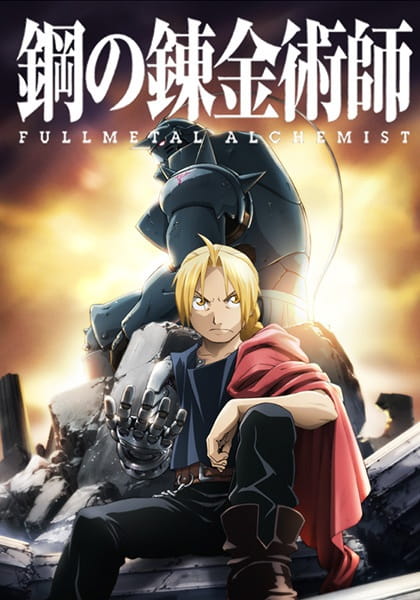
Brotherhood is not the default "perfect entry point" to anime because it's safe. It's the default because Bones, Yasuhiro Irie, and Hiromu Arakawa's completed manga conspired to produce a 64-episode shonen where the Ishvalan flashback, Hughes's murder, Mustang's coup, and Father's nationwide transmutation circle all converge on the Promised Day without a single arc of filler tax. That's a rare alignment, and it's the actual reason you're here looking for a follow-up.
What Brotherhood Is Actually Good At
The Codex has Brotherhood at 9.25, and the shape of that score matters more than the number. Story sits at 9.5, character at 9.4, cultural impact at 9.5, themes at 9.2, world-building at 9.0, animation at 8.8. Read that distribution honestly: Brotherhood is a story-and-character monster with a thematic spine (equivalent exchange as both magic rule and moral thesis) and a worldbuilding system rigorous enough that flame alchemy and Xingese alkahestry feel like dialects of the same grammar. Animation is the lowest criterion. That's not an insult to Bones — the Mustang/Lust duel and the Briggs sequences are still benchmarks — it's a diagnostic. People who love Brotherhood love the writing.
This is where most "anime like Fullmetal Alchemist: Brotherhood" lists collapse. They recommend by aesthetic (steampunk, military uniforms, brothers) or by MyAnimeList adjacency (Brotherhood is 9.11; whatever else is in the 9s goes on the pile). The Codex departs here. If your love of Brotherhood is really a love of foreshadowed plot architecture and ensemble interiority, then the correct next show is not the one that looks similar — it's the one whose criterion vector sits closest to 9.5/9.4/9.2/9.0. That's the methodology behind how Anime Codex ranks anime, and it's what produces the order below.
Hunter × Hunter (2011): The Closest Critical Profile to Brotherhood in the Catalogue
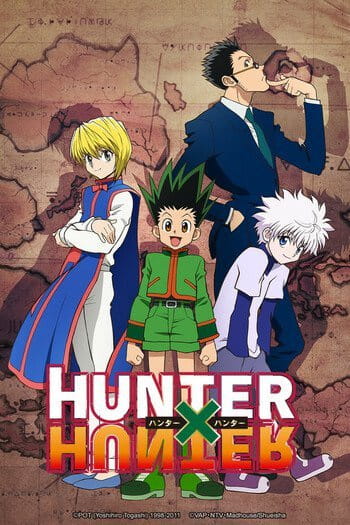
Hunter × Hunter (2011) lands at Codex 9.23 — two-hundredths off Brotherhood, and the profile underneath is almost a mirror image. Story 9.5, character 9.5, themes 9.0, world 9.5, animation 8.5, cultural 8.5. Madhouse's 148-episode adaptation matches Brotherhood's story score outright, edges it on character, and dramatically outpaces it on worldbuilding — Nen as a power system is the rare construction that rivals alchemy's internal consistency, with the added benefit that Togashi keeps escalating its grammar through Greed Island and Chimera Ant rather than locking it down in episode three.
If what hooked you in Brotherhood was the way the Promised Day made every earlier thread pay off simultaneously, Chimera Ant is the closest equivalent the medium offers: a 60-plus-episode arc where Meruem, Komugi, Netero, and Gon's psychological collapse all converge with the same architectural inevitability. It loses Brotherhood on cultural impact (8.5 vs 9.5) because it never became the universal entry-point recommendation, and on animation parity it sits a touch lower than Bones at its sharpest. Everywhere else, this is the recommendation the rubric makes first and loudest.
One Piece: The Character Score That Out-Brotherhoods Brotherhood
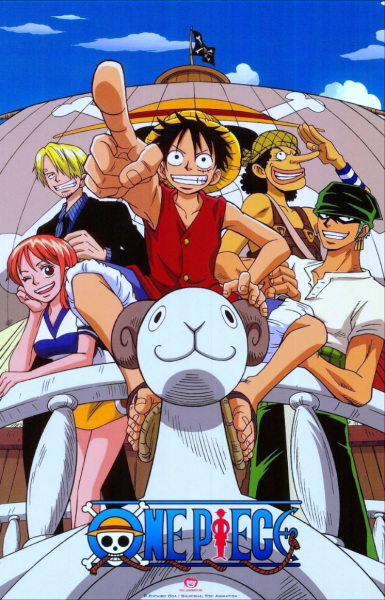
One Piece at Codex 8.58 is the unusual case where one criterion exceeds Brotherhood's own. Story 8.5, character 9.0, themes 8.7. That character figure is not a typo. Toei Animation's two-decade Oda adaptation has built an ensemble whose interiority — Robin at Enies Lobby, Law's flashback at Dressrosa, Sanji's family arc at Whole Cake — operates at the same register where Brotherhood placed Mustang's Ishval guilt and Hawkeye's complicity. Where Arakawa's cast benefits from the discipline of a finite manga, Oda's benefits from sheer accumulated weight.
The thematic kinship is sharper than the aesthetic gap suggests. Brotherhood interrogates state violence through Ishval; One Piece does the same through the World Government, the Celestial Dragons, and the Fish-Man Island arc's reckoning with inherited prejudice. The trade-off is honest: story drops from 9.5 to 8.5 because no ongoing shonen of this length can architect like a completed work, and animation is wildly inconsistent across eras. But if Mustang and Hawkeye were the reason you stayed, the Straw Hats are the longest-running answer in the medium. The Codex explored this dynamic at length in its breakdown of the 10 anime with the best characters.
Dragon Quest: The Adventure of Dai: Brotherhood's Tonal Twin in Miniature
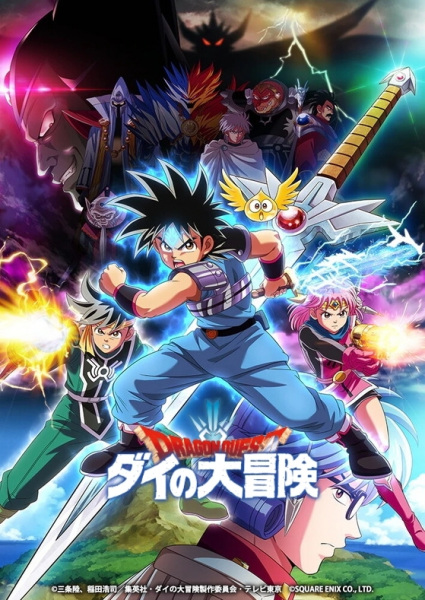
Dragon Quest: The Adventure of Dai at Codex 7.40 is the recommendation that surprises people, and shouldn't. Story 7.5, character 8.0, themes 7.3, world 6.8. Toei's 2020 hundred-episode adaptation of the 1989 manga is doing something structurally identical to Brotherhood: taking a completed source with a known endpoint and adapting it without filler, letting every arc bend toward a climactic final confrontation. The character score is the tell. Popp's arc from coward to mage is the closest thing modern shonen has produced to the supporting-cast interiority Brotherhood made standard.
It's not at Brotherhood's altitude — themes don't push past genre comfort, worldbuilding is competent rather than rigorous, and the visual ceiling is lower. But the shape of the experience is unusually faithful to what made Brotherhood work, and at 100 episodes it's the rare modern shonen that actually finishes.
The Heroic Legend of Arslan: The Worldbuilding Inheritance
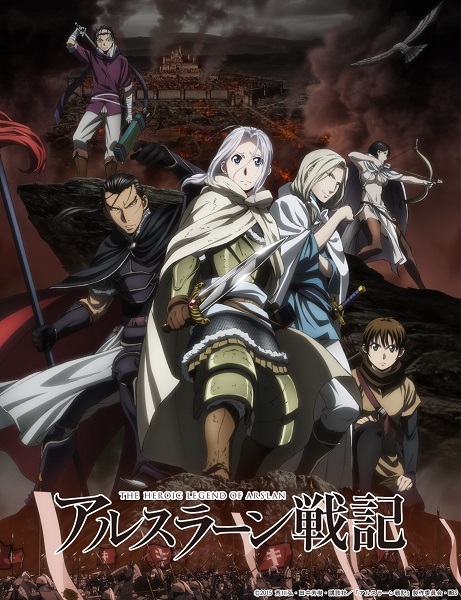
The Heroic Legend of Arslan at Codex 6.93 is the lowest-scored show on this list, and the most defensible inclusion on a single axis. World 7.5, character 7.2, story 7.0, themes 7.0. SANZIGEN's 25-episode 2015 adaptation of Yoshiki Tanaka's novels — adapted through Arakawa's own manga, which is the connective tissue — operates in the geopolitical-fantasy register Brotherhood gestured at with Amestris, Drachma, and Xing but never fully developed.
This is the show for the viewer whose favorite Brotherhood beat was the realization that Amestris was a militarized state founded on hidden genocide. Pars, Lusitania, and the religious-conquest framing give Arslan room to do what Brotherhood was too busy to: actually develop the politics of empire across multiple cultures. Animation is the weakness (Codex 6.0 — the CG is rough), cultural impact is modest, but on the war-and-statecraft axis the inheritance from Arakawa is direct.
Fairy Tail: The Honest Outlier
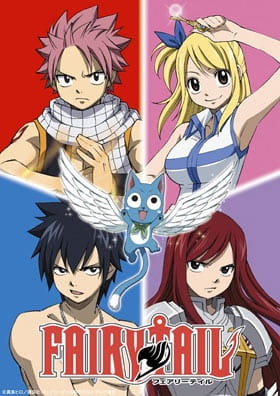
Fairy Tail at Codex 6.25 is the recommendation that requires an asterisk. Story 6.0 — that's the floor of this list by a wide margin. Satelight's 175-episode run shares Brotherhood's structural premise (a magic system, a found family, escalating villains) and almost none of its execution discipline. It is on this list because the criterion that survives intact is the shonen warmth of the ensemble itself, not because it competes with Brotherhood on any axis Brotherhood actually wins.
The Counter-Argument: "These Don't Look Like Brotherhood"
The honest objection is that none of these — except maybe Dai — visually or tonally resemble Brotherhood. No automail, no homunculi, no Roy Mustang. Pattern-matching recommendation logic would surface Soul Eater or Blue Exorcist instead, and that's the consensus path most lists take.
The rubric reads it differently. Brotherhood's animation score is its lowest component. Recommending by visual or tonal similarity optimizes for the criterion Brotherhood is weakest on. Recommending by story, character, themes, and worldbuilding — its actual strengths — produces this list. The aesthetic mismatch is the feature, not the bug.
Verdict
Hunter × Hunter is the recommendation if you trust the numbers. One Piece is the recommendation if you stayed for the ensemble. Dai is the recommendation if you want the structural experience again at smaller scale, Arslan if you want the geopolitics Brotherhood underdeveloped, and Fairy Tail if you've already exhausted the other four. The rubric doesn't recommend by vibe. It recommends by which criteria carried Brotherhood — and these are the five that share the load.
Featured in the Codex
More from The Codex
The Seven Deadly Sins Is a 6.60 Wearing a 7.60 Costume: A One-Point Gap Earned by Groping Gags and Convenient Flashbacks
The Seven Deadly Sins scores 6.60 on the Codex against MyAnimeList's 7.60 because the crowd is grading a Netflix breakout and a Ban-and-King friendship, not the 24 episodes A-1 Pictures actually broadcast in 2014.
The 10.0 That Built a Sunday: How Sazae-san's Cultural Score Carries a 6.58 Scorecard
Sazae-san is a case study in how a single criterion — cultural — can define how a show is remembered, and the 10.0 the Codex hands Eiken's 1969 institution is doing every bit of the heavy lifting its other five scores refuse to.
The Sebastian Problem: Why Black Butler Sits 1.10 Below Its MAL Line and the Crowd Refuses to Notice
Black Butler (Kuroshitsuji) posts a 1.10-point gap between MyAnimeList's 7.65 and the Codex 6.55 because the crowd is grading Sebastian's silhouette and a Phantomhive aesthetic, not the anime-original finale A-1 Pictures actually shipped in 2009.
Discussion
Set a display name above to post.
Loading discussion…