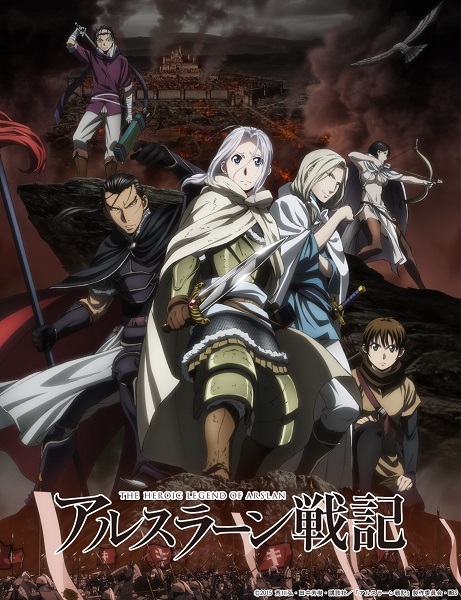
The Heroic Legend of Arslan
Is The Heroic Legend of Arslan worth watching?
Worth a look. Anime Codex rates The Heroic Legend of Arslan 6.93 out of 10 — scored on six criteria (story, characters, themes, world-building, animation, and cultural impact), not crowd votes. 136th of 226 on the Codex rubric — bottom 41% of the catalogue. The crowd rates it 0.72 higher than the rubric does — the Codex is harder on it than on 61% of the catalogue.
Where to watch
Trailer
What the data says
Computed from the Codex rubric across the whole catalogue.
Summary
The Heroic Legend of Arslan distinguishes itself within shonen primarily through its setting and ambition: a Persian-inspired war-of-succession epic adapted from Yoshiki Tanaka's novels, trading the genre's usual battle tournaments for political betrayal, religious conflict, and the moral education of a young king. Arslan's growth from a sheltered prince into a ruler who questions slavery and fanaticism is genuinely engaging, anchored by a memorable supporting cast — the unshakeable Daryun, the brilliant and vain strategist Narsus, and the antagonist Hermes, whose claim to the throne supplies real dramatic tension. The world-building is the show's strongest asset, offering a textured, historically grounded alternative to the medieval-European fantasy that dominates the demographic. Its weaknesses are equally clear: the CGI used for the mass battles, which should be the show's spectacle, often looks stiff and weightless, and the 25-episode adaptation loses narrative momentum in its second half, leaving threads unresolved and themes raised but underexplored. It is a thoughtful, handsomely designed series that rewards patience but never quite delivers the climactic payoff its premise promises — good and distinctive, but flawed in execution rather than definitive of its kind.
Criterion breakdown
Story & narrative
Adapted from Yoshiki Tanaka's novels, the narrative grounds itself in a genuine war-of-succession epic rather than monster-of-the-week beats, opening strongly with the betrayal at Atropatene and the fall of Ecbatana. The Silver Mask (Hermes) subplot involving Arslan's contested legitimacy gives the political intrigue real stakes, but the 25-episode run noticeably loses momentum in its back half, where the second season's coverage feels rushed and several siege engagements blur together without satisfying resolution.
Character writing & growth
Arslan's arc from sheltered, naive prince toward a ruler who questions slavery and earns loyalty is the show's spine, and it grows him credibly through episodes like his confrontation with Kharlan and his idealistic clashes with Andragoras. The supporting cast is the real strength — Daryun's stoic loyalty, Narsus's strategic arrogance, Gieve and Farangis's lighter dynamic, and Etoile's religious foil — though Hermes is given strong motivation that the adaptation never fully pays off, and several retainers stay one-note.
Themes & emotional resonance
The series engages seriously with kingship, religious fanaticism (Lusitania's monotheism versus Parsian polytheism), and the ethics of slavery, with Arslan's abolitionist leanings positioned as the moral core. These ideas are presented with more nuance than typical shonen, but the show often raises them and then retreats to battlefield spectacle before the emotional weight lands fully.
World-building & power system
The Persian-inspired setting of Pars is a genuine standout in a demographic saturated with quasi-European or Japanese fantasy worlds, drawing on Achaemenid and Sassanid aesthetics for a distinct flavor. Tanaka's political and religious conflicts feel internally consistent and historically textured, with the Lusitanian crusade reading as a clear medieval-crusades analogue, though the geography of the wider region stays vague.
Animation & direction
Studio Pierrot and SANZIGEN's hybrid approach produces handsome character art and strong individual duels, but the CGI armies in the large-scale battles — the supposed centerpiece of a war epic — frequently look stiff and weightless, undercutting the scale. Direction is competent and the costume and architectural design impress, yet the animation is the weakest pillar and visibly strains during the climactic sieges.
Cultural impact
As an adaptation of a long-running, respected novel series with a Hiromu Arakawa manga, Arslan carried built-in prestige and drew a solid audience, but its impact remains modest — the rushed second season and unfinished story dampened its staying power. It is fondly regarded as a competent historical-fantasy entry rather than a genre-defining one.
Synopsis (from MAL)
The year is 320. Under the rule of the belligerent King Andragoras III, the Kingdom of Pars is at war with the neighboring empire, Lusitania. Though different from his father in many aspects, Arslan, the young prince, sets out to prove his valor on the battlefield for the very first time. However, when the king is betrayed by one of his most trusted officials, the Parsian army is decimated and the capital city of Ecbatana is sieged. With the army in shambles and the Lusitanians out for his head, Arslan is forced to go on the run. With a respected general by his side, Daryun, Arslan soon sets off on a journey in search of allies that will help him take back his home. However, the enemies that the prince faces are far from limited to just those occupying his kingdom. Armies of other kingdoms stand ready to conquer Ecbatana. Moreover, the mastermind behind Lusitania's victory, an enigmatic man hiding behind a silver mask, poses a dangerous threat to Arslan and his company as he possesses a secret that could jeopardize Arslan's right to succession. With the odds stacked against him, Arslan must find the strength and courage to overcome these obstacles, and allies who will help him fight in the journey that will help prepare him for the day he becomes king. [Written by MAL Rewrite]
Ranked nearby



Explore rankings
Discussion
Set a display name above to post.
Loading discussion…