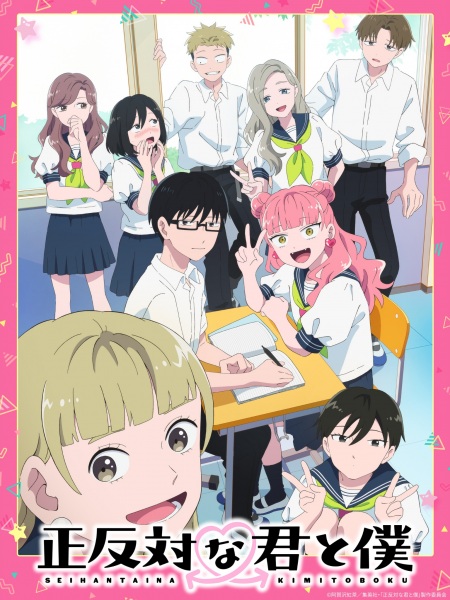
You and I Are Polar Opposites
Is You and I Are Polar Opposites worth watching?
Worth a look. Anime Codex rates You and I Are Polar Opposites 6.93 out of 10 — scored on six criteria (story, characters, themes, world-building, animation, and cultural impact), not crowd votes. 135th of 226 on the Codex rubric — bottom 41% of the catalogue. The crowd rates it 1.36 higher than the rubric does — the Codex is harder on it than on 88% of the catalogue.
Where to watch
Trailer
What the data says
Computed from the Codex rubric across the whole catalogue.
Summary
You and I Are Polar Opposites is a confident, character-first school romance that distinguishes itself by resolving its central confession early and devoting its back half to the messier reality of a relationship between two genuinely incompatible temperaments. Its greatest strength is the writing of its leads: Suzuki's conformity-driven anxiety and Yuusuke's social detachment are treated as real psychological pressures, and their mutual, incremental growth feels earned rather than convenient. Lapin Track's direction supports this with intimate, restraint-driven framing that lets glances and physical distance carry emotional weight. The show's weaknesses are those of its subgenre: a generic contemporary-school setting with no setting originality beyond the premise, a thin supporting cast, and an episodic structure that pads its middle stretch with low-stakes filler. It is also thematically gentle, gesturing at authenticity versus belonging without pressing those ideas to anything uncomfortable. Judged against the best romance-leaning shonen, it is a polished, emotionally legible entry that does the fundamentals very well without reaching for the formal ambition or thematic depth of the genre's finest. A satisfying, well-crafted watch that earns its strong audience reception while falling short of definitive status.
Criterion breakdown
Story & narrative
The narrative is a clean, confession-forward romance that smartly front-loads Suzuki's declaration rather than dragging out a will-they-won't-they premise across all twelve episodes, freeing the back half to explore the harder work of an actual relationship. However, the arc structure is episodic and low-stakes to a fault — beyond the central confession beat, the show rarely escalates conflict, leaning on minor misunderstandings and school-event filler that pad rather than deepen the throughline.
Character writing & growth
The opposites premise is executed with real specificity: Suzuki's people-pleasing anxiety and Yuusuke's indifference to social expectation are written as genuine internal pressures rather than quirks, and the show lets each character's strength expose the other's weakness convincingly. The growth is mutual and incremental — Suzuki learning to voice her own wants, Yuusuke learning that detachment is its own form of avoidance — though the supporting cast remains thinly sketched and exists mostly to reflect the leads.
Themes & emotional resonance
The show's strongest thematic vein is the tension between authenticity and belonging, embodied cleanly in the contrast between Suzuki's conformity and Yuusuke's autonomy. It earns quiet emotional moments through restraint rather than melodrama, but it stops short of interrogating these ideas deeply, treating self-acceptance as a gentle arc rather than a genuinely difficult reckoning.
World-building & power system
Read as setting depth, this is a conventional contemporary high-school backdrop with little to distinguish its classrooms, festivals, and cafe outings from the genre's standard furniture. The premise itself — the polarity of temperaments — is the only real source of originality, and it carries the show despite an internally consistent but unambitious world that never extends beyond the immediate orbit of the two leads.
Animation & direction
Lapin Track delivers warm, soft-palette direction that prioritizes intimate framing — close cuts on hands, averted glances, and the physical distance between desks — to externalize emotional states without dialogue. Character acting in the confession sequence is a clear standout, but the show is visually modest overall, with limited backgrounds and conservative episode-to-episode quality that rarely reaches for memorable composition.
Cultural impact
A strong 8.29 MAL score across 213,000 members indicates solid resonance within the romance-leaning shonen audience, and the opposites-attract framing taps a reliable, popular vein. Still, it arrives as a competent entry in an extremely crowded subgenre rather than a trend-setter, with no evidence of the broader crossover or lasting discourse that defines genre-defining titles.
Synopsis (from MAL)
Miyu Suzuki is a high school girl whose cheerful outlook on life is tempered by her need to fit in. Coincidentally, beside her in the classroom sits Yuusuke Tani, a boy unconcerned with others' expectations. Their exchanges rarely extend beyond brief discourse, yet the polarity of their demeanors unexpectedly draws them to one another. As their mutual interest grows, the newfound feelings are no longer easy to ignore. Eventually, Suzuki voices what is inside her heart, forcing both of them to confront the unspoken affection between them. With each passing moment, their relationship evolves, and they gradually come to better understand themselves and the person who is their polar opposite. [Written by MAL Rewrite]
Ranked nearby




Explore rankings
Discussion
Set a display name above to post.
Loading discussion…