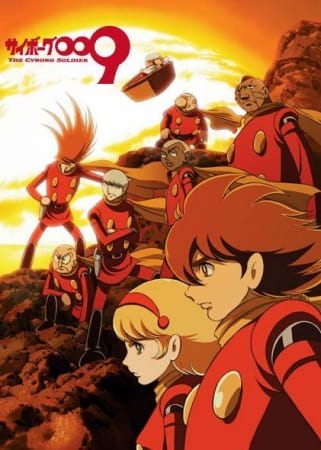
Cyborg 009
Is Cyborg 009 worth watching?
Worth a look. Anime Codex rates Cyborg 009 6.92 out of 10 — scored on six criteria (story, characters, themes, world-building, animation, and cultural impact), not crowd votes. 138th of 226 on the Codex rubric — bottom 40% of the catalogue. The crowd rates it 0.47 higher than the rubric does — the Codex is harder on it than on 46% of the catalogue.
Where to watch
Streaming availability varies by region — check your local services.
What the data says
Computed from the Codex rubric across the whole catalogue.
Summary
Cyborg 009 (2001) is a faithful, earnest revival of Shotaro Ishinomori's seminal manga, and it should be judged as a classically-minded shonen rather than a modern action spectacle. Its greatest strength is thematic: a sincere anti-war, anti-arms-industry conscience and a persistent question of whether nine weaponized humans can reclaim their humanity, culminating in unusually metaphysical late arcs about gods, fate, and human self-destruction. The nine-member ensemble is its emotional core, with Joe, Jet, Albert, and Dr. Gilmore well-served, though fifty episodes cannot give every cyborg meaningful interiority, leaving several as power-gimmicks. The premise — multinational abductees rebuilt as cyborgs who turn on their creators — remains original and prescient, and the individual abilities are used with consistency and cleverness. Weaknesses are real: the episodic early stretch feels dated, the digital 2001 animation fluctuates and has aged unevenly, action is modest, and the ambiguous ending frustrates without supplementary material. As a foundational franchise it carries immense historical influence over the cyborg-team and tokusatsu lineage. The result is a thoughtful, slightly uneven adaptation — good but flawed — that rewards viewers interested in classic shonen ideals over flashy modern execution.
Criterion breakdown
Story & narrative
The 2001 adaptation faithfully tracks Shotaro Ishinomori's manga, moving from the origin/Black Ghost arc through the Mythos cyborgs and the philosophically ambitious 'Battle with the Gods' and final angel/demon arcs. The early episodic enemy-of-the-week structure feels dated and uneven, but the back half escalates into surprisingly metaphysical territory that distinguishes it from contemporary shonen; the abrupt, ambiguous ending (resolved partly by the later OVA) is a real narrative weakness for newcomers.
Character writing & growth
The nine-member ensemble is the franchise's heart — Joe Shimamura's reluctant-soldier conscience, Jet's hotheadedness, Albert's stoic grief, and Dr. Gilmore's paternal guilt give the cast texture. However, fifty episodes spread thin across nine cyborgs means several members (Chang, Great Britain, Pyunma) get little interior development beyond their gimmick power, and growth is more thematic than arc-driven.
Themes & emotional resonance
This is the show's strongest dimension: Ishinomori's anti-war, anti-arms-dealer message and the recurring question of what makes the cyborgs human rather than weapons carry genuine weight, especially in 0010/0011 and the war-profiteering episodes. The late religious arcs interrogate fate, free will, and humanity's self-destructive impulse with an earnestness rare in the demographic, even if execution sometimes preaches more than it dramatizes.
World-building & power system
The premise — conscripted multinational victims rebuilt as cyborgs who defect from their creators — remains strikingly original and prescient for a property rooted in the 1960s. Each cyborg's specific ability (acceleration, fire-breathing, telepathy, transformation) is internally consistent and used cleverly, though the global-Cold-War-flavored setting feels more sketched than deeply realized in this adaptation.
Animation & direction
Studio Vistec/Ishimori delivers clean early-digital 2001 production with strong character designs faithful to Ishinomori's lineart and memorable acceleration-mode sequences for 009. Direction is competent and occasionally striking in the surreal final arcs, but action choreography is modest, animation quality fluctuates across the fifty episodes, and the digital compositing has aged less gracefully than cel-era contemporaries.
Cultural impact
As an adaptation of one of manga's foundational works by Shotaro Ishinomori, Cyborg 009 carries enormous historical weight — it predates and influenced countless team-cyborg and tokusatsu properties. The 2001 series itself is a respectful revival rather than a landmark, but the franchise's pioneering status earns strong marks here.
Synopsis (from MAL)
Skull, the evil leader of the terrorist organization known as Black Ghost, has nine powerful cyborgs under his control. But Dr. Isaac Gilmore, the Black Ghosts cybernetics scientist, decides to go rogue, helping the cyborgs turn against Skull and his evil organization. Black Ghost wishes to start the next major world war by flooding the market with weapons of mass destruction. It seems the nine brave cyborgs have their work cut out for them, as Black Ghost is determined to bring those nine cyborgs down.
Ranked nearby


Explore rankings
Discussion
Set a display name above to post.
Loading discussion…