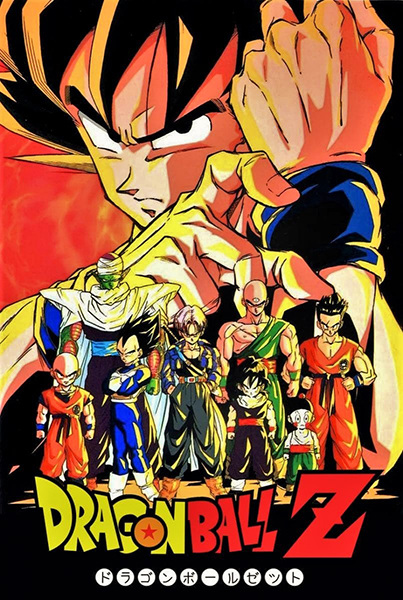
Dragon Ball
Is Dragon Ball worth watching?
Worth a look. Anime Codex rates Dragon Ball 6.93 out of 10 — scored on six criteria (story, characters, themes, world-building, animation, and cultural impact), not crowd votes. 133rd of 226 on the Codex rubric — bottom 42% of the catalogue. The crowd rates it 1.28 higher than the rubric does — the Codex is harder on it than on 85% of the catalogue.
Where to watch
What the data says
Computed from the Codex rubric across the whole catalogue.
Summary
Dragon Ball Z is the load-bearing pillar of the battle shonen genre, and judged against its own kind it remains a foundational, hugely entertaining work. Its strengths are spectacle and escalation: the Frieza and Cell arcs deliver genre-defining set pieces, the Super Saiyan transformation became cultural shorthand, and Vegeta's redemptive journey plus Gohan's coming-of-age provide real emotional anchors. Its world-building introduced concepts—scouters, power levels, ki auras, fusion—that the entire genre subsequently borrowed. The weaknesses are equally clear. The 291-episode anime adaptation is padded relentlessly, with charged standoffs and reaction shots stretching single moments across multiple episodes, and animation quality swings from stunning to threadbare recycled footage. Narratively it is formulaic—stronger villain, training montage, last-second victory—and the Dragon Balls' resurrection mechanic and Senzu beans repeatedly undercut tension. Most of the supporting cast is demoted to bystanders, and Gokuu grows in power without growing as a person. Thematically it is sincere but unexamined. Still, no honest accounting of shonen can dismiss it: as a template-setter, an emotional crowd-pleaser, and a cultural juggernaut, DBZ is essential, even if its execution is rougher and baggier than the genre's later, tighter masterworks.
Criterion breakdown
Story & narrative
The escalating arc structure—Saiyan, Frieza, Cell, Buu—delivers consistent momentum and memorable stakes, with the Frieza arc on Namek standing as a high point of sustained tension. However, the narrative leans heavily on repetitive beats: a new stronger villain appears, training raises power levels, the hero wins at the last moment, and the infamous Namek 'five minutes' that stretched across many episodes exposes the pacing bloat endemic to its 291-episode anime-original padding.
Character writing & growth
Vegeta's evolution from genocidal villain to grudging anti-hero father is the standout arc, and Gohan's growth from timid child to the Cell Games warrior gives the series its emotional spine. The weakness is that the broader cast—Krillin, Tien, Yamcha, Piccolo to a degree—is progressively sidelined into spectators, and Gokuu himself remains largely static in personality despite endless power escalation, prioritizing the next fight over interior development.
Themes & emotional resonance
The series threads genuine emotional weight through paternal legacy (Gokuu and Gohan, Vegeta and Trunks) and self-sacrifice, with Gokuu's death against Raditz and Vegeta's tearful end against Buu being real high points. But thematic depth is shallow compared to the best shonen; perseverance and protecting loved ones are sincere but rarely interrogated, and the relentless tournament-fight cadence flattens reflection.
World-building & power system
The Saiyan backstory, scouters, the Namekian Dragon Balls, and the fusion mechanics expand Toriyama's universe inventively, and the ki/power-level system is iconic for codifying the visible 'auras' and transformations later copied across the genre. Yet internal consistency frays badly—power levels are abandoned mid-series, Senzu beans and resurrection via Dragon Balls repeatedly defuse stakes, and the escalating numbers become arbitrary rather than meaningful.
Animation & direction
Toei's direction produces era-defining iconography—the Super Saiyan transformation against Frieza, the Spirit Bomb, the Kamehameha—with strong key animation in climactic moments. But the production is wildly inconsistent: long stretches of recycled footage, motion-line backgrounds substituting for movement during charged standoffs, and the notorious filler that stalls action for whole episodes betray clear budget-stretching across its enormous run.
Cultural impact
Few anime have shaped the medium and the genre more decisively; DBZ defined the template of the modern battle shonen, from transformations and power escalation to tournament structure, influencing Naruto, One Piece, and Bleach directly. Its global reach—Toonami, Latin America, Europe—made it a gateway franchise for generations and a permanent fixture of pop culture.
Synopsis (from MAL)
Five years after winning the World Martial Arts tournament, Gokuu is now living a peaceful life with his wife and son. This changes, however, with the arrival of a mysterious enemy named Raditz who presents himself as Gokuu's long-lost brother. He reveals that Gokuu is a descendant of the once powerful but now virtually extinct Saiyan race, whose homeworld was annihilated. When he was sent to Earth as a baby, Gokuu's sole purpose was to conquer and destroy the planet; but after suffering amnesia from a head injury, his violent and savage nature changed, and instead was raised as a kind and well-mannered boy, now fighting to protect others. With his failed attempt at forcibly recruiting Gokuu as an ally, Raditz warns Gokuu's friends of a new threat that's rapidly approaching Earth—one that could plunge Earth into an intergalactic conflict and cause the heavens themselves to shake. A war will soon be fought over the seven mystical Dragon Balls, magic objects that can grant any wish. Only the strongest will survive. [Written by MAL Rewrite]
Ranked nearby

Explore rankings
Discussion
Set a display name above to post.
Loading discussion…