
I Want to End this Love Game
Is I Want to End this Love Game worth watching?
Worth a look. Anime Codex rates I Want to End this Love Game 6.92 out of 10 — scored on six criteria (story, characters, themes, world-building, animation, and cultural impact), not crowd votes. 139th of 226 on the Codex rubric — bottom 39% of the catalogue. The crowd rates it 0.40 higher than the rubric does — the Codex is harder on it than on 42% of the catalogue.
Where to watch
Trailer
What the data says
Computed from the Codex rubric across the whole catalogue.
Summary
I Want to End this Love Game stands out in a saturated school rom-com field through one genuinely sharp idea: weaponizing the confession itself, turning 'I love you' into both a competitive jab and a creeping truth the leads can't control. Felix Film wisely pours its production into expressive close-up character acting, letting Yukiya and Miku's suppressed embarrassment and dawning sincerity carry the show. At its best, it generates real tension from the fear that winning means losing the friendship — a smarter emotional core than most genre stasis. The limitations are structural: the turn-based format is inherently repetitive, individual challenges blur by the cour's end, and the premise resists the very progression romance fans crave, leaving the central relationship somewhat frozen. The supporting cast is thin, functioning as instigators rather than characters, and the high school setting adds little texture. Thematically it nails one note — the terror of changing something comfortable — without reaching beyond it. The result is a well-crafted, charming entry that excels at its core gimmick and emotional micro-beats, but settles for being a strong seasonal rom-com rather than a definitive one. Recommended for genre fans; those impatient with prolonged will-they-won't-they tension should temper expectations.
Criterion breakdown
Story & narrative
The 'say I love you to embarrass the other' premise is a clever engine for romantic tension, weaponizing the very confession most rom-coms build toward, and the show mines genuine suspense from each round of the game. However, the episodic 'one-up' structure is inherently repetitive — by the back half of the cour, individual challenges start to blur, and the central will-they-won't-they stalls because the format actively resists resolution. The arc where the game's rules begin breaking down as real feelings intrude is the strongest stretch, but the narrative leans on stasis more than progression.
Character writing & growth
Yukiya and Miku are well-realized as childhood friends whose competitiveness masks vulnerability, and the writing is sharp at showing how their bravado cracks the moment a 'win' lands too close to sincerity. Miku in particular gets strong interiority — her internal panic when Yukiya escalates contrasts nicely with her smug exterior. The weakness is the supporting cast, who function mostly as referees and instigators rather than people, leaving the emotional weight resting almost entirely on the two leads.
Themes & emotional resonance
The show thoughtfully explores the fear of changing a comfortable relationship — the idea that ending the game means risking the friendship itself — which gives the romantic hesitation real emotional logic rather than artificial stalling. There's a genuine poignancy in how 'I love you' becomes harder to say as a joke precisely because it starts being true. It doesn't dig much deeper than this single, well-handled note, however, keeping its thematic ambitions modest.
World-building & power system
As a grounded school rom-com, the 'setting depth' lies in the rules and escalating stakes of the love game itself, which the show treats with pleasing internal consistency — the unspoken etiquette of who blushes first, what counts as a win. The premise is genuinely original within its crowded subgenre, distinguishing it from standard misunderstanding-driven rom-coms. The high school backdrop itself is generic and underused, contributing little texture beyond a stage for the central dynamic.
Animation & direction
Felix Film delivers expressive, blush-heavy character acting that sells the central conceit — the micro-expressions of suppressed embarrassment are the show's visual core, and the direction frequently uses tight close-ups and held reaction beats to milk the tension of each confession. Color and lighting shift subtly to mark when a line crosses from game to genuine. Backgrounds and overall production are competent but unremarkable, with the budget clearly concentrated on faces rather than spectacle, which is the correct call for this material.
Cultural impact
A 7.32 MAL score with nearly 80,000 members for an ongoing series signals solid traction within the romance-comedy fanbase, and the hooky premise has given it meme-able clip appeal. It is not, however, a genre-defining or conversation-shifting work in the way of the subgenre's heavyweights, and its impact reads as a strong seasonal performer rather than a lasting landmark.
Synopsis (from MAL)
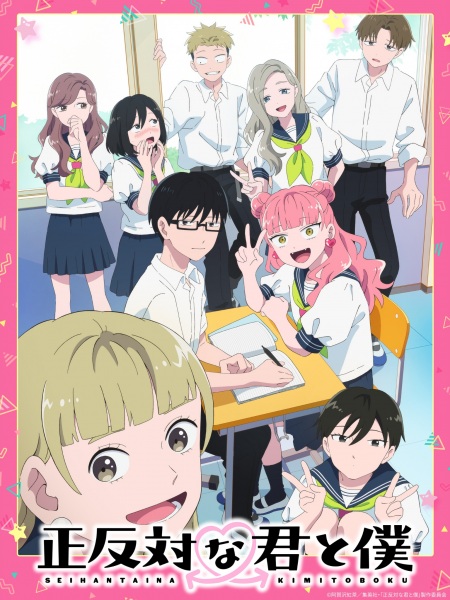
In sixth grade, childhood friends Yukiya Asagi and Miku Sakura created a game with the objective to embarrass the other person by taking turns saying "I love you." Four years later, even as they are entering high school, the two are still trying to one-up the other and claim victory. However, as tender feelings begin to bloom in their hearts, the simple phrase has taken on new meaning beyond the rules of their game. With the passing of each day, the urge to become more than childhood friends grows—but both Yukiya and Miku resist making the first move, hesitant about what is in store once the game finally ends. [Written by MAL Rewrite]
Ranked nearby




Explore rankings
Discussion
Set a display name above to post.
Loading discussion…