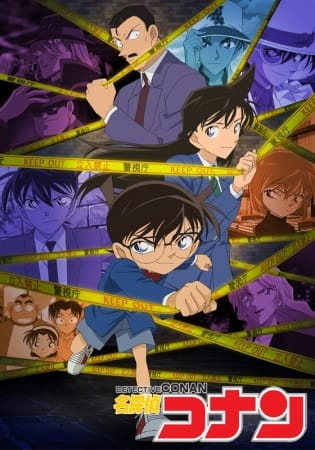
Detective Conan (Case Closed)
Is Detective Conan (Case Closed) worth watching?
Worth a look. Anime Codex rates Detective Conan (Case Closed) 6.55 out of 10 — scored on six criteria (story, characters, themes, world-building, animation, and cultural impact), not crowd votes. 173rd of 226 on the Codex rubric — bottom 24% of the catalogue. The crowd rates it 1.64 higher than the rubric does — the Codex is harder on it than on 95% of the catalogue.
Where to watch
What the data says
Computed from the Codex rubric across the whole catalogue.
Summary
Detective Conan is a foundational mystery-shonen institution built on a brilliantly generative premise: a teenage detective shrunk into a child's body, solving crimes while chasing the organization that did it. Within its genre, its case construction is consistently sharp—locked rooms, alibi-breaking, and clever misdirection that respect the audience's intelligence—and its faux-gadget 'power system' is internally coherent and fun. Conan himself anchors the show, while Ai Haibara provides its rare emotional depth. Its greatest strength is also tied to its greatest weakness: the format demands a frozen status quo, so the Shinichi-Ran romance and the central drug-reversal plot crawl forward across more than a thousand episodes, padded by filler that tests patience. Characters rarely grow, death is often reduced to puzzle fuel, and the TV animation has aged poorly compared to the superior theatrical films. Yet within the detective-shonen niche it essentially defines, no series matches its longevity, consistency, or cultural saturation in Japan. It is best judged not as a tightly plotted thriller but as an evergreen mystery procedural—immensely reliable at its core craft, structurally repetitive, and culturally monumental despite its modest production and deliberately static cast.
Criterion breakdown
Story & narrative
The case-of-the-week structure is reliably clever, with standout entries like the Moonlight Sonata arc and the Desperate Revival arc demonstrating genuine ingenuity in misdirection and locked-room puzzles. However, the overarching Black Organization plot moves at a glacial pace across 1000+ episodes, with the central drug-reversal premise barely advancing, and the show leans heavily on episodic filler that dilutes narrative momentum. The APTX 4869 mystery and figures like Gin and Vermouth offer compelling stakes when they appear, but their rarity exposes the format's reliance on repetition.
Character writing & growth
Conan/Shinichi is a strong central figure, but the cast is largely static by design—Ran's obliviousness, Kogorou's bumbling, and the Detective Boys' antics remain frozen to preserve the status quo. The Shinichi-Ran relationship inches forward over hundreds of episodes with minimal payoff, and genuine growth is reserved for peripheral figures like Ai Haibara, whose guilt over the organization gives her real interiority. The deliberate stasis serves the mystery format but caps emotional development well below shonen's character-driven best.
Themes & emotional resonance
Recurring themes of identity, isolation, and the burden of a hidden self resonate through Conan's inability to reveal himself to Ran, and Ai Haibara's arc touches on atonement effectively. Justice and the rationality of truth-seeking are consistent throughlines, but the episodic murder format rarely lingers long enough for emotional weight, treating death as puzzle fuel more than tragedy. The strongest emotional beats—the films' confessional moments, Shinichi's longing—are episodic exceptions rather than the rule.
World-building & power system
The premise—a brilliant detective trapped in a child's body—is genuinely original and structurally generative, enabling endless scenarios while sustaining a comedic-tense double life. The internal logic of the gadgets (voice-changing bowtie, tranquilizer wristwatch, soccer-ball belt) is consistent and clever, functioning as a faux power system that respects its own rules. The contemporary Japanese setting is realistic rather than deep, but the criminal-organization mythology adds welcome scale, even if underdeveloped relative to its runtime.
Animation & direction
Production values are modest and have aged unevenly across decades, with flat TV-budget animation, repetitive deduction-sequence framing, and recycled establishing shots. Direction shines in tension-building during reveals—the dramatic spotlight effect during Conan's accusations and the iconic 'the truth is always only one' framing are effective signatures. The theatrical films (e.g., The Phantom of Baker Street) far outclass the series in fluidity and spectacle, exposing the weekly show's visual limitations.
Cultural impact
Detective Conan is a genuine cultural institution in Japan, one of the longest-running and best-selling manga franchises with annual films routinely topping the domestic box office. It revitalized mainstream interest in the mystery genre within shonen and remains a household name decades on. Its international footprint is smaller than action-shonen titans, but its sustained domestic dominance is remarkable.
Synopsis (from MAL)
Shinichi Kudou, a high school student of astounding talent in detective work, is well known for having solved several challenging cases. One day, when Shinichi spots two suspicious men and decides to follow them, he inadvertently becomes witness to a disturbing illegal activity. Unfortunately, he is caught in the act, so the men dose him with an experimental drug formulated by their criminal organization, leaving him to his death. However, to his own astonishment, Shinichi lives to see another day, but now in the body of a seven-year-old child. Perfectly preserving his original intelligence, he hides his real identity from everyone, including his childhood friend Ran Mouri and her father, private detective Kogorou Mouri. To this end, he takes on the alias of Conan Edogawa, inspired by the mystery writers Arthur Conan Doyle and Ranpo Edogawa. Shinichi, as Conan, starts secretly solving the senior Mouri's cases from behind the scenes with his still exceptional sleuthing skills, while covertly investigating the organization responsible for his current state, hoping to reverse the drug's effects someday. [Written by MAL Rewrite]
Ranked nearby


Explore rankings
Discussion
Set a display name above to post.
Loading discussion…