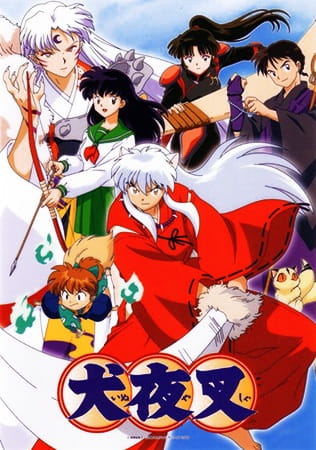
InuYasha
Is InuYasha worth watching?
Worth a look. Anime Codex rates InuYasha 6.53 out of 10 — scored on six criteria (story, characters, themes, world-building, animation, and cultural impact), not crowd votes. 177th of 226 on the Codex rubric — bottom 23% of the catalogue. The crowd rates it 1.35 higher than the rubric does — the Codex is harder on it than on 87% of the catalogue.
Where to watch
Trailer
What the data says
Computed from the Codex rubric across the whole catalogue.
Summary
InuYasha is a foundational feudal-fantasy shonen whose strengths lie in atmosphere, folklore-rooted world-building, and an emotionally resonant central cast — Inuyasha's half-demon identity struggle, the tragic Kikyou romance, and the Sango-Miroku subplot all give it more emotional texture than typical monster-hunting fare. Naraku ranks among the genre's more memorable schemers, and Kaoru Wada's score is genuinely affecting. Its weaknesses, however, are structural and significant: the shard-hunting premise breeds heavy filler that cripples pacing across 167 episodes, the love triangle stagnates for dozens of hours, and the original anime ends without resolving its core conflict, requiring the later Final Act to finish the story. The power system functions more as timed plot upgrades than a consistent ruleset, and combat leans on recycled animation. Judged against the best shonen of its era, InuYasha is a beloved, durable, and atmospheric series that punches above its weight emotionally but is held back by bloat and a notoriously incomplete original run. It earns its place as an influential Western gateway title without reaching the top tier of its demographic. A good show, flawed by its length and lack of narrative discipline.
Criterion breakdown
Story & narrative
The shard-hunting framework gives the series a clear engine but quickly becomes its biggest liability, generating dozens of monster-of-the-week filler episodes that stall momentum across its 167-episode run. The Naraku arc provides a genuinely compelling spine — his manipulations, the Band of Seven, and the tragic Kikyou-Onigumo backstory are highlights — but the original anime infamously ends without resolution at episode 167, leaving the central conflict dangling until The Final Act. The pacing problem, where major plot beats are separated by long stretches of repetitive errand-running, keeps this from rising above competent.
Character writing & growth
Inuyasha's arc from a guarded, Kikyou-haunted half-demon to someone who chooses Kagome is the show's strongest throughline, and Sango and Miroku arrive with real emotional stakes (Sango's brother Kohaku under Naraku's control, Miroku's wind tunnel curse). However, the Inuyasha-Kagome-Kikyou love triangle stagnates badly, recycling the same jealousy beats for over a hundred episodes, and Kagome too often slides into a reactive role whose main contribution is sensing shards and 'sit' commands. Sesshomaru and Rin offer the most quietly surprising growth in the cast.
Themes & emotional resonance
The half-demon identity theme — belonging to neither human nor demon world — gives Inuyasha emotional weight rare in monster-hunting shonen, and Kikyou's lingering ghost makes mortality and unfinished love a persistent ache. The Miroku-Sango romance and Sango's anguish over Kohaku land genuine emotional moments. Yet the show rarely interrogates these themes with depth, and the endless filler dilutes resonance, so the emotional highs feel scattered rather than cumulative.
World-building & power system
The Sengoku-era setting grounded in actual Japanese folklore — yokai, the Shikon Jewel's Buddhist purity-versus-corruption logic, shrine maiden spiritual powers — gives the world a textured authenticity many fantasy shonen lack. The well as a time-bridge between modern Tokyo and feudal Japan is a clean, memorable premise. The 'power system' is loose rather than rigorous (Tessaiga's escalating techniques like Wind Scar and Backlash Wave function more as plot-timed upgrades than a consistent ruleset), keeping this strong but not exceptional.
Animation & direction
Sunrise delivers solid late-2000s TV production with strong character designs faithful to Rumiko Takahashi's art and atmospheric feudal landscapes. Combat is serviceable but heavily reliant on recycled stock footage for signature attacks like the Wind Scar, and many filler episodes show visibly lower budgets. Yasunao Aoki's direction handles the melancholic Kikyou scenes well, and Kaoru Wada's score — especially 'Affections Touching Across Time' — is a standout that elevates emotional sequences.
Cultural impact
InuYasha was a defining early-2000s gateway anime in the West via Adult Swim, cementing Rumiko Takahashi's mainstream international reach alongside Ranma 1/2. Its character designs, opening themes (notably 'Change the World' and 'My Will'), and the Inuyasha-Kagome pairing remain enduring fandom touchstones, and the franchise's longevity — culminating in the sequel Yashahime — speaks to lasting impact.
Synopsis (from MAL)
Kagome Higurashi's 15th birthday takes a sudden turn when she is forcefully pulled by a demon into the old well of her family's shrine. Brought to the past, when demons were a common sight in feudal Japan, Kagome finds herself persistently hunted by these vile creatures, all yearning for an item she unknowingly carries: the Shikon Jewel, a small sphere holding extraordinary power. Amid such a predicament, Kagome encounters a half-demon boy named Inuyasha who mistakes her for Kikyou, a shrine maiden he seems to resent. Because of her resemblance to Kikyou, Inuyasha takes a violent dislike to Kagome. However, after realizing the dire circumstances they are both in, he sets aside his hostility and lends her a hand. Unfortunately, during a fight for the Shikon Jewel, the miraculous object ends up shattered into pieces and scattered across the land. Fearing the disastrous consequences of this accident, Kagome and Inuyasha set out on a challenging quest to recover the shards before they fall into the wrong hands. [Written by MAL Rewrite]
Ranked nearby
Explore rankings
Discussion
Set a display name above to post.
Loading discussion…