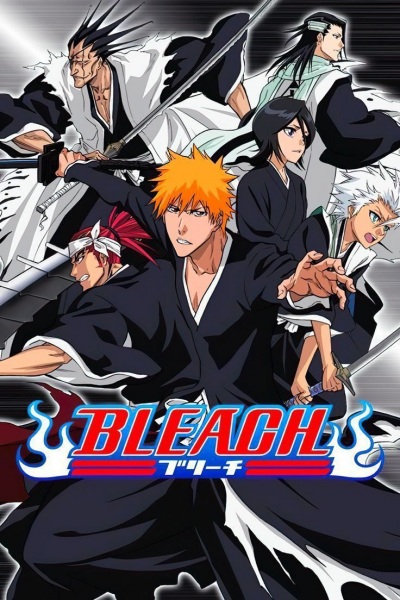
Bleach
Is Bleach worth watching?
Worth a look. Anime Codex rates Bleach 6.55 out of 10 — scored on six criteria (story, characters, themes, world-building, animation, and cultural impact), not crowd votes. 175th of 226 on the Codex rubric — bottom 24% of the catalogue. The crowd rates it 1.45 higher than the rubric does — the Codex is harder on it than on 89% of the catalogue.
Where to watch
Trailer
What the data says
Computed from the Codex rubric across the whole catalogue.
Summary
Bleach is a foundational 'Big Three' shonen whose strengths and flaws are equally instructive. At its best—the Soul Society arc—it delivers tight escalation, an outstanding villain in Aizen, and one of the genre's most stylish power systems in the personality-driven Zanpakuto and bankai mechanics. Shiro Sagisu's score and Pierrot's moody, cool-toned direction give it a distinctive identity that influenced countless successors. Its weaknesses, however, are significant for a series of this stature. The supporting cast stagnates badly, with Orihime in particular relegated to a passive damsel, and Ichigo's growth devolves into repetitive power-up cycles. The Arrancar arc bloats into endless one-on-one duels, the anime's heavy filler erodes pacing, and the 2004 series ends abruptly on the weak Fullbring arc without adapting its true finale. Power scaling grows arbitrary, and the show frequently prioritizes posturing over the thematic depth its mortality-and-duty premise promises. Judged against the best shonen of its kind, Bleach is a stylish, atmospheric, and hugely influential series that never fully capitalizes on its strong foundation—good but flawed, carried by aesthetic confidence and a handful of genuinely great arcs rather than sustained narrative excellence.
Criterion breakdown
Story & narrative
The Soul Society arc is Bleach's narrative peak—the rescue of Rukia builds genuine tension with the Aizen betrayal twist standing as one of shonen's best executed rug-pulls. However, the Arrancar/Hueco Mundo arc bloats badly with endless sequential duels, and the anime's filler (Bount arc, Zanpakuto Rebellion) dilutes momentum, while the rushed, unadapted ending leaves the 2004 series concluding on the unsatisfying Fullbring arc rather than a true climax.
Character writing & growth
Ichigo's reluctant-hero arc and Rukia's quiet dignity anchor the early show effectively, and antagonists like Aizen, Grimmjow, and Ulquiorra are charismatic and memorable. The crippling weakness is the supporting cast's stagnation—Orihime is reduced to a damsel and emotional liability, Chad and Ishida are perpetually sidelined, and Ichigo himself plateaus into repetitive power-up beats rather than meaningful growth.
Themes & emotional resonance
Bleach gestures at mortality, duty, and the thin line between protecting and devouring souls, and Ulquiorra's 'is this the heart?' death scene lands as a rare moment of real philosophical weight. But the series rarely commits to its themes, favoring cool posturing over interrogation; the emotional resonance is intermittent rather than sustained, peaking in Soul Society and fading thereafter.
World-building & power system
The Zanpakuto/shikai/bankai system is one of shonen's most stylish and personality-driven power frameworks, with each blade reflecting its wielder. Soul Society's feudal afterlife bureaucracy and the Espada's aspect-of-death gimmick show strong concept design, though internal consistency erodes as power scaling becomes arbitrary and unexplained late, and Hueco Mundo feels comparatively underdeveloped.
Animation & direction
Pierrot's direction shines in atmosphere—the muted color palettes, Shiro Sagisu's iconic soundtrack, and stylish fight choreography (Ichigo vs. Byakuya, Ichigo vs. Ulquiorra) give Bleach a distinctive cool aesthetic. Consistency is the issue: peak sakuga moments alternate with noticeably degraded animation during filler and lower-budget stretches across the 366-episode run.
Cultural impact
As one of the 'Big Three' alongside Naruto and One Piece, Bleach defined an era of shonen and built an enormous global fanbase, with its character designs and aesthetics widely imitated. Its influence on a generation of fans and creators is undeniable, even if its anime's incomplete ending dented its legacy until the later Thousand-Year Blood War adaptation.
Synopsis (from MAL)
Ichigo Kurosaki is an ordinary high schooler—until his family is attacked by a Hollow, a corrupt spirit that seeks to devour human souls. It is then that he meets a Soul Reaper named Rukia Kuchiki, who gets injured while protecting Ichigo's family from the assailant. To save his family, Ichigo accepts Rukia's offer of taking her powers and becomes a Soul Reaper as a result. However, as Rukia is unable to regain her powers, Ichigo is given the daunting task of hunting down the Hollows that plague their town. However, he is not alone in his fight, as he is later joined by his friends—classmates Orihime Inoue, Yasutora Sado, and Uryuu Ishida—who each have their own unique abilities. As Ichigo and his comrades get used to their new duties and support each other on and off the battlefield, the young Soul Reaper soon learns that the Hollows are not the only real threat to the human world. [Written by MAL Rewrite]
Ranked nearby

Explore rankings
Discussion
Set a display name above to post.
Loading discussion…