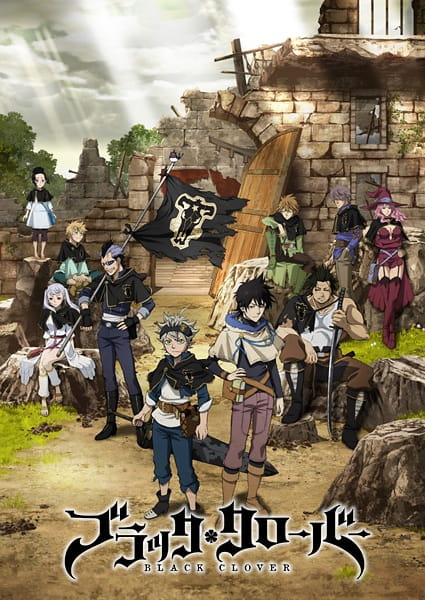
Black Clover
Is Black Clover worth watching?
Worth a look. Anime Codex rates Black Clover 6.52 out of 10 — scored on six criteria (story, characters, themes, world-building, animation, and cultural impact), not crowd votes. 178th of 226 on the Codex rubric — bottom 22% of the catalogue. The crowd rates it 1.62 higher than the rubric does — the Codex is harder on it than on 94% of the catalogue.
Where to watch
Trailer
What the data says
Computed from the Codex rubric across the whole catalogue.
Summary
Black Clover is a textbook modern battle shonen executed with conviction rather than originality. Its underdog premise—a magicless boy in a mana-stratified world—drives a sincere, class-conscious narrative anchored by Asta's relentless determination and the colorful, well-developed Black Bulls ensemble. The show's chief weakness is its slow, derivative early stretch and Pierrot's uneven production, marred by filler and flat early animation that test viewer patience across 170 episodes. Those who persist are rewarded: the Eye of the Midnight Sun and Spade Kingdom arcs deliver genuine emotional weight through the elf reincarnation tragedy and the Dark Triad conflict, alongside marked visual improvement and standout sakuga sequences. Thematically it explores effort versus innate talent and cyclical hatred competently, if without seinen-level depth. Within its demographic, it stands as a strong, dependable mid-to-upper-tier entry—not a genre-redefining masterwork like its most celebrated Jump peers, but a satisfying execution of shonen fundamentals with a distinctive anti-magic hook and a likeable squad. Asta's perpetually shouting characterization remains polarizing and can grate. Ultimately it rewards commitment, peaking late, and earns its devoted following without ever fully escaping the conventions it so faithfully follows.
Criterion breakdown
Story & narrative
Black Clover follows a deeply conventional shonen progression—exams, magic knight squad rankings, escalating arc bosses—and leans hard on familiar beats, with the early Magic Knights Entrance Exam and dungeon arcs being especially formulaic. However, it tightens significantly during the Eye of the Midnight Sun and especially the Spade Kingdom/Dark Triad arc, where elf reincarnation reveals and the Clover-Spade-Diamond geopolitical conflict add genuine stakes. The pacing is hampered by Pierrot's heavy filler stretches and recap episodes that dilute momentum across 170 episodes.
Character writing & growth
Asta's loud, unrelenting optimism is divisive but functions as a thematic engine, and his anti-magic underdog framing pays off against opponents like Mars and the elf-possessed captains. Yuno serves as an effective rival foil though he stagnates emotionally, while the Black Bulls ensemble—Noelle's tsundere growth, Yami's leadership, Vanessa's Red Thread of Fate awakening, Finral's cowardice arc—gives the squad real texture. The villains, particularly Patolli/Licht and the Dark Triad, get sympathetic backstories, but many supporting Magic Knights remain one-note.
Themes & emotional resonance
The core theme of overcoming a rigid magic-based class hierarchy through sheer effort is sincere and resonates in Asta's commoner-versus-royalty conflict, sharply embodied by Noelle's family abuse and the peasant-noble divide. The elf reincarnation arc adds a layer about cyclical hatred and forgiveness that elevates the emotional payoff beyond pure shonen grind. Still, the show rarely interrogates its own messaging deeply, often resolving complex resentment with friendship-and-screaming resolution.
World-building & power system
The grimoire-and-mana system is internally consistent with creative individual applications—Yami's dark magic and Dimension Slash, Asta's anti-magic swords, Charmy's food magic—but the foundational premise of mana-determined social rank is borrowed wholesale from the broader isekai/magic-academy tradition. The Clover Kingdom and rival nations get serviceable but shallow geography until the Spade arc fleshes out cross-border conflict. Power scaling occasionally becomes incoherent during late-game amplifications.
Animation & direction
Pierrot's production is wildly inconsistent: early episodes feature flat compositing, stiff motion, and overuse of static panning, undercutting fight tension. The studio compensates with standout sakuga spikes—the Asta vs. elf-Licht clashes and the Dark Triad battles in the Spade arc show dramatically improved fluidity, lighting, and effects work. The strong OP/ED rotation and energetic sound design help, but overall direction never reaches the visual consistency of top-tier shonen contemporaries.
Cultural impact
Black Clover became a reliable long-running Jump pillar with a strong international streaming following and a well-received 2023 film, Sword of the Wizard King. Asta's screaming intensity became a recurring fandom meme, both beloved and mocked, and the show is frequently cited in the 'good but underrated' shonen discourse. It never reached the genre-defining ubiquity of its Jump stablemates, however.
Synopsis (from MAL)
Asta and Yuno were abandoned at the same church on the same day. Raised together as children, they came to know of the "Wizard King"—a title given to the strongest mage in the kingdom—and promised that they would compete against each other for the position of the next Wizard King. However, as they grew up, the stark difference between them became evident. While Yuno is able to wield magic with amazing power and control, Asta cannot use magic at all and desperately tries to awaken his powers by training physically. When they reach the age of 15, Yuno is bestowed a spectacular Grimoire with a four-leaf clover, while Asta receives nothing. However, soon after, Yuno is attacked by a person named Lebuty, whose main purpose is to obtain Yuno's Grimoire. Asta tries to fight Lebuty, but he is outmatched. Though without hope and on the brink of defeat, he finds the strength to continue when he hears Yuno's voice. Unleashing his inner emotions in a rage, Asta receives a five-leaf clover Grimoire, a "Black Clover" giving him enough power to defeat Lebuty. A few days later, the two friends head out into the world, both seeking the same goal—to become the Wizard King! [Written by MAL Rewrite]
Ranked nearby
Explore rankings
Discussion
Set a display name above to post.
Loading discussion…