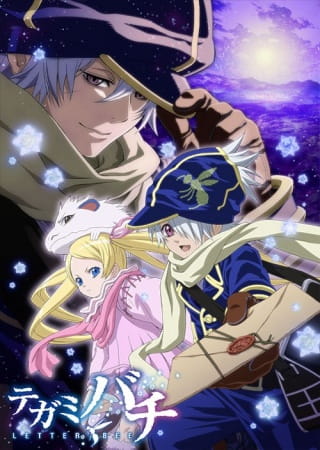
Tegami Bachi: Letter Bee
Is Tegami Bachi: Letter Bee worth watching?
Worth a look. Anime Codex rates Tegami Bachi: Letter Bee 6.88 out of 10 — scored on six criteria (story, characters, themes, world-building, animation, and cultural impact), not crowd votes. 145th of 226 on the Codex rubric — bottom 37% of the catalogue. The crowd rates it 0.73 higher than the rubric does — the Codex is harder on it than on 62% of the catalogue.
Where to watch
Trailer
What the data says
Computed from the Codex rubric across the whole catalogue.
Summary
Tegami Bachi: Letter Bee distinguishes itself within shonen by trading combat spectacle for emotional sincerity, built on the haunting premise of a world under an artificial sun where messengers deliver letters—and sometimes people—across dangerous terrain. Its shindan power system, in which carriers fire fragments of their own hearts, is one of the more thematically integrated mechanics in the demographic, binding action directly to the show's preoccupation with memory, loss, and human connection. Lag Seeing is a refreshingly gentle protagonist whose tears are framed as strength, and the episodic deliveries frequently achieve genuine pathos. The world-building—social hierarchy mapped onto proximity to light—gives the setting unusual depth. The adaptation's chief weaknesses are structural and technical: 25 episodes are not enough to develop the central Gauche/Reverse conspiracy, leaving the season feeling like extended prologue, and Gauche's pivotal arc happens largely offscreen. The CG Gaichuu clash with the hand-drawn art, and production values waver. The emotional palette can also lean too readily on sentimentality. Still, for viewers seeking a quieter, melancholic shonen with a distinctive setting and heart-forward themes, it remains a worthwhile, underappreciated entry, if an incomplete one.
Criterion breakdown
Story & narrative
The episodic letter-delivery structure gives the first cours a strong emotional throughline—standalone stories like Sylvette's restoration and the Niche introduction land with self-contained pathos, framed by the search for Gauche. However, the 25-episode run barely advances the larger Reverse/government conspiracy that the manga develops, so the season ends on setup rather than payoff, and the Gauche-as-Noir thread feels truncated. The 'sending a person as a letter' premise is a genuinely arresting hook that the early episodes exploit well.
Character writing & growth
Lag Seeing's defining trait—crying as a source of strength rather than weakness—is an unusually tender characterization for a shonen lead and is handled without mockery. Niche and the dog Steak provide comic levity that mostly avoids grating, and Sylvette's bitterness toward her absent brother adds texture. The weakness is that Gauche, the emotional engine of Lag's motivation, is largely absent in person, so his transformation into Noir is told more than felt within these episodes.
Themes & emotional resonance
The 'heart' (kokoro) motif—that letters carry the emotional essence of their senders—is woven consistently into the shindan mechanic and gives nearly every delivery a meditation on memory, loss, and connection. Episodes like the mother who cannot let go of her son's letter, or Lag firing his own heart to reveal memories, give the show real emotional resonance uncommon in action-adjacent shonen. It occasionally tips into sentimentality, leaning on Lag's tears as an emotional shortcut.
World-building & power system
Amberground's perpetual twilight lit by an artificial man-made sun is a striking, original setting, and the social stratification by proximity to that light (Akatsuki vs. the outer districts) gives the world thematic weight beyond aesthetics. The shindan power system—firing fragments of one's own heart as ammunition, with Gaichuu feeding on heart—is genuinely distinctive and ties mechanics directly to the show's themes. Internal consistency is strong, though much of the deeper political lore remains unexplored in this adaptation.
Animation & direction
Pierrot Plus delivers a warm, painterly palette suited to the twilight setting and some evocative lighting in delivery sequences, but the production is modest. Gaichuu battles rely heavily on CG insectoid models that clash with the 2D art and look stiff, and animation quality dips noticeably in later episodes. Direction is competent and emotionally legible but rarely ambitious in composition or movement.
Cultural impact
The series earned a devoted niche following and a second season (Reverse), with the unique premise giving it lasting cult recognition among fans of melancholic shonen. However, it never achieved mainstream breakout status, spawned little merchandise or lasting influence, and remains a comparatively obscure Jump SQ title overshadowed by its contemporaries.
Synopsis (from MAL)
Gauche Suede is highly respected among the Letter Bees—a government organization that delivers written messages to even the most remote locations. However, the Amberground, the land Gauche must traverse, is blanketed in a constant twilight and home to monsters known as Gaichuu. On one precarious journey, Gauche meets Lag Seeing, a troubled young boy who has himself been sent as a letter. Five years later, Lag joins the Letter Bee as well, inspired by his journey with Gauche. As he strives to become like his hero, Lag discovers the conflict and complexity at the heart of his world. [Written by MAL Rewrite]
Ranked nearby
Explore rankings
Discussion
Set a display name above to post.
Loading discussion…