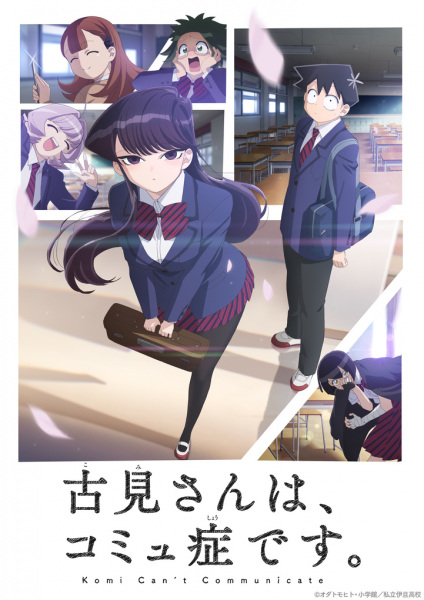
Komi Can't Communicate
Is Komi Can't Communicate worth watching?
Worth a look. Anime Codex rates Komi Can't Communicate 6.85 out of 10 — scored on six criteria (story, characters, themes, world-building, animation, and cultural impact), not crowd votes. 147th of 226 on the Codex rubric — bottom 36% of the catalogue. The crowd rates it 0.93 higher than the rubric does — the Codex is harder on it than on 72% of the catalogue.
Where to watch
Trailer
What the data says
Computed from the Codex rubric across the whole catalogue.
Summary
Komi Can't Communicate stands out as a tender, visually inventive entry in the slice-of-life romcom corner of shonen. Its greatest strength is the empathetic handling of Komi herself—her crippling social anxiety is treated as a real obstacle whose smallest conquests feel meaningful, elevated by OLM's expressive direction, dramatic framing, and clever use of the blackboard motif to externalize her unspoken thoughts. Tadano's quiet decency makes him an unusually thoughtful romcom lead. The show's limitations are structural and tonal. The 100-friends premise yields an episodic, momentum-light narrative that introduces a parade of single-gimmick eccentrics—Najimi's chaos, Yamai's stalking, Nakanaka's chuunibyou—who often sideline Komi's actual growth in favor of broad comedy. That same comedy occasionally trivializes the anxiety the show otherwise depicts with care, blunting its thematic ambition. The world is built more from caricature than believable texture. Judged against the best comfort-romcoms of its demographic, it is warm, sincere, and beautifully styled but narratively modest and inconsistent in how seriously it takes its own central condition. It is a strong, good-but-flawed show that excels at mood and empathy while falling short of the structural and thematic depth of the genre's finest.
Criterion breakdown
Story & narrative
The narrative is episodic and goal-driven—Komi's quest for 100 friends provides a loose throughline, with each episode introducing a new classmate or low-stakes scenario like the field trip or the cultural festival. This structure is gentle and warm but lacks escalating tension or arc-level payoff; the friend counter becomes a mechanical device rather than a source of genuine dramatic momentum. It works as comfort viewing but never builds toward anything narratively ambitious within its 12 episodes.
Character writing & growth
Komi herself is sensitively rendered—her panic, the gap between her serene image and her internal terror, and small victories like ordering food or texting are handled with real empathy. Tadano is a thoughtful, observant straight-man whose quiet decency anchors the show. The weakness is the supporting cast: Najimi is an entertaining but one-note chaos engine, and several side characters (Yamai's obsessive stalking, Nakanaka's chuunibyou) are defined entirely by a single gimmick that crowds out Komi's growth in their episodes.
Themes & emotional resonance
The depiction of social anxiety as something earnest and non-trivial gives the show genuine emotional weight, especially in early episodes where simply speaking aloud is framed as a monumental act of courage. The blackboard conversation in episode 1 and Komi's first real friendship land with sincerity. However, the show occasionally undercuts its own seriousness by treating anxiety as quirky cuteness, softening the thematic edge it sets up.
World-building & power system
As a premise, a heroine with a communication disorder pursuing friendship is fresh for romcom-adjacent shonen, and the school setting is internally consistent. But the world leans on broad caricature—the escalating gallery of eccentric students (gyaru, chuunibyou, otaku stereotypes) prioritizes comedic exaggeration over a grounded, believable school ecosystem, limiting the setting's depth.
Animation & direction
OLM's direction is the show's strongest technical asset: Komi's expressive eyes, the use of negative space, sparkles, and dramatic shojo-esque framing to convey her inner panic are genuinely inventive. The frequent on-screen text and chalkboard sequences are cleanly integrated. Outside these stylized highlights the baseline animation is fairly standard TV fare, with conversation scenes that can feel static.
Cultural impact
A long-running, highly popular Shonen Sunday property, Komi reached a wide audience and earned a Netflix global release plus a second season, cementing it as a recognizable name in the slice-of-life romcom space. Its real cultural note is normalizing a protagonist with social anxiety, though it didn't reshape the genre the way landmark titles do.
Synopsis (from MAL)
Hitohito Tadano is an ordinary boy who heads into his first day of high school with a clear plan: to avoid trouble and do his best to blend in with others. Unfortunately, he fails right away when he takes the seat beside the school's madonna—Shouko Komi. His peers now recognize him as someone to eliminate for a chance to sit next to the most beautiful girl in class. Gorgeous and graceful with long, dark hair, Komi is universally adored and immensely popular despite her mysterious persona. However, unbeknownst to everyone, she has crippling anxiety and a communication disorder which prevents her from wholeheartedly socializing with her classmates. When left alone in the classroom, a chain of events forces Komi to interact with Tadano through writing on the blackboard, as if in a one-way conversation. Being the first person to realize she cannot communicate properly, Tadano picks up the chalk and begins to write as well. He eventually discovers that Komi's goal is to make one hundred friends during her time in high school. To this end, he decides to lend her a helping hand, thus also becoming her first-ever friend. [Written by MAL Rewrite]
Ranked nearby


Explore rankings
Discussion
Set a display name above to post.
Loading discussion…