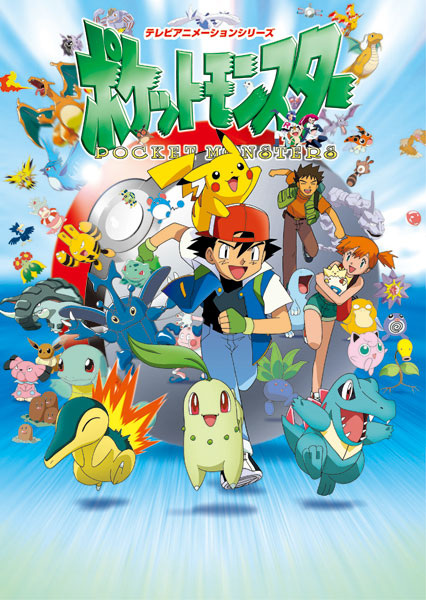
Pokémon
Is Pokémon worth watching?
Worth a look. Anime Codex rates Pokémon 7.02 out of 10 — scored on six criteria (story, characters, themes, world-building, animation, and cultural impact), not crowd votes. 127th of 226 on the Codex rubric — bottom 45% of the catalogue. The crowd rates it 0.40 higher than the rubric does — the Codex is harder on it than on 42% of the catalogue.
Where to watch
Trailer
What the data says
Computed from the Codex rubric across the whole catalogue.
Summary
Pokémon (1997) is a near-definitive example of kodomomuke serialization: its episodic gym-to-league structure, sincere friendship themes, and the irresistible Satoshi-Pikachu bond make it accessible and emotionally reliable for its young audience. Standout moments — Pikachu's protection in the premiere, the bittersweet release of Butterfree, and the genuinely unsentimental Indigo League loss — show the writing is willing to teach failure and letting go rather than offering constant triumph. Its greatest strength is the world itself: a wildly original, internally consistent premise built on creature-capture and an elemental type chart, faithfully translated from the games. Cultural impact is essentially unmatched in any demographic. The weaknesses are equally clear. Across 276 episodes the formula becomes repetitive, the 'Pokémon Master' goal is endlessly deferred, and Satoshi is effectively reset between regions, capping his growth. Team Rocket are charming but locked in a static comedy loop, and OLM's TV animation is competent but stock-heavy and unambitious outside theatrical releases. Judged against the best children's anime rather than against shonen spectacle, it is a strong, foundational entry whose ambition lies in warmth and accessibility rather than depth — a show that defined a genre's commercial reach more than it pushed its artistic ceiling.
Criterion breakdown
Story & narrative
The episodic gym-badge-and-league structure is perfectly suited to kodomomuke serialization, giving each episode a self-contained beginning and resolution that young viewers can drop into at any point. The Indigo League arc earns real narrative weight when Satoshi loses in the quarterfinals after Charizard refuses to obey him, a surprisingly unsentimental outcome for the demographic. However, the overarching 'Pokémon Master' goal is perpetually deferred and the formula grows repetitive across 276 episodes, with the Orange Islands filler arc padding noticeably before Johto.
Character writing & growth
Satoshi's bond with Pikachu, established in 'Pokémon, I Choose You!' where Pikachu protects him from Spearow, is genuinely affecting and remains the emotional anchor. Takeshi and Kasumi provide functional dynamics, and Satoshi's release of Butterfree and farewell to a wild Pidgeot show real growth in letting go. The ceiling is that Satoshi is essentially reset between regions and Team Rocket's Musashi and Kojiro, while charming, never evolve beyond their blast-off gag loop.
Themes & emotional resonance
Friendship, perseverance, and respect between human and creature are delivered with sincerity rather than cynicism, and the Butterfree and Charmander abandonment episodes quietly teach loyalty and responsibility. The Indigo League loss models graceful acceptance of failure, unusual honesty for a children's title. The thematic palette is intentionally simple and rarely reaches beyond these reliable beats.
World-building & power system
The premise of a world organized entirely around capturing and raising creatures with a rock-paper-scissors elemental type chart is enormously original and internally consistent, mapping faithfully onto the games. Kanto's gyms, Pokémon Centers, and the type system give the setting genuine coherence and replayability. It loses points only because the anime largely inherits rather than expands the game's worldbuilding, and biological logic (how Pokémon eat, breed, coexist) is left vague.
Animation & direction
OLM's late-90s TV animation is functional and brightly colored with appealing character designs, but the production is workmanlike rather than ambitious, relying on stock battle stills and recycled attack cuts. The infamous 'Dennō Senshi Porygon' episode caused seizures and forced industry-wide flashing-light guidelines, a notable if unintended directorial footnote. Movement is generally limited outside theatrical releases.
Cultural impact
Pokémon is one of the most commercially and culturally significant media franchises on Earth, and the anime was the global gateway that turned the games into a generational phenomenon. Pikachu became a near-universal mascot and the show normalized anime for an entire Western generation of children. Few titles in any demographic match its reach.
Synopsis (from MAL)
Pokémon are peculiar creatures with a vast array of different abilities and appearances; many people, known as Pokémon trainers, capture and train them, often with the intent of battling others. Young Satoshi has not only dreamed of becoming a Pokémon trainer but also a "Pokémon Master," and on the arrival of his 10th birthday, he finally has a chance to make that dream a reality. Unfortunately for him, all three Pokémon available to beginning trainers have already been claimed and only Pikachu, a rebellious Electric-type Pokémon, remains. However, this chance encounter would mark the start of a lifelong friendship and an epic adventure! Setting off on a journey to become the very best, Satoshi and Pikachu travel across beautiful, sprawling regions with their friends Kasumi, a Water-type trainer, and Takeshi, a Rock-type trainer. But danger lurks around every corner. The infamous Team Rocket is always nearby, seeking to steal powerful Pokémon through nefarious schemes. It'll be up to Satoshi and his friends to thwart their efforts as he also strives to earn the eight Pokémon Gym Badges he'll need to challenge the Pokémon League, and eventually claim the title of Pokémon Master. [Written by MAL Rewrite]
Ranked nearby
Explore rankings
Discussion
Set a display name above to post.
Loading discussion…