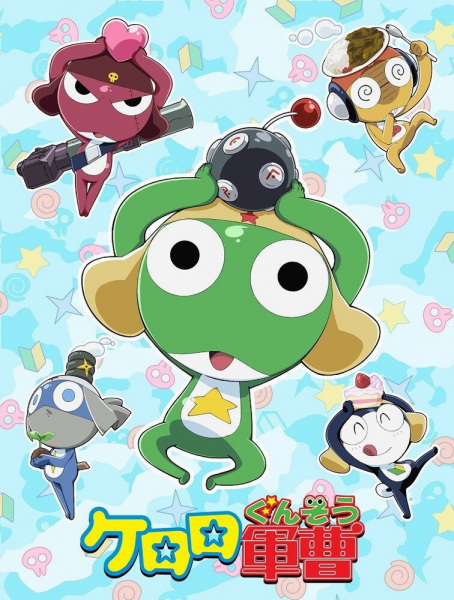
Sgt. Frog (Keroro Gunsou)
Is Sgt. Frog (Keroro Gunsou) worth watching?
Worth a look. Anime Codex rates Sgt. Frog (Keroro Gunsou) 6.85 out of 10 — scored on six criteria (story, characters, themes, world-building, animation, and cultural impact), not crowd votes. 149th of 226 on the Codex rubric — bottom 35% of the catalogue. The crowd rates it 0.86 higher than the rubric does — the Codex is harder on it than on 68% of the catalogue.
Where to watch
What the data says
Computed from the Codex rubric across the whole catalogue.
Summary
Sgt. Frog stands as one of the more durable and inventive kodomomuke comedies, built on a brilliantly self-aware premise: a bumbling alien invasion squad that conquers nothing and instead becomes a found family within a human household. Its greatest strengths are the sharply differentiated platoon cast, a dense and internally consistent Keronian world, and a relentless parody sensibility that mocks Gundam, tokusatsu, and otaku culture with affectionate precision. Sunrise's bright, elastic animation and excellent comic timing—complete with fourth-wall gags and shifting art styles—keep the formula lively. The show's themes of coexistence and friendship land warmly without ever feeling preachy, appropriate to its young audience. Its weaknesses are structural: at 358 episodes the episodic invasion-of-the-week format grows repetitive, character growth is deliberately cyclical, and the heavy reliance on pop-culture references can feel dated or thin over time. Emotional depth is real but kept intentionally light. Judged against the best children's comedies of its kind, Keroro Gunsou succeeds admirably—imaginative, funny, and surprisingly heartfelt—while never aspiring to the narrative ambition or lasting resonance that would push it into the upper tier of the medium overall.
Criterion breakdown
Story & narrative
As an episodic gag comedy, Keroro Gunsou thrives on its 'invasion-of-the-week' formula where Keroro's elaborate schemes collapse into slapstick, often derailed by his Gunpla obsession rather than any real opposition. The lack of an overarching plot is by design for kodomomuke, but the sheer 358-episode length exposes repetitive beats, and arcs like the Kiruru reawakening or the seasonal specials show the writing is strongest when it briefly raises stakes before resetting. Its parody-heavy structure—riffing on Gundam, Evangelion, and tokusatsu—is clever but leans on referential humor that thins out over hundreds of episodes.
Character writing & growth
The platoon dynamic carries the show: Keroro's lazy cowardice, Giroro's tsundere devotion to Natsumi, Kururu's malicious genius, Tamama's bipolar jealousy, and Dororo's perpetually forgotten ninja trauma form a reliable comedic engine with distinct comic identities. Growth is minimal and intentionally cyclical—Keroro never truly conquers anything—but the gradual softening of the Hinata-Keronian household into genuine found-family affection, especially Fuyuki and Keroro's bond, gives the cast warmth beyond gags. Natsumi's grounded exasperation anchors the chaos effectively.
Themes & emotional resonance
Beneath the absurdity runs a gentle theme of coexistence: would-be conquerors who end up cherishing the planet and people they meant to subjugate, which lands sweetly in episodes emphasizing Dororo's loneliness or the platoon protecting the Hinatas. The emotional resonance is real but deliberately light and rarely sustained, prioritizing the next punchline over lingering sentiment. For its demographic this restraint is appropriate, though it ceilings the show's deeper impact.
World-building & power system
The Pekopon premise is delightfully inventive—Keronian biology, Anti-Barrier tech, the Kero Ball, and the running gag that frogs secretly run Earth's history give the setting surprising internal logic and density for a comedy. The world expands convincingly with recurring locales, rival platoons, and Keron homeworld lore, while its self-aware integration of real Japanese pop culture (Gunpla shops, otaku conventions) makes it feel rooted. Originality of concept is a genuine strength here.
Animation & direction
Sunrise delivers consistent, colorful, expressive character animation well-suited to rapid-fire comedy, with elastic reaction faces and frequent fourth-wall-breaking visual gags like onscreen narration cards and chibi inserts. Direction excels at comic timing and parody pastiche, shifting art styles to mock whatever it references, though budget naturally limits genuinely spectacular sequences across such a long run. It looks bright and clean rather than ambitious.
Cultural impact
Keroro became a major merchandising and Gunpla cross-promotion franchise, with the green sergeant recognizable across multiple manga, films, and games throughout the 2000s in Japan. Its long syndication and family appeal cemented it as a staple kids' comedy, though its referential humor and domestic focus limited its international footprint compared to flagship shonen titles.
Synopsis (from MAL)
It is the year 2004 AD, and pandemonium breaks as a mysterious frog-like alien race fills the sky with UFOs—or so 12-year-old Fuyuki Hinata dreams. Coincidentally, Sergeant Keroro, leader of a preliminary squad for the Keronian invasion of Pekopon—the alien name for Earth—begins his mission by invading Fuyuki's home. After subduing the boy and his sister, Keroro plans to reunite with his comrades and return to the mothership to repair his invaluable invasion device, the Kero Ball. Unfortunately, he receives word that headquarters has abandoned his unit's retrieval due to an unprecedented issue that forced the rest of the Keronians to flee. Consequently, Keroro is forced to stay at the Hinata residence together with the friendly, starry-eyed Fuyuki; his athletic, short-tempered sister Natsumi; and their hardworking, attractive mother Aki. Now stuck until further notice, Keroro and his platoon spend each day plotting world domination, but are thwarted each and every time by various unexpected factors. Nevertheless, as they live alongside humans, they learn to treat them as friends and allies, forming comedic yet meaningful connections that make their lives on Earth worthwhile. [Written by MAL Rewrite]
Ranked nearby
Explore rankings
Discussion
Set a display name above to post.
Loading discussion…