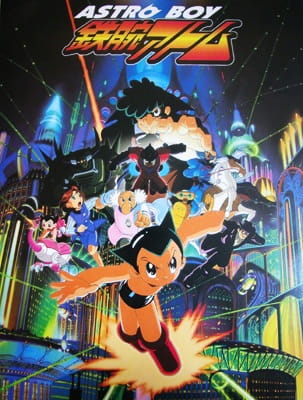
Astro Boy (Tetsuwan Atom)
Is Astro Boy (Tetsuwan Atom) worth watching?
Worth a look. Anime Codex rates Astro Boy (Tetsuwan Atom) 7.29 out of 10 — scored on six criteria (story, characters, themes, world-building, animation, and cultural impact), not crowd votes. 111th of 226 on the Codex rubric — top 49% of the catalogue. The Codex rates it Δ +0.15 above its MAL score — more underrated than 88% of the catalogue.
Where to watch
Trailer
What the data says
Computed from the Codex rubric across the whole catalogue.
Summary
The 2003 Astro Boy is a thoughtful modernization of Tezuka's foundational work, and judged within kodomomuke it punches above its demographic. Rather than a simple hero-of-the-week, it presents Atom as a child wrestling with rejection, identity, and the question of whether a robot can possess a genuine heart. Its strongest material — Tenma's grief-driven abandonment, the morally ambiguous Blue Knight, and the recurring tension over robot rights — gives the series unexpected thematic seriousness about prejudice and coexistence, themes faithful to Tezuka's humanism. The clean digital animation and restrained emotional direction respect young viewers without talking down to them. Its weaknesses are structural: across 50 episodes the episodic monster-of-the-week format dilutes the compelling overarching narrative, the middle stretch drags, and the need to restore an optimistic status quo sometimes blunts its sharper ideas. Several supporting characters stay archetypal, and the action is competent rather than thrilling. As a remake it is also less historically pivotal than the 1963 original that launched TV anime. Still, it stands as one of the more intelligent and emotionally resonant children's series of its era, anchored by a genuinely sympathetic protagonist and ideas that reward viewers older than its target audience.
Criterion breakdown
Story & narrative
The 2003 series reframes Atom's origin with more narrative weight than its predecessors, leaning into Tenma's grief and the political tension between humans and robots, with arcs like the Blue Knight and the conflict surrounding robot rights giving it surprising thematic ambition for kodomomuke. However, the episodic structure dilutes momentum, with many monster-of-the-week installments that don't build toward the larger arc, and the pacing across 50 episodes sags in its middle stretch. Strong by children's-anime standards but uneven in serialization.
Character writing & growth
Atom himself is well-realized as a child grappling with rejection and identity rather than a simple hero, and the moral complexity of Tenma — a father who both creates and abandons his son — and the antagonistic-yet-sympathetic Blue Knight elevate the cast above typical kids' fare. Supporting figures like Ochanomizu and Atom's robot 'family' provide warmth, though several characters remain functional archetypes. Atom's growth is gradual and genuine, but the episodic format limits sustained development for most of the ensemble.
Themes & emotional resonance
For a children's title, the series engages seriously with prejudice, the ethics of artificial life, and what constitutes a 'heart,' echoing Tezuka's original humanist concerns about discrimination and coexistence. The Blue Knight arc in particular interrogates whether peaceful coexistence or robot separatism is the answer, refusing easy resolutions. The emotional resonance is real but occasionally undercut by the need to reset to a safe, optimistic status quo by episode's end.
World-building & power system
The setting builds a coherent vision of a robot-integrated society with the Ministry of Science, robot laws, and visible class tension between humans and machines, faithfully extending Tezuka's premise. Atom's array of abilities — flight, strength, searchlight eyes, the iconic arm cannons — are distinctive and consistently applied. The world is imaginative but not deeply explored beyond what individual episodes require, and some sci-fi logic remains loose.
Animation & direction
The 2003 production modernizes Tezuka's designs with clean digital animation, fluid flight sequences, and a brighter palette while retaining the rounded character aesthetic. Direction handles the emotional beats — Atom's confrontations with Tenma, moments of rejection — with restraint that respects its young audience without condescension. It's polished for its era and budget but rarely spectacular, with conservative action choreography compared to the best of its time.
Cultural impact
Astro Boy is foundational to anime itself — Tezuka's 1963 original effectively launched TV anime — and this 2003 remake commemorates that legacy for a new generation. While the remake itself is less historically pivotal than the original, it carries immense franchise weight and remains a touchstone for the robot-with-a-heart archetype that influenced countless later works. Its cultural footprint rests heavily on the property's enduring significance.
Synopsis (from MAL)
At the Ministry of Science, fervent Professor Ochanomizu alongside his coworkers strive to reactivate Atom—the first robot with a human heart. Atom is the masterpiece of enigmatic Professor Umatarou Tenma, who built the android to replace his deceased son Tobio. However, while Tenma inexplicably shut down his brainchild and disappeared, Ochanomizu refuses to let such a major breakthrough in science go to waste. Despite having the appearance of a nine-year-old, Atom not only possesses incredible strength and intelligence, but he is also endowed with a remarkable conscience and compassion that rivals humans. Sadly, the mechanical boy soon faces rejection and learns that not everyone is as welcoming as Ochanomizu. Although automatons have integrated into society, they are accepted only as tools and even seen as an upcoming threat to mankind's dominion. Dreaming of a world where people and robots can prosper together, Atom dedicates his existence to protecting the lives of both and inspiring them to form genuine bonds. [Written by MAL Rewrite]
Ranked nearby



Explore rankings
Discussion
Set a display name above to post.
Loading discussion…