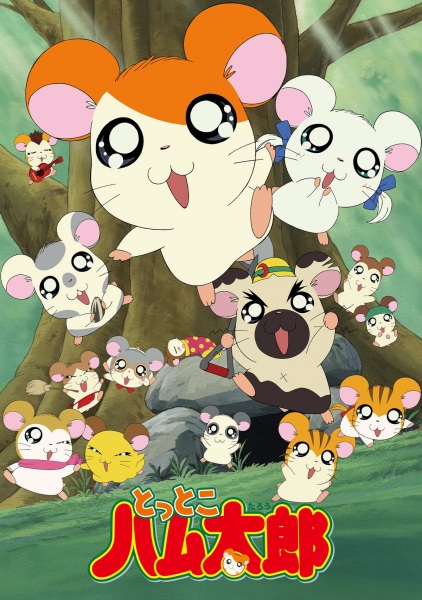
Hamtaro (Tottoko Hamtaro)
Is Hamtaro (Tottoko Hamtaro) worth watching?
Worth a look. Anime Codex rates Hamtaro (Tottoko Hamtaro) 6.90 out of 10 — scored on six criteria (story, characters, themes, world-building, animation, and cultural impact), not crowd votes. 142nd of 226 on the Codex rubric — bottom 38% of the catalogue. The crowd rates it 0.13 higher than the rubric does — the Codex is harder on it than on 23% of the catalogue.
Where to watch
Streaming availability varies by region — check your local services.
What the data says
Computed from the Codex rubric across the whole catalogue.
Summary
Hamtaro is a near-textbook example of effective kodomomuke craft. Its central premise — a hidden society of pet hamsters with their own clubhouse, language, and explorer culture running parallel to the everyday lives of their child owners — is genuinely inventive and internally consistent, giving the show more structural interest than typical preschool fare. Its enormous cast is built on clear, memorable single-trait personalities (anxious Oxnard, vain Bijou, gruff Boss) that are ideal for teaching young viewers to read character, and the dual hamster/human storylines add welcome texture. Thematically it reliably models friendship, empathy, and cooperation with sincere warmth, and its animation is clean, expressive, and consistently on-model across a long run. Its cultural footprint — driving a hamster pet boom and a massive merchandise empire — was substantial. The weaknesses are inherent to its format and ambition: across 296 episodes the episodic formula barely evolves, characters remain static archetypes without growth, longer fantasy arcs feel padded, and the direction is competent rather than distinctive. Judged against the best of its own demographic, it is a strong, charming, and influential entry that succeeds fully at its modest aims without reaching the deeper emotional or formal heights of the genre's finest works.
Criterion breakdown
Story & narrative
Hamtaro runs on an episodic, low-stakes formula where the Ham-Hams resolve a small problem at their clubhouse or help their owners with a minor drama, and within kodomomuke norms this is well-judged: each episode is self-contained, emotionally legible to small children, and never overstays its welcome. The dual-layer structure of hamster adventures running parallel to Hiroko and Laura's human subplots (school crushes, friendships, family) is a clever touch that gives the show more narrative texture than pure gag shows. The weakness is that across 296 episodes the formula rarely evolves; longer 'magical land' arcs like the candy kingdom feel padded, and there is no meaningful overarching progression to reward sustained viewing.
Character writing & growth
The strength here is the enormous, instantly readable cast built on single defining traits — Bijou's vanity and crush on Hamtaro, Boss's gruff-but-soft leadership, Oxnard's anxious hoarding of his sunflower seed, Howdy's puns, Pashmina's gentleness — which is exactly the right design philosophy for a preschool audience learning to distinguish personalities. The recurring 'Ham-Ham' vocabulary and catchphrases reinforce identity memorably. However, by the conventions of the best kodomomuke, these characters are essentially static archetypes; there is little growth or interiority, and Hamtaro himself remains a cheerful constant rather than a developing protagonist.
Themes & emotional resonance
The show consistently models friendship, cooperation, helping others, and gentle conflict resolution, and its emotional resonance is genuine for its target age — episodes where the Ham-Hams quietly support a sad Laura or reconcile two squabbling friends land with real warmth. It teaches empathy and curiosity about the wider world without moralizing heavily. It does not aim for the deeper emotional ambition some standout children's works reach, so the resonance stays pleasant and reassuring rather than affecting for older viewers.
World-building & power system
The premise itself is strong and original: a secret society of pet hamsters with their own clubhouse, language, social hierarchy, and explorer ethos operating invisibly inside the human world. The internal consistency is impressive for the genre — the Ham-Hams have rules, recurring locations, and a coherent miniature geography, and the contrast of scale between the cozy hamster spaces and the human environment is used cleverly and consistently. The candy-land and other fantastical excursions slightly dilute that grounded charm, but the core setting is one of the more inventive in kodomomuke.
Animation & direction
TMS delivers clean, bright, soft-edged character designs perfectly tuned to appeal to small children, with expressive hamster faces and consistent on-model work across a very long run. Direction favors clarity and gentle pacing over ambition; the comedy timing on gags like Oxnard's seed panic or Howdy's reaction faces is reliably effective. It is competent and consistent rather than visually distinguished — backgrounds and action are functional, and there is little of the directorial flourish that elevates the best children's animation.
Cultural impact
Hamtaro was a genuine merchandising and cross-media phenomenon, anchoring a hugely successful line of toys, video games, and goods, and helping drive the late-'90s/2000s hamster pet boom in Japan. The instantly recognizable character design and 296-episode longevity cemented it as a defining preschool property of its era, and its international broadcast gave it real recognition abroad as well.
Synopsis (from MAL)
He's small, fluffy, and absolutely adorable: Hamtarou is one perfect little hamster! After moving to a new house with his owner, 5th grader Hiroko Haruna, Hamtarou discovers other hamsters and quickly makes friends. The group of hamster explorers call themselves the Ham-Hams, and there's nowhere they won't go. The Ham-Hams go on crazy adventures all around the city while their owners are away, visiting everything from plays to magical lands of candy. Meanwhile, the humans face their own dramas.. Hamtarou meets a huge cast of different personalities, gets himself into—and out of—some pretty tight spots, and even helps Hiroko and her friends out more than once. Through it all, he never stops being unbearably cute. It's Hamtarou time!
Ranked nearby

Explore rankings
Discussion
Set a display name above to post.
Loading discussion…