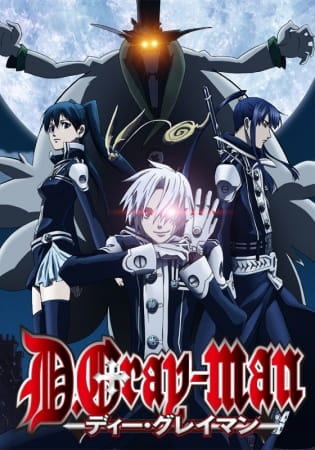
D.Gray-man
Is D.Gray-man worth watching?
Worth a look. Anime Codex rates D.Gray-man 6.81 out of 10 — scored on six criteria (story, characters, themes, world-building, animation, and cultural impact), not crowd votes. 153rd of 226 on the Codex rubric — bottom 33% of the catalogue. The crowd rates it 1.19 higher than the rubric does — the Codex is harder on it than on 81% of the catalogue.
Where to watch
Trailer
What the data says
Computed from the Codex rubric across the whole catalogue.
Summary
D.Gray-man stands out among mid-2000s shonen for its genuinely grim premise: the Millennium Earl weaponizes human grief, trapping the souls of the dead inside mechanical Akuma, and Allen Walker's cursed eye forces him to witness their suffering. This lends fights a moral and tragic dimension absent from most Jump action series, and the gothic-Victorian setting, distinctive Innocence/Akuma system, and Noah's Ark arc give it a memorable identity. Allen is a refreshingly gentle, self-sacrificing protagonist, and the supporting cast and worldbuilding hold real promise. The 2006 anime's chief weaknesses are structural: adapting a slow-publishing, hiatus-prone manga, it sags badly through filler-heavy middle episodes, lets character growth and lore drift, suffers visible budget dips, and ultimately ends without resolving the central conflict with the Earl. When it commits to the horror of its premise—Yeegar's death, Suman Dark, the Noah confrontations—it's among the more atmospheric and thematically serious shonen of its era. Judged against the best of its demographic, it is a strong, distinctive work hampered by adaptation circumstances and inconsistent execution rather than flawed conception: good but flawed, with more ambition and tonal courage than its uneven delivery fully realizes.
Criterion breakdown
Story & narrative
The early Black Order and Rewinding Town arcs establish a compelling tragic premise, but the 2006 anime's pacing suffers heavily in its middle stretch with filler and an episodic monster-of-the-week structure before the strong Noah's Ark arc reasserts momentum. Adapting an ongoing, slow-publishing manga, it ends abruptly without resolution around the Lulubell/Order invasion, leaving the central conflict with the Earl unfinished. The Yeegar General's death and the Suman Dark episode show the narrative is at its best when it leans into the horror of the Akuma premise rather than tournament-style progression.
Character writing & growth
Allen Walker is a sympathetic, slightly atypical shonen lead—polite, self-sacrificing, and burdened by his cursed eye's empathy for trapped souls—but his growth stalls in the anime's filler stretches. Kanda, Lavi, and Lenalee form a solid supporting cast, with Lenalee's attachment to the Order and Kanda's coldness given some weight, yet many Exorcists and Generals remain underdeveloped backstory promises the anime never pays off. Allen's relationship with the absent General Cross and the mystery of his past are introduced but barely advanced within these 103 episodes.
Themes & emotional resonance
The core idea—that grief and the wish to resurrect the dead are weaponized by the Earl, trapping souls in Akuma—is genuinely affecting and darker than typical Jump fare. The recurring tension between saving the akuma's soul versus killing to win, embodied in Allen's eye, gives fights moral weight, as seen in the Suman Dark and Mater arcs. The 'destroyer who saves' framing resonates, though the anime's tonal inconsistency from filler dilutes the gothic melancholy at its heart.
World-building & power system
The Innocence/Akuma system is distinctive: Innocence is a finite, semi-sentient divine substance with Equipment and Parasite types, and the Akuma evolution levels create real escalation rather than arbitrary power-ups. The gothic-Victorian aesthetic, the Noah clan as inheritors of biblical memory, and Noah's Ark are richly original worldbuilding. Some internal mechanics (Synchronization rates, Innocence compatibility) are introduced faster than they're explained, leaving the system intriguing but not fully consistent in the anime.
Animation & direction
TMS delivers atmospheric gothic art direction with strong character designs and memorable Akuma horror imagery, and the OPs convey the show's melancholic tone well. However, the long run shows clear budget fluctuation—filler episodes look noticeably flatter, and action choreography is serviceable rather than spectacular outside key Noah's Ark confrontations. The Skin Bolic and Tyki fights are the visual high points, while routine episodes settle for static, repetitive direction.
Cultural impact
D.Gray-man enjoyed solid popularity as a recognizable mid-2000s Jump dark-fantasy title and retains a devoted fanbase, but its impact was undercut by Hoshino's frequent manga hiatuses and the anime's inconclusive ending. It never reached the cultural footprint of contemporaries like Bleach or Fullmetal Alchemist, and the later Hallow reboot fragmented its anime legacy. It remains a cult favorite rather than a genre-defining work.
Synopsis (from MAL)
Losing a loved one is so painful that one may sometimes wish to be able to resurrect them—a weakness that the enigmatic Millennium Earl exploits. To make his mechanical weapons known as "Akuma," he uses the souls of the dead that are called back. Once a soul is placed in an Akuma, it is trapped forever, and the only way to save them is to exorcise them from their vessel using the Anti-Akuma weapon, "Innocence." After spending three years as the disciple of General Cross, Allen Walker is sent to the Black Order—an organization comprised of those willing to fight Akuma and the Millennium Earl—to become an official Exorcist. With an arm as his Innocence and a cursed eye that can see the suffering souls within an Akuma, it's up to Allen and his fellow Exorcists to stop the Millennium Earl's ultimate plot: one that can lead to the destruction of the world. [Written by MAL Rewrite]
Ranked nearby
Explore rankings
Discussion
Set a display name above to post.
Loading discussion…