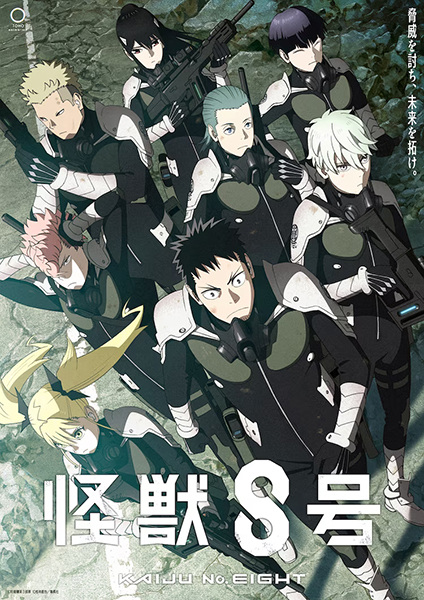
Kaiju No. 8
Is Kaiju No. 8 worth watching?
Worth a look. Anime Codex rates Kaiju No. 8 6.82 out of 10 — scored on six criteria (story, characters, themes, world-building, animation, and cultural impact), not crowd votes. 152nd of 226 on the Codex rubric — bottom 34% of the catalogue. The crowd rates it 1.39 higher than the rubric does — the Codex is harder on it than on 89% of the catalogue.
Where to watch
Trailer
What the data says
Computed from the Codex rubric across the whole catalogue.
Summary
Kaiju No. 8 distinguishes itself in a crowded shonen field chiefly through its protagonist: Kafka Hibino is a 32-year-old failure rather than a teenage prodigy, and the irony of a man who cleans up monster corpses gaining monster powers gives the show a melancholy, adult-relatable hook that the genre rarely offers. Its workplace-procedural take on monster defense—numbered kaiju, combat-suit ratings, bureaucratic cleanup crews—is a grounded, distinctive setting, and Production I.G's polished animation lends real weight to the transformations and Hoshina's swordplay. The show's weaknesses, however, become apparent once the novelty settles: it retreats into familiar recruitment-exam and trial structures it initially seemed ready to subvert, underdevelops key figures like Mina, and keeps its monster/humanity themes at surface level. The twelve-episode run also functions more as setup than a complete arc, ending before its central tensions fully pay off. The result is a confident, highly watchable adaptation that is good but not yet great—buoyed by a strong premise and lead character, held back by conventional execution and unrealized worldbuilding. It is a notable, accessible entry point to modern shonen rather than a definitive one.
Criterion breakdown
Story & narrative
The premise—a 32-year-old failure who gains the power of the very monsters he cleans up after—is a genuinely fresh inversion of the shonen 'young chosen hero' formula, and the early episodes mine real pathos from Kafka's stalled dreams. However, once the structure settles into the standard recruitment-exam and combat-trial beats (the selection test, the base assault), the narrative becomes far more conventional and predictable, leaning on tropes Kaiju No. 8 initially seemed poised to subvert. The first cour also ends mid-arc with the Kafka-identity tension only partially resolved, leaving the season feeling like a setup rather than a complete story.
Character writing & growth
Kafka is the standout: his age, self-deprecation, and quiet decency make him an unusually relatable lead, and his secret-identity anxiety gives him a sustained internal conflict beyond power-fueling rage. Reno and Kikoru Shinomiya are serviceable foils—Kikoru's prodigy-with-a-dead-mother backstory adds some weight—but Mina remains underdeveloped despite being central to Kafka's motivation, functioning more as a distant ideal than a person. The supporting cast (Iharu, Haruichi, Soshiro Hoshina) is likable but largely defined by single traits within these twelve episodes.
Themes & emotional resonance
The show's strongest thematic thread is the dignity of late-blooming ambition and the idea that worth isn't bound by age or rank—Kafka literally fights from inside the body of the enemy, embodying a thoughtful monster/humanity duality. Yet it rarely pushes these ideas to uncomfortable places; the kaiju-as-self metaphor stays surface-level and the emotional beats, while sincere, are softened by the brisk pacing. It evokes warmth and rooting interest more than lasting resonance.
World-building & power system
The Defense Force's bureaucratic, almost workplace-procedural framing—numbered kaiju, cleanup crews, combat-power suits rated by 'unleashed' percentages—is a distinctive and grounded spin on monster-fighting that recalls a tokusatsu-meets-corporate sensibility. The numbering system and weapon tech are internally consistent, but the kaiju biology and the origins of Kafka's transformation are left frustratingly vague in this season. It's an appealing setting that hasn't yet been excavated for its full depth.
Animation & direction
Production I.G delivers polished, weighty CG-integrated kaiju with strong impact frames, and the Kafka transformation sequences and Hoshina's dual-blade swordplay are genuine highlights. The sound design and Yungblud's opening give it a slick, modern presentation that befits its hype. It's high-quality and consistent rather than visionary—the direction is competent and clean but rarely takes the bold staging or stylistic risks that elevate the demographic's very best.
Cultural impact
As one of Shonen Jump+'s biggest digital-manga breakouts, the adaptation arrived with enormous anticipation and dominated 2024 simulcast conversation, backed by a high-profile multi-platform rollout. Its 8.21 MAL score across 734k members reflects broad mainstream reach, though it has not yet generated the lasting fandom depth or genre-shaping influence of the era's tentpole shonen.
Synopsis (from MAL)
After the destruction of their hometown, childhood friends Kafka Hibino and Mina Ashiro make a pact to become officers in the Defense Force—a militarized organization tasked with protecting Japan from colossal monsters known as "kaijuu." Decades later, the 32-year-old Kafka has all but given up on his dreams of heroism. Instead, he cleans up the remains of the slaughtered kaijuu after they are defeated by valiant soldiers—including Mina, who has successfully achieved their shared goal. Upon meeting his new coworker, Reno Ichikawa, Kafka faces a mirror of his past self: an ambitious young man whose one desire is to fight as a member of the Defense Force. Unfortunately, the two are soon involved in a freak encounter with a rogue kaijuu. Though Kafka demonstrates his innate heroic nature and rescues Reno from certain doom, he is left gravely injured. While both men recover in a hospital, Kafka is seemingly attacked by another one of the beasts. As a result, he gains the ability to transform into a humanoid kaijuu with the strength and powers of the massive monsters menacing Japan. Dubbed "Kaijuu No. 8" by the military, Kafka resolves to use his newfound gifts for the greater good. Tied together by mutual respect, Kafka and Reno set out to join warriors like Mina at the forefront of the Defense Force. [Written by MAL Rewrite]
Ranked nearby
Explore rankings
Discussion
Set a display name above to post.
Loading discussion…