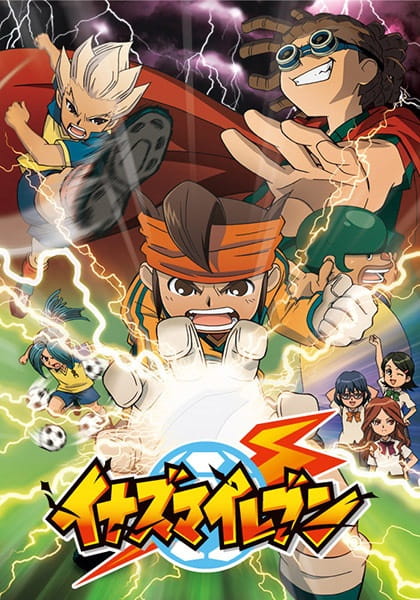
Inazuma Eleven
Is Inazuma Eleven worth watching?
Worth a look. Anime Codex rates Inazuma Eleven 6.65 out of 10 — scored on six criteria (story, characters, themes, world-building, animation, and cultural impact), not crowd votes. 165th of 226 on the Codex rubric — bottom 28% of the catalogue. The crowd rates it 1.13 higher than the rubric does — the Codex is harder on it than on 77% of the catalogue.
Where to watch
What the data says
Computed from the Codex rubric across the whole catalogue.
Summary
Inazuma Eleven is a benchmark kodomomuke sports series that successfully fuses an accessible underdog soccer narrative with flashy hissatsu special moves, making it both an engaging children's show and a powerful Level-5 cross-media engine. Endou Mamoru is a standout protagonist whose fun-first philosophy and Gouenji's redemption arc give the early Football Frontier seasons genuine heart and momentum. Its strengths are clear escalation, memorable signature techniques, and earnest themes of teamwork and perseverance that land squarely for its young audience. The weaknesses are equally clear: a sprawling eleven-man cast leaves many players as one-note comic archetypes, the animation relies heavily on recycled CG move cut-ins across its 127 episodes, and the mid-series shift to the sci-fi-tinged Aliea Academy arc strains the internal logic with runaway power creep. The international tournament stretch grows formulaic and padded. Judged against the best of children's sports anime rather than against shonen action standards, it earns its 7.78 reputation — consistently entertaining, emotionally sincere, and franchise-defining — without reaching the narrative or visual heights of the medium's elite. It is notable far more for cultural footprint and reliable kid-friendly fun than for ambition or polish.
Criterion breakdown
Story & narrative
The Football Frontier tournament arc gives the first season a clean, escalating structure as Raimon climbs from a near-disbanded club to national contenders, with each rival school (Occult, Zeus) presenting a distinct obstacle. The mid-series pivot to Aliea Academy raises stakes effectively but introduces heavy escalation creep, and the Football Frontier International stretch grows repetitive in its match-of-the-week formula. For kodomomuke this is a tightly motivated sports narrative, though it leans on tournament padding more than the best of its kind.
Character writing & growth
Endou Mamoru is a genuinely strong kodomomuke protagonist — his relentless optimism and goalkeeper philosophy anchor the team, and Gouenji's arc from a player who abandoned soccer (over his sister's accident) back to ace striker gives the early episodes real emotional spine. The supporting cast of eleven-plus players is large, however, and many recruits like Kabeyama or Kurimatsu remain comic-relief archetypes with little growth. Kidou's shift from Teikoku antagonist to ally is the standout secondary arc.
Themes & emotional resonance
Teamwork, perseverance, and the joy of play over winning are delivered earnestly and land well for the target child audience, especially through Endou's insistence that soccer should be fun. The Aliea arc adds themes of manufactured talent versus genuine passion that resonate beyond its years. Emotional beats can feel formulaic and reset between arcs, limiting cumulative resonance compared to the genre's strongest entries.
World-building & power system
The premise of hissatsu special moves grounded in a real-sport framework is a clever hook, and signature techniques like Endou's God Hand and Gouenji's Fire Tornado are memorable and consistently animated. Internal consistency suffers as the power scaling balloons with Aliea Academy's pseudo-sci-fi meteor-powered teams, stretching the soccer conceit thin. The setting is functional rather than deeply built, serving the game-tie-in origins more than world depth.
Animation & direction
OLM uses heavy CG and recycled stock animation for the hissatsu shots, which is cost-effective and serviceable for TV but visibly repetitive across 127 episodes. The signature move cut-ins and dramatic camera spins give matches a satisfying punch for kids, and character designs are clean and readable. Overall direction prioritizes franchise consistency over visual ambition.
Cultural impact
As a Coro Coro and Level-5 cross-media property, Inazuma Eleven became a major franchise spawning games, multiple sequels (GO, Ares, Orion), and merchandise, with strong international reach in Europe especially. Within kodomomuke it stands among the more commercially influential sports titles of its era, even if its prestige doesn't rival the medium's giants.
Synopsis (from MAL)
While other schools in Japan compete for the title of being the best soccer team in the country, Raimon Middle School's soccer club, Inazuma Eleven, struggles to rise from the verge of being disbanded. The grandson of Inazuma Eleven's first generation goalkeeper and captain of the team, Mamoru Endou, takes the challenge of kicking the long neglected club back into shape. To do this, he'll need a little help and more than a little luck. Mamoru Endou finds hope in the hands of Shuuya Gouenji, a brilliant young player who has given up on soccer. Mamoru is determined to get Shuuya and other new recruits to join his team, no matter what the cost. Is his passion and determination enough to treat the ailing club? Or is there no more hope for the team?
Ranked nearby


Explore rankings
Discussion
Set a display name above to post.
Loading discussion…