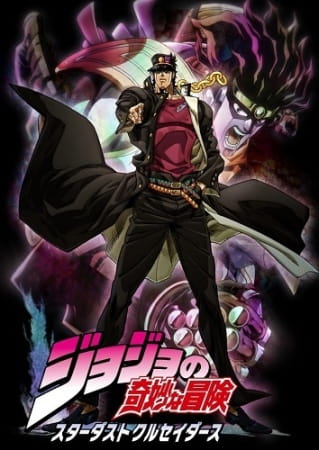
JoJo's Bizarre Adventure
Is JoJo's Bizarre Adventure worth watching?
Yes, it's worth watching. Anime Codex rates JoJo's Bizarre Adventure 7.55 out of 10 — scored on six criteria (story, characters, themes, world-building, animation, and cultural impact), not crowd votes. 81st of 226 on the Codex rubric — top 36% of the catalogue. The crowd rates it 0.56 higher than the rubric does — the Codex is harder on it than on 50% of the catalogue.
Where to watch
What the data says
Computed from the Codex rubric across the whole catalogue.
Summary
Stardust Crusaders is the arc that cemented JoJo as a shonen institution, and its strengths are unmistakable: the Stand system is among the most creative and influential power frameworks in the genre, prioritizing rule-based puzzle combat over simple strength escalation, and David Production renders it with audacious, color-saturated, pose-heavy direction that became instantly iconic. The globe-trotting Cairo quest, anchored by a memorable ensemble — Joseph, Avdol, Kakyouin, and Polnareff — delivers strong individual battles and genuinely affecting late-game deaths, culminating in a superb DIO time-stop finale. Its weaknesses are equally clear. The monster-of-the-week road-trip structure produces noticeable early pacing sag and filler-feeling encounters before the stakes sharpen. Protagonist Joutarou, while effortlessly cool, is so emotionally impassive that he undergoes minimal growth, leaving the supporting cast to carry the show's heart. Thematic depth is intermittent rather than cumulative. Judged against the best of shonen, it excels in originality, style, and cultural footprint while falling short on protagonist development and consistent narrative momentum — a hugely influential, stylistically distinctive adventure whose creativity outpaces its character writing. It is essential genre viewing despite its structural unevenness.
Criterion breakdown
Story & narrative
Stardust Crusaders adopts a road-trip, monster-of-the-week structure as the crew travels from Japan to Cairo, which gives the 50-day countdown urgency but also produces real pacing dips — the early DIO's-henchmen encounters (Tower of Gray, the orangutan ship Stand) feel like filler before the stakes sharpen. The episodic format works best when individual Stand puzzles are clever (Devo's revenge doll, the Sun, Death Thirteen's dream world), and the back half tightens considerably as the assassins close in. The final DIO confrontation, with the time-stopping reveal of The World mirroring Star Platinum, is a genuinely strong escalation that pays off the season's build.
Character writing & growth
Joutarou is a deliberately stoic, near-impassive protagonist — effective as an icon of cool but offering minimal internal growth across 24 episodes, which is a real limitation versus the best shonen leads. The ensemble carries the emotional weight instead: Joseph's veteran wit, Avdol's sacrifice and return, Kakyouin's arc from antagonist to loyal friend, and Polnareff's quest to avenge his sister provide the show's most affecting beats. The cast functions as memorable archetypes rather than deeply evolving figures, which suits the adventure format but caps the depth.
Themes & emotional resonance
The series leans on a clear bloodline-destiny theme — the Joestar lineage versus DIO — and on stoic resolve in the face of mortality, exemplified by Kakyouin's dying clock-message and Avdol's repeated willingness to die for the group. Emotional resonance spikes in specific deaths during the final Cairo stretch, but the monster-of-the-week structure dilutes sustained thematic weight, and Joutarou's emotional flatness blunts the impact. It hits hard in moments rather than building a cumulative emotional throughline.
World-building & power system
The Stand system is one of the most influential power frameworks in shonen: each Stand is a bespoke ability with rigid internal rules, encouraging puzzle-combat over raw power escalation — Hanged Man existing only in mirrors and reflections, or Death Thirteen operating solely within dreams. This emphasis on creative, condition-based abilities over strength-scaling is genuinely original and consistently applied. The Tarot/Egyptian-god naming and the globe-trotting setting reinforce a distinctive, mythically-tinged world that few contemporaries match.
Animation & direction
David Production delivers bold, color-shifting direction with the signature dynamic 'menacing' compositions, dramatic posing, and onomatopoeia-as-visual-design that define JoJo's aesthetic. The shifting palettes during tense standoffs and the kinetic Star Platinum 'ORA' barrages are striking, and the DIO finale is a directorial highlight with the time-stop staging. It is not flawlessly fluid throughout — some mid-run fights show conservative animation — but the stylistic confidence and faithfulness to Araki's art elevate it well above average.
Cultural impact
Stardust Crusaders is the cultural cornerstone of the franchise, popularizing the Stand concept, Joutarou's 'Yare yare daze,' and an endless wellspring of internet memes ('ZA WARUDO,' the menacing ゴゴゴ, time-stop gags). It introduced a global audience to the series and remains a touchstone for fighting-game crossovers and reaction culture. Its influence on later ability-based shonen and meme literacy is outsized relative to its viewership.
Synopsis (from MAL)
Years after an ancient evil was salvaged from the depths of the sea, Joutarou Kuujou sits peacefully within a Japanese jail cell. He's committed no crime yet demands he not be released, believing he's been possessed by an evil spirit capable of harming those around him. Concerned for her son, Holy Kuujou asks her father, Joseph Joestar, to convince Joutarou to leave the prison. Joseph informs his grandson that the "evil spirit" is in fact something called a "Stand," the physical manifestation of one's fighting spirit which can adopt a variety of deadly forms. After a fiery brawl with Joseph's friend Muhammad Avdol, Joutarou is forced out of his cell and begins learning how to control the power of his Stand. However, when a Stand awakens within Holy and threatens to consume her in 50 days, Joutarou, his grandfather, and their allies must seek out and destroy the immortal vampire responsible for her condition. They must travel halfway across the world to Cairo, Egypt and along the way, do battle with ferocious Stand users set on thwarting them. If Joutarou and his allies fail in their mission, humanity is destined for a grim fate. [Written by MAL Rewrite]
Ranked nearby

Explore rankings
Discussion
Set a display name above to post.
Loading discussion…