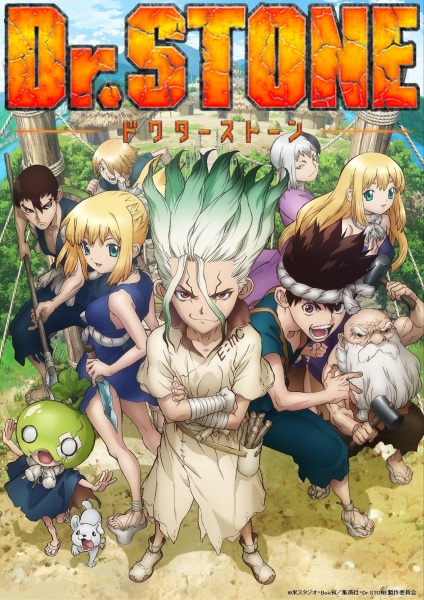
Dr. Stone
Is Dr. Stone worth watching?
Yes, it's worth watching. Anime Codex rates Dr. Stone 7.63 out of 10 — scored on six criteria (story, characters, themes, world-building, animation, and cultural impact), not crowd votes. 77th of 226 on the Codex rubric — top 34% of the catalogue. The crowd rates it 0.63 higher than the rubric does — the Codex is harder on it than on 56% of the catalogue.
Where to watch
Trailer
What the data says
Computed from the Codex rubric across the whole catalogue.
Summary
Dr. Stone stands out in shonen by replacing combat with cumulative human ingenuity: its 'kingdom of science' premise rebuilds civilization from the stone age using genuine, internally consistent chemistry, making the rediscovery of glass, antibiotics, and iron feel as triumphant as any battle. Senku is a refreshingly cerebral protagonist, and Tsukasa provides a thematically coherent antagonist whose 'who deserves the revived world' philosophy gives the season real ideological stakes. The world-building and premise originality are the series' strongest assets, supported by polished, color-rich TMS direction that makes crafting montages genuinely engaging. Its weaknesses are typical first-season growing pains: supporting characters lean on archetypes—Taiju is one-dimensional muscle, Yuzuriha barely developed—and growth is more about expanding alliances than internal change. The relentlessly upbeat tone occasionally undercuts emotional weight, and the back half defers its central conflict in favor of setup. Within its demographic, it's a smart, distinctive, confidently executed series that succeeds at making knowledge itself the source of shonen excitement, even if it doesn't yet match the emotional or character depth of the genre's very best. A strong, original entry that rewards curiosity over spectacle.
Criterion breakdown
Story & narrative
Season one's narrative is unusually disciplined for shonen: the petrification premise creates a clear escalating goal (revive humanity via science) and the season builds methodically from survival to village politics to the looming conflict with Tsukasa's Empire of Might. The arc structure—Taiju/Yuzuriha revival, the cure-all for Tsukasa's sister, the establishment of Ishigami Village—gives steady forward momentum, though the back half slows into a tournament-and-alliance setup that delays the central Senku-Tsukasa ideological clash rather than resolving it. The 'kingdom of science' framing keeps even mundane crafting steps feeling like plot beats.
Character writing & growth
Senku is a genuinely distinctive shonen lead—a cerebral problem-solver whose 'this is exhilarating' catchphrase substitutes intellect for the usual battle-lust, and Tsukasa works as a thoughtful antagonist with a coherent philosophy rather than cartoon villainy. However, supporting characters lean archetypal: Taiju is one-note brawn-and-shouting, Yuzuriha is underdeveloped, and Chrome and Kohaku get charm but limited interiority. Growth is more conceptual (alliances forming) than internal, which is the season's main character weakness.
Themes & emotional resonance
The show's love letter to scientific progress and human cumulative knowledge is its strongest thematic asset, genuinely conveying wonder at rediscovering fire, glass, and antibiotics. The Senku-versus-Tsukasa debate—whether civilization's revival benefits the powerful or restores all—poses a real ideological question about who deserves the future. Emotional resonance is intermittent, though; beats like Senku honoring Byakuya land, but the relentlessly upbeat tone keeps stakes from carrying real weight.
World-building & power system
Premise originality is the series' standout: a post-petrification Earth reclaimed by nature, rebuilt from literal stone age through verifiable real-world chemistry, is nearly unmatched in shonen. The internal consistency is rigorous—recipes for sulfa drugs, iron smelting, and the cell-phone endgame follow plausible technological dependency chains. It reads as a 'tech tree' made narrative, and the petrification mystery adds a sci-fi hook beneath the survival-craft layer.
Animation & direction
TMS delivers vibrant, color-saturated direction well-suited to the lush overgrown world, with strong character expressiveness and energetic montage sequences for science processes that could have been dull. The reveal of the petrified-statue Earth and the green-light sequences are visually striking. It's polished and consistent rather than spectacular—no standout sakuga set-pieces, and some CG and crowd work is functional at best.
Cultural impact
Dr. Stone became a notable Jump success precisely for proving a science-edutainment shonen could be mainstream, earning a wide audience and multiple sequel seasons plus an OVA and specials. It carved a distinct niche and is frequently cited as 'educational' anime, though its cultural footprint remains below era-defining titles like Demon Slayer or Jujutsu Kaisen.
Synopsis (from MAL)
After five years of harboring unspoken feelings, high-schooler Taiju Ooki is finally ready to confess his love to Yuzuriha Ogawa. Just when Taiju begins his confession however, a blinding green light strikes the Earth and petrifies mankind around the world—turning every single human into stone. Several millennia later, Taiju awakens to find the modern world completely nonexistent, as nature has flourished in the years humanity stood still. Among a stone world of statues, Taiju encounters one other living human: his science-loving friend Senkuu, who has been active for a few months. Taiju learns that Senkuu has developed a grand scheme—to launch the complete revival of civilization with science. Taiju's brawn and Senkuu's brains combine to forge a formidable partnership, and they soon uncover a method to revive those petrified. However, Senkuu's master plan is threatened when his ideologies are challenged by those who awaken. All the while, the reason for mankind's petrification remains unknown. [Written by MAL Rewrite]
Ranked nearby
Explore rankings
Discussion
Set a display name above to post.
Loading discussion…